
An organization has deployed an AI coding assistant for software developers. Security researchers report that the assistant occasionally suggests code with known vulnerabilities. What risk does this represent?
Select an answer to reveal the explanation.
Short Explanation
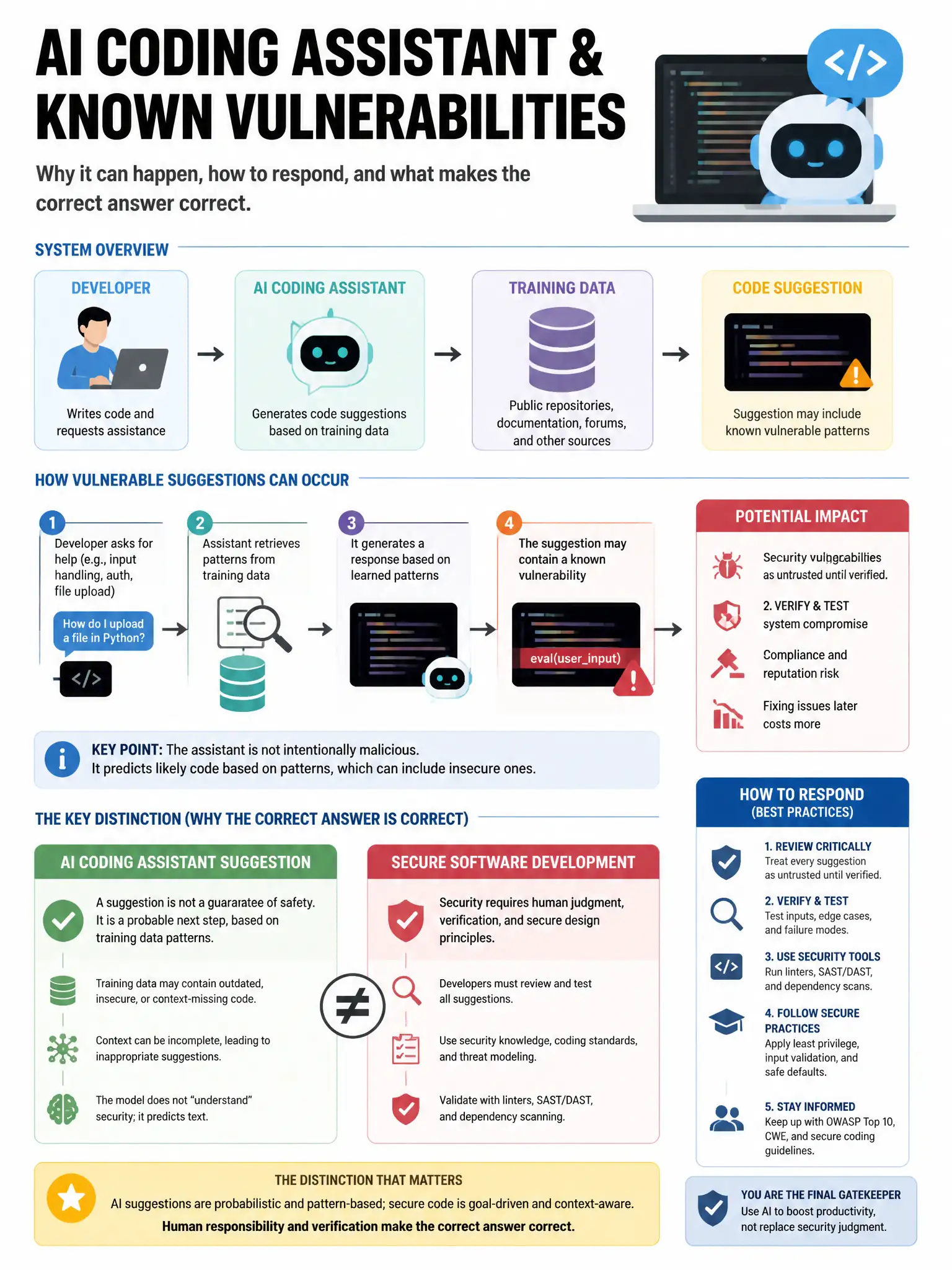
Here's the deal — you're dealing with training data risk. The assistant learned from code repositories full of vulnerable, insecure patterns, so it can reproduce those same risky snippets when it suggests code.
Full Explanation
Training data risk is correct because AI coding assistants trained on public code repositories learn from vulnerable, insecure code present there and may reproduce those patterns when suggesting code, creating a training-data quality risk with security consequences. The hallucination option is wrong because it describes fabricated API functions that do not exist. The adversarial attack option is wrong because it requires evidence of external manipulation by competitors. The model drift option is wrong because it requires baseline comparison showing performance degradation since deployment.