
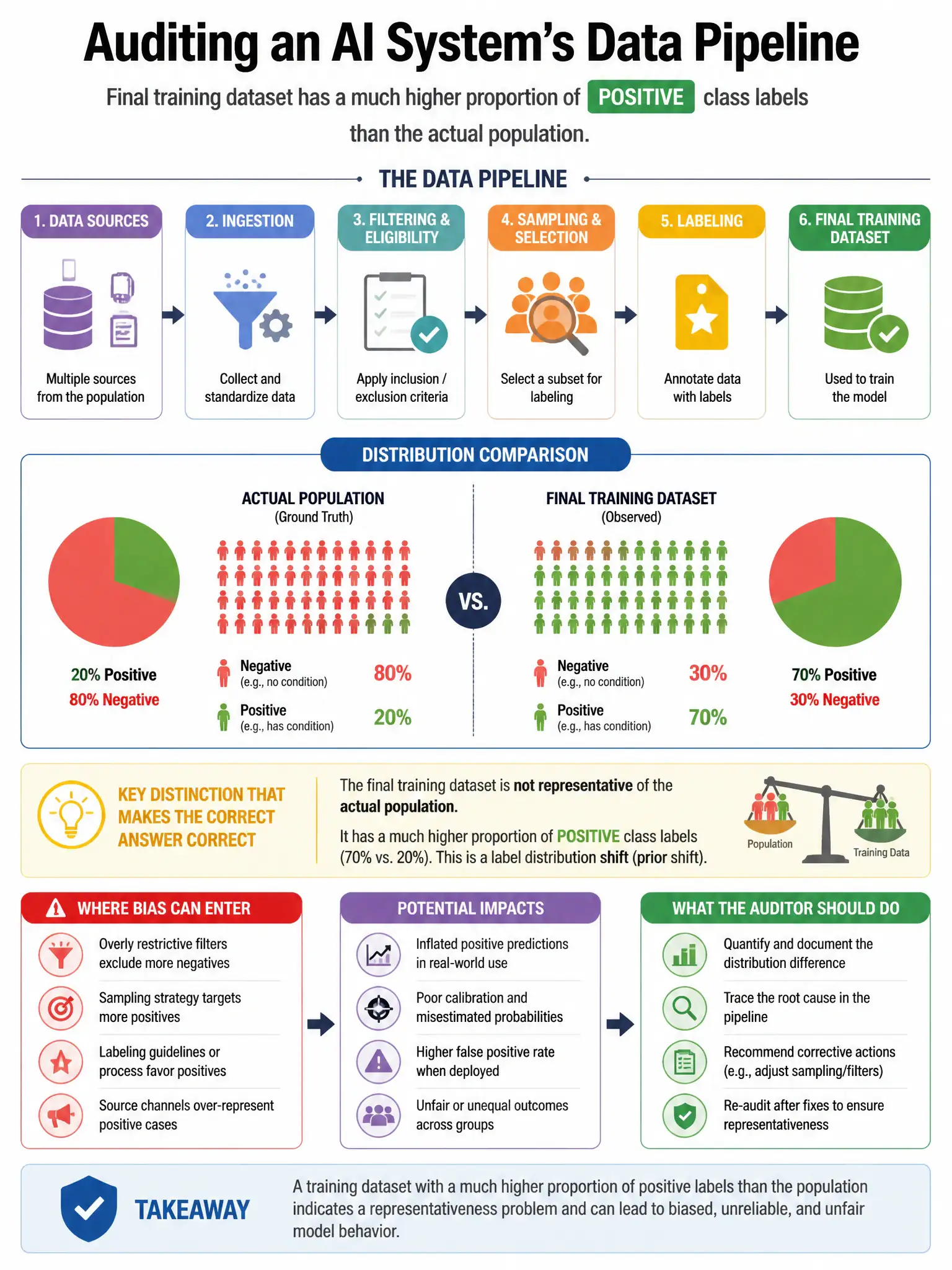
When auditing an AI system's data pipeline, the auditor discovers that the final training dataset has a much higher proportion of positive class labels than the actual population. What risk does this create?
Select an answer to reveal the explanation.
Short Explanation
Here's the deal — when you overrepresent positive cases, you create miscalibration. Your model's predicted probabilities for the positive class will be inflated relative to actual population prevalence, so it overestimates positive outcomes in production. That's especially dangerous in risk scoring, where calibration drives decision thresholds.
Full Explanation
The correct risk is miscalibration: overrepresenting positive cases creates miscalibration — the model's predicted probability outputs will be inflated relative to actual population prevalence, causing overestimation of positive outcomes in production. This is particularly problematic in risk scoring applications where calibration drives decision thresholds. The underfitting-from-insufficient-positive-examples option is incorrect because the dataset has more positive examples, not fewer, and more positive examples typically improves positive class performance. The training-failure-from-insufficient-negative-examples option is incorrect because negative examples exist. The covariate-shift option is incorrect because it is a different concept related to input distribution.