
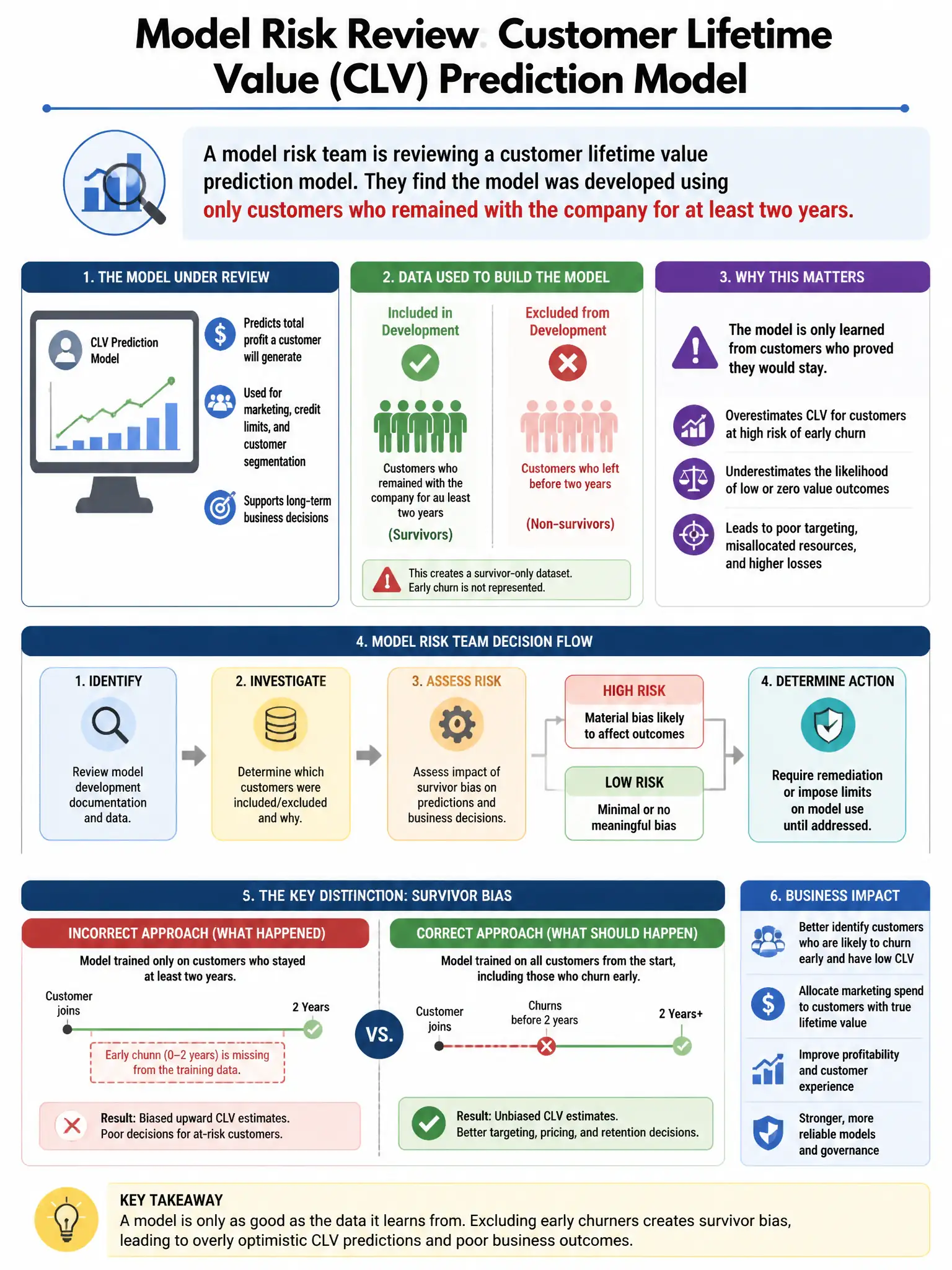
A model risk team is reviewing a customer lifetime value prediction model. They find the model was developed using only customers who remained with the company for at least two years, excluding churned customers. What model risk does this introduce?
Select an answer to reveal the explanation.
Short Explanation
You've got survivorship bias here. By training only on customers who stayed, the model never learns churn patterns, so it underpredicts churn risk and lifetime value for likely churners, and it overfits to loyal-customer traits.
Full Explanation
The answer combining underprediction of lifetime value for likely churners and overfitting to loyal-customer features is correct because excluding churned customers creates survivorship bias: the model never learns churn patterns, so it underpredicts churn risk and lifetime value for likely churners, and it overfits to loyal-customer features, reducing generalizability. The underprediction-only statement misses the overfitting effect. The overfitting-only statement misses the underprediction effect. The insufficient-data statement is wrong because the problem is biased representation, not just low volume.