
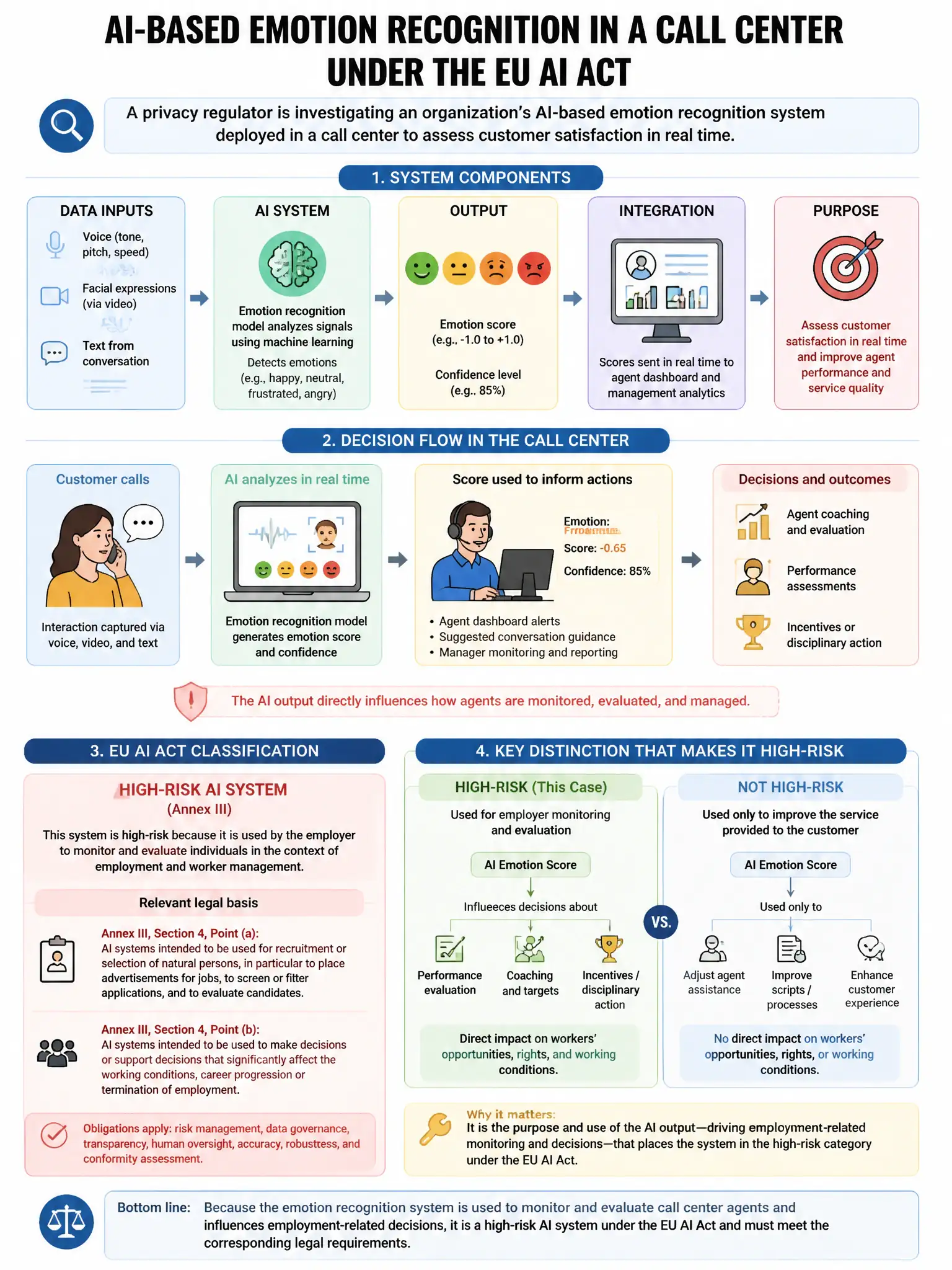
A privacy regulator is investigating an organization's AI-based emotion recognition system deployed in a call center to assess customer satisfaction in real time. Under the EU AI Act, which provision is MOST directly applicable to this system?
Select an answer to reveal the explanation.
Short Explanation
Here's the deal—you need to look at the transparency rule for emotion recognition, because the EU artificial intelligence law makes deployers tell people when an emotion recognition system is being used, unless a narrow security exception applies. In a customer-facing call center, the key obligation is notification, not a blanket ban.
Full Explanation
The correct provision is the transparency obligation for emotion recognition systems. Article 52(3) of the EU artificial intelligence law requires deployers to inform natural persons exposed to such systems, unless a legitimate or justified security purpose applies. Here, the call center system assesses customers in real time, so customers must be told an emotion recognition system is used. The prohibited-practice answer is not the best fit because Article 5 bans emotion recognition in workplaces and educational institutions specifically; if employees were monitored, that could be prohibited, but customer-facing use triggers notification. The high-risk classification answer is not directly applicable because emotion recognition is addressed through Article 52, not Annex III. The general-purpose model answer is incorrect because emotion recognition is a specific application, not a general-purpose model issue.