
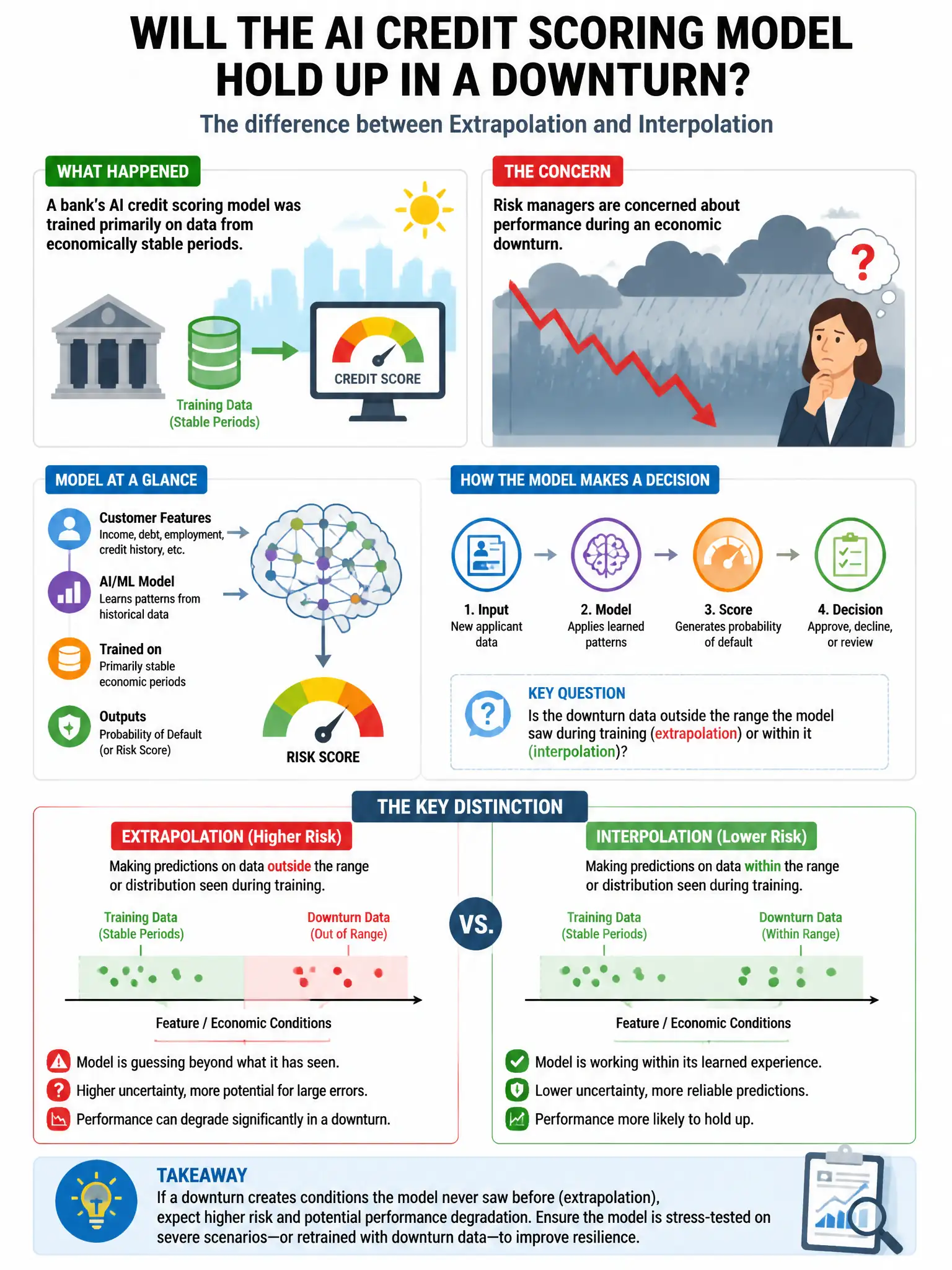
A bank's AI credit scoring model was trained primarily on data from economically stable periods. Risk managers are concerned about performance during an economic downturn. Which assessment technique is MOST appropriate to evaluate this risk?
Select an answer to reveal the explanation.
Short Explanation
Here's the deal — stress testing using adverse scenario data is right because it checks how the model behaves under extreme conditions that weren't well represented in training data, which is exactly the economic downturn concern. Cross-validation on a held-out test set won't help much because it uses the same data distribution as training.
Full Explanation
Stress testing using adverse scenario data is correct because it evaluates model performance under extreme or adverse conditions not well represented in training data, directly addressing the economic downturn concern. Cross-validation on a held-out test set is wrong because it uses the same data distribution as training. SHAP value analysis for feature importance is wrong because it explains feature contributions but does not test performance under adverse conditions. Production split testing in a live environment is wrong because it would expose real customers to potentially degraded model outputs.