
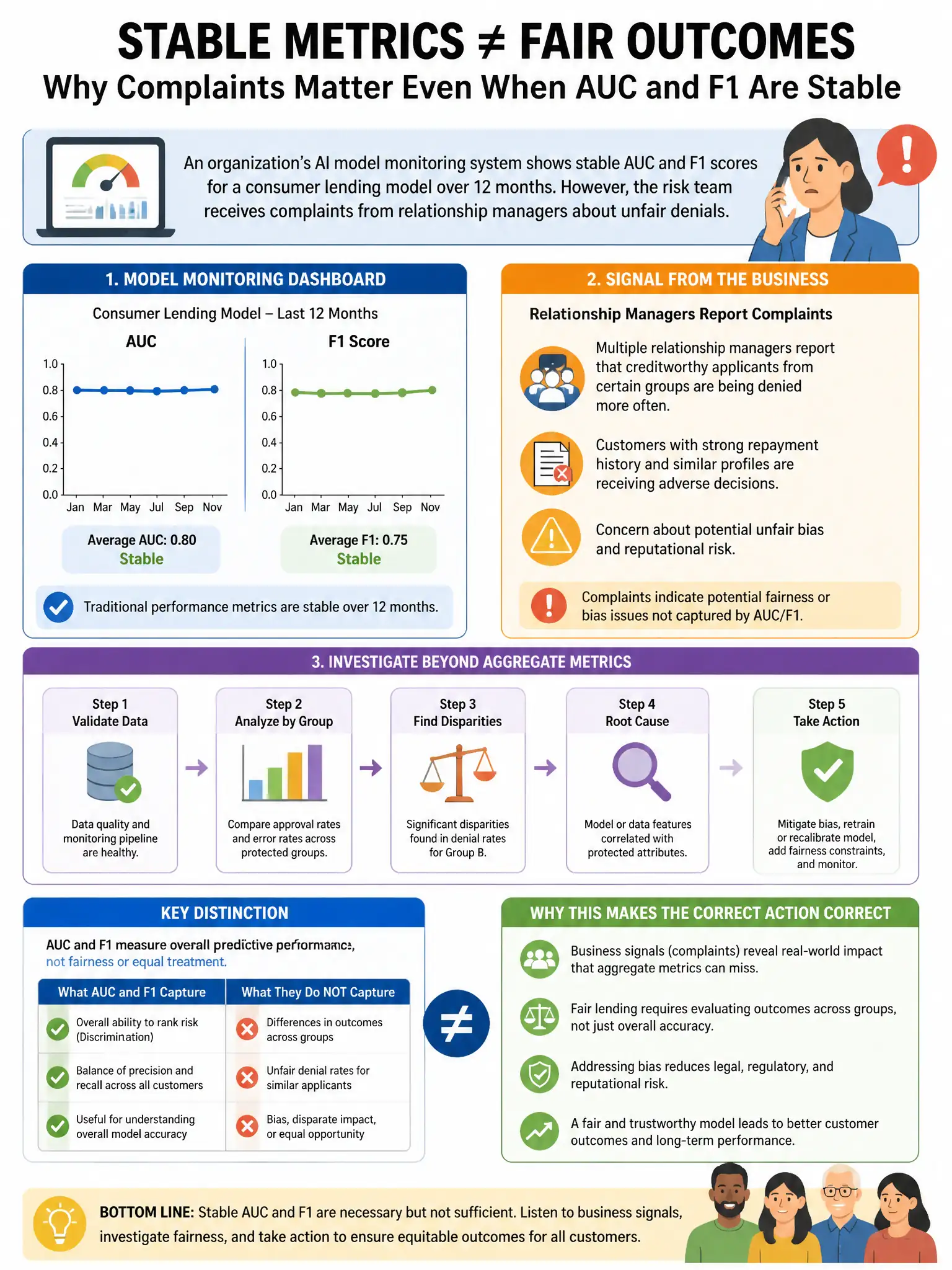
An organization's AI model monitoring system shows stable AUC and F1 scores for a consumer lending model over 12 months. However, the risk team receives complaints from relationship managers that the model's recommendations are increasingly inconsistent with their expert judgment on similar cases. What does this discrepancy MOST suggest?
Select an answer to reveal the explanation.
Short Explanation
Here's the deal — aggregate metrics like area under the curve and F1 can look stable while the model drifts for specific subpopulations or changes behavior in ways domain experts notice case by case. You should treat the relationship managers' complaints as a monitoring gap, not as noise.
Full Explanation
The correct suggestion is that standard monitoring metrics may not capture emerging concept drift or subpopulation performance issues visible to domain experts. Aggregate metrics like area under the curve and F1 can remain stable at the population level while the model underperforms for specific subpopulations or behaves differently than historically. Relationship managers working individual cases daily may detect shifts in model reasoning that aggregate metrics miss. This is a monitoring gap: human expert feedback provides risk intelligence automated metrics miss. The concern deserves investigation, not dismissal. The idea that the relationship managers' judgment has deteriorated and needs training is not most likely. The idea that the model is correct and managers show automation bias by over-trusting the model also does not fit, because they are questioning the model. Switching to monitoring only the Gini coefficient addresses metric choice, not the discrepancy between metrics and expert observation.