
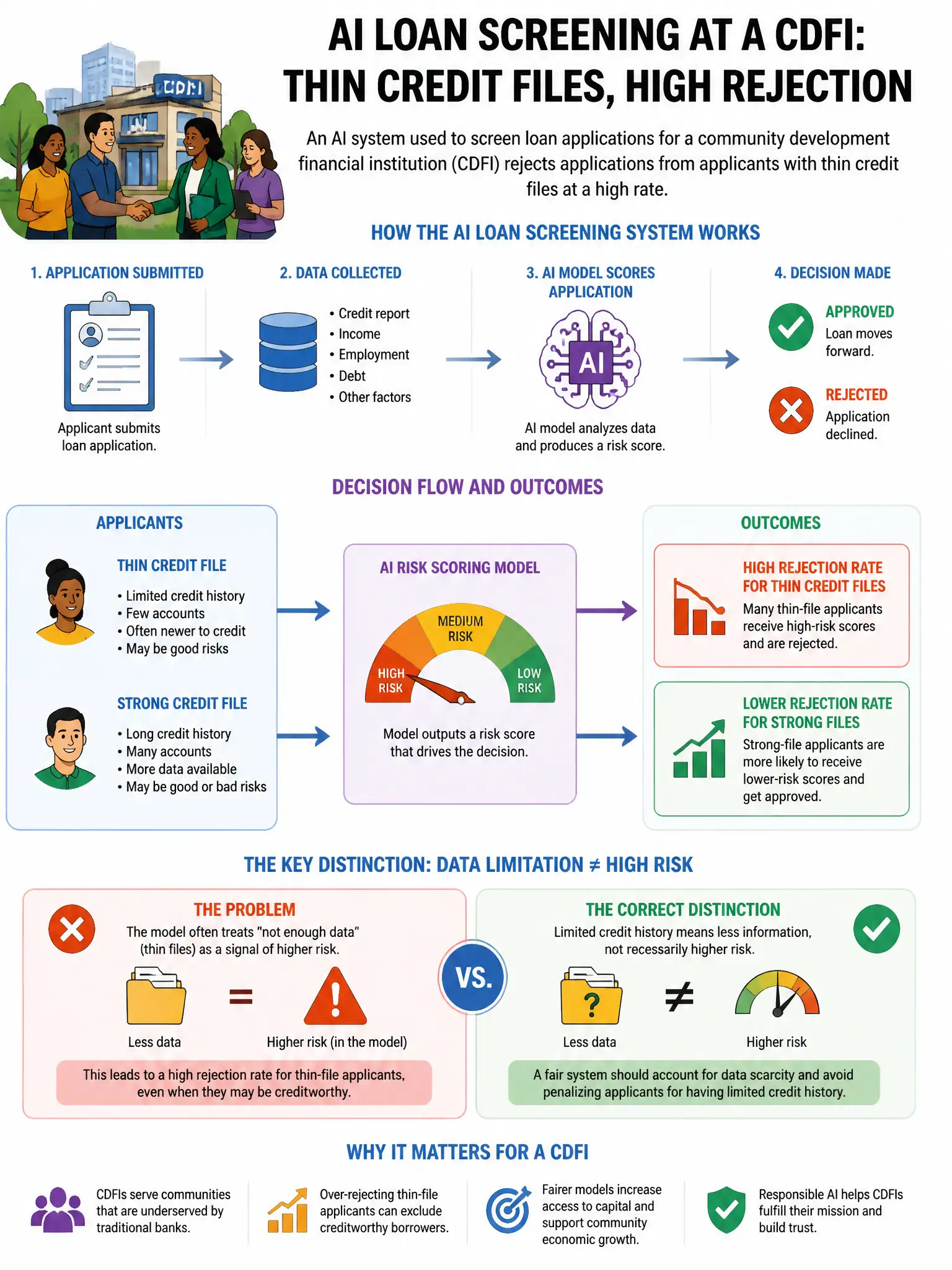
An AI system used to screen loan applications for a community development financial institution (CDFI) rejects applications from applicants with thin credit files at a high rate. The CDFI's mission is specifically to serve underbanked populations who typically have thin credit files. What is the MOST appropriate AI risk management response?
Select an answer to reveal the explanation.
Short Explanation
Here's the deal — you need to recognize that the model is misaligned with the CDFI's mission to serve underbanked applicants. Then assess alternative data sources like rent payments, utility history, and employment history to reduce thin-file rejections while still managing credit risk.
Full Explanation
The correct response is to recognize that the model is misaligned with the CDFI's mission and assess whether alternative data sources, such as rent payments, utility history, and employment history, can be incorporated to reduce thin-file rejection rates while maintaining credit risk management objectives. The CDFI's mission is to serve underbanked populations, the exact population the model is systematically rejecting. This misalignment creates mission risk and business risk. The appropriate response is to explore alternative data sources that better predict creditworthiness for thin-file applicants without relying only on traditional credit bureau data. Accepting the model's performance because thin credit files are legitimate risk signals abandons the institution's mission. Increasing the credit score cutoff threshold to further reduce default risk would worsen the problem. Replacing the AI model with purely manual underwriting to eliminate AI-related bias is disproportionate; the issue is with this specific model's features, not AI generally.