
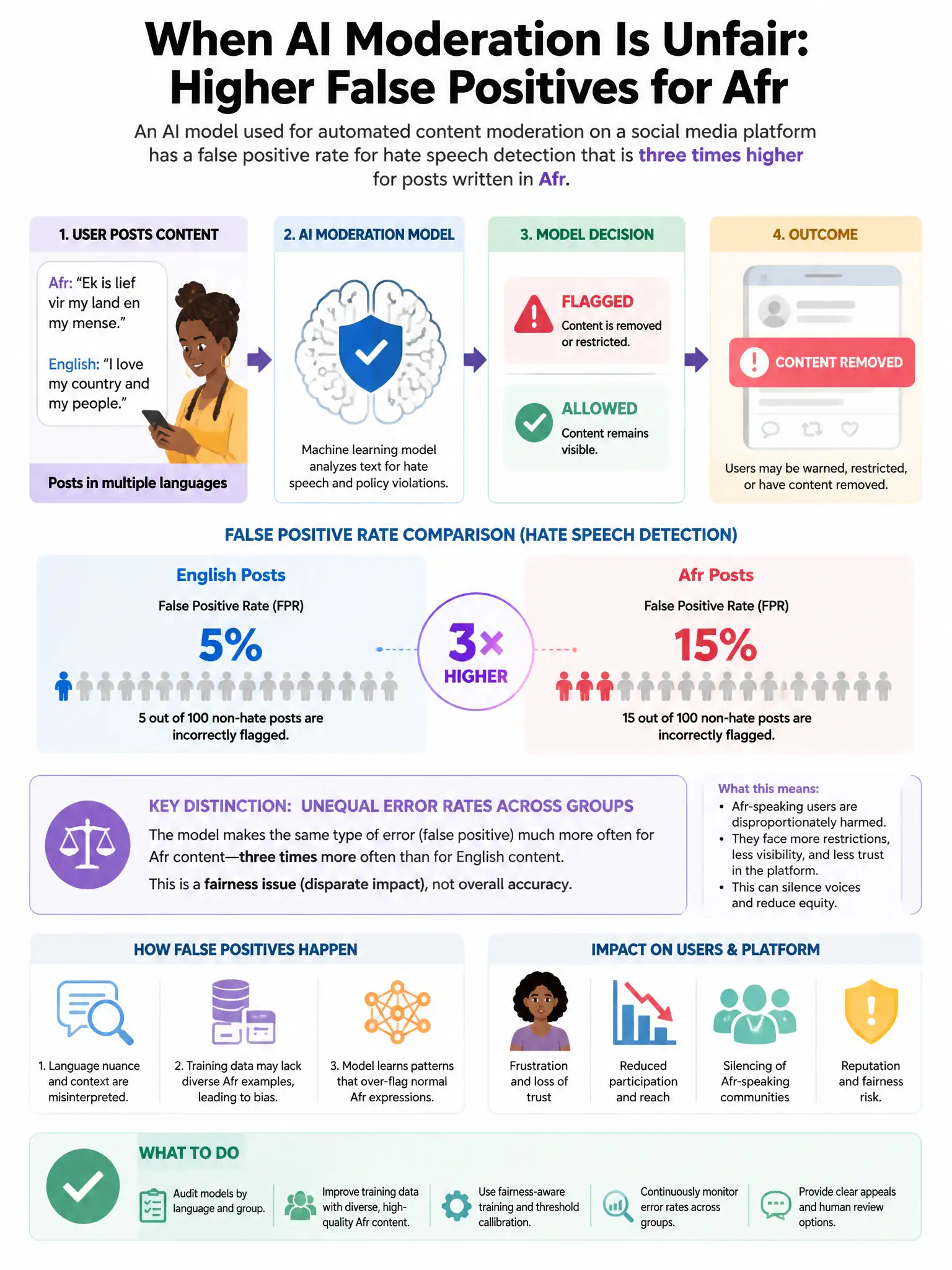
An AI model used for automated content moderation on a social media platform has a false positive rate for hate speech detection that is three times higher for posts written in African American Vernacular English (AAVE) compared to Standard American English. What type of bias does this illustrate?
Select an answer to reveal the explanation.
Short Explanation
Here's the deal — you're seeing linguistic bias. The model learned mostly from Standard American English and underrepresents African American Vernacular English, so it mistakes legitimate speech patterns for hate speech and over-flags Black users.
Full Explanation
The correct answer is linguistic bias where the model's training data underrepresents African American Vernacular English, causing it to misclassify legitimate speech as hate speech at higher rates for those speakers. This is measurement bias: the model was trained mostly on Standard American English and did not learn to separate dialect patterns from hate speech markers, so legitimate speech is over-flagged and Black users are disproportionately harmed. The temporal bias option, training on older content before the dialect became common, wrongly implies the dialect emerged recently. The adversarial bias option, bad actors gaming the classifier with dialect phrasing, requires intentional manipulation. The sampling bias option, overrepresenting flagged dialect content, would not explain why legitimate dialect speech is falsely flagged.