
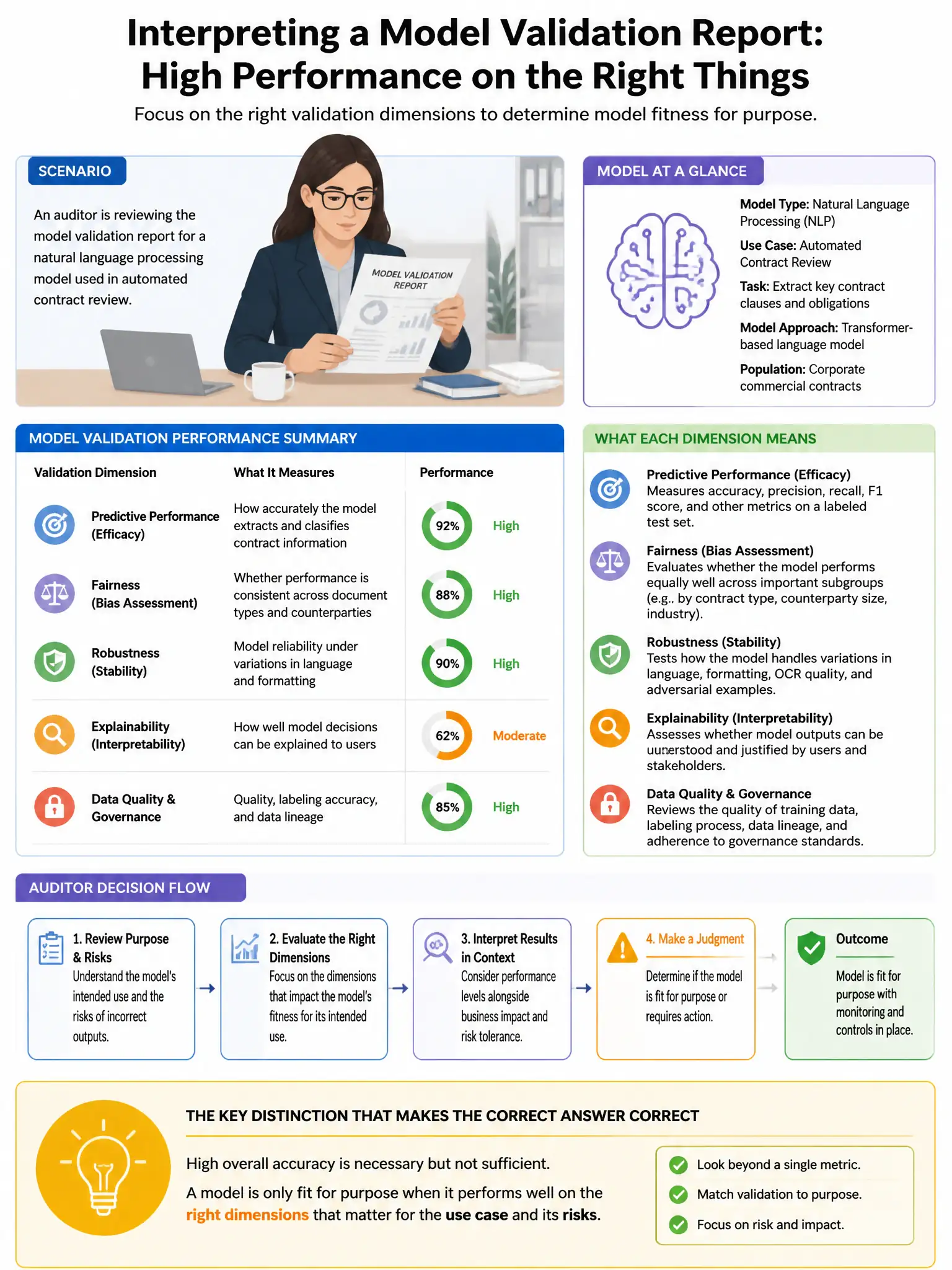
An auditor is reviewing the model validation report for a natural language processing model used in automated contract review. The validation report shows high performance on the vendor's internal test set but the deploying organization has not conducted its own independent testing. What is the MOST significant validation gap?
Select an answer to reveal the explanation.
Short Explanation
Here's the deal — you need to know the model works on your contracts, not just the vendor's. Vendor test sets can miss your contract types, terminology, jurisdictions, and language patterns, so independent testing on your own corpus is the key validation gap.
Full Explanation
The most significant validation gap is that the organization has not assessed the model's performance on its own contract types and language patterns. Vendor test sets are composed of the vendor's own data, which may not represent the deploying organization's specific contract types, terminology, legal jurisdictions, or language complexity. The organization must independently test the model on its own representative contract corpus to validate that performance generalizes to their use case. Vendor performance metrics alone are insufficient for the deploying organization's due diligence. The claim that the vendor's test set was not reviewed by the organization's internal audit team before validation was accepted is an additional assurance concern, but it's secondary to the fundamental gap of deployer-specific testing. The claim that the model was not validated by the organization's preferred third-party artificial-intelligence auditing firm is also an additional assurance activity, not the core validation gap. The omission of the model's carbon footprint from training isn't a model performance validation concern.