
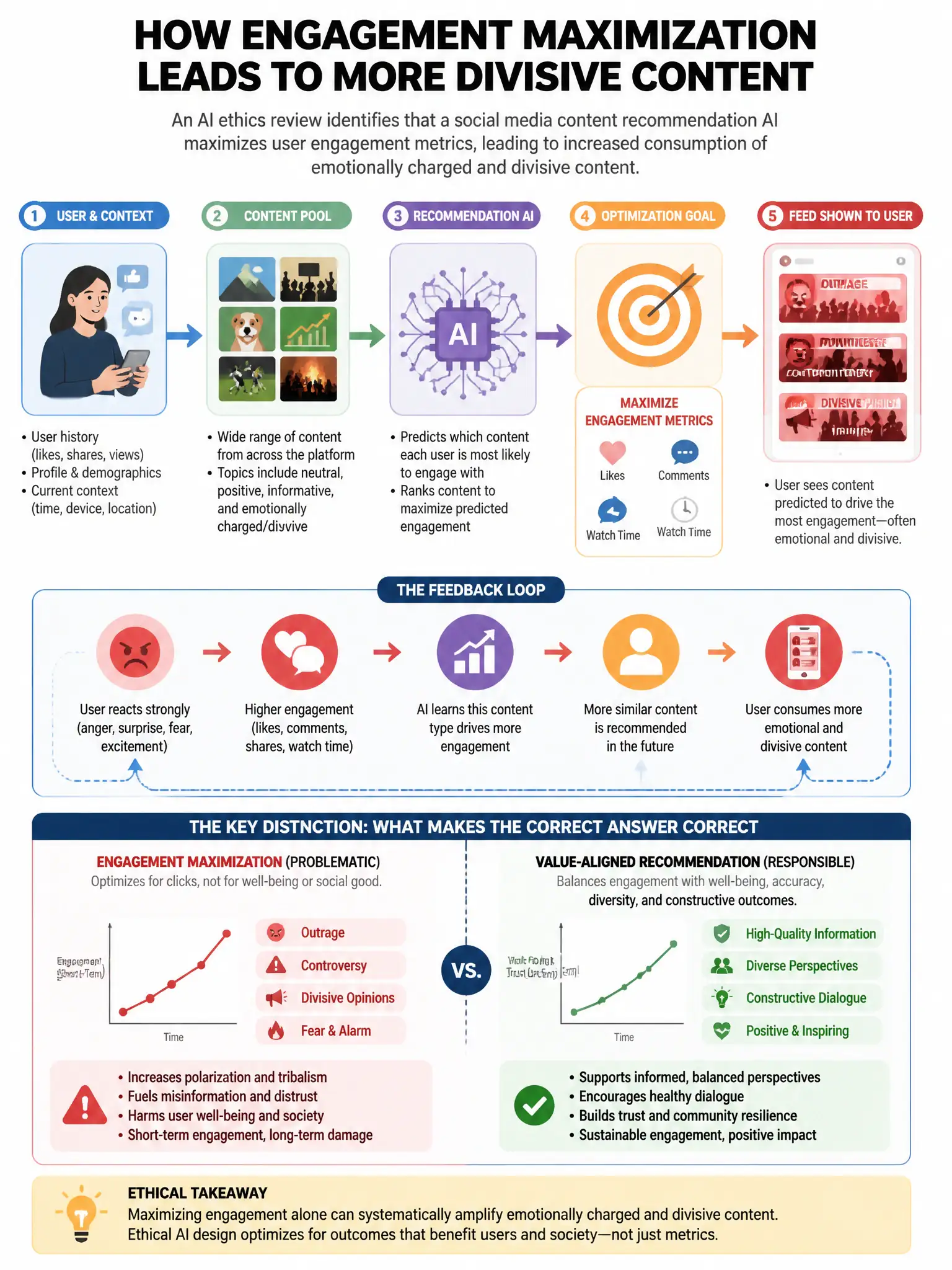
An AI ethics review identifies that a social media content recommendation AI maximizes user engagement metrics, leading to increased consumption of emotionally charged and divisive content. Which ethical principle is MOST directly at issue?
Select an answer to reveal the explanation.
Short Explanation
Here's the deal — the issue is beneficence and non-maleficence because optimizing for engagement can harm user wellbeing and society. You're not just hiding the algorithm, spreading divisive content unevenly, or missing an owner; you're chasing a metric that may hurt people.
Full Explanation
The correct principle is beneficence and non-maleficence because maximizing engagement, a narrow business objective, can harm individual mental health, promote radicalization, and damage societal discourse. That is a conflict between beneficence, acting in users' best interests, and non-maleficence, avoiding harm. The transparency option, saying users are not informed that their feed is curated by an algorithm, is relevant but not most direct because disclosure does not resolve harm from the objective. The fairness option, saying divisive content is not distributed equally across demographic groups, concerns unequal distribution, while the scenario centers on harmful engagement maximization. The accountability option, saying no named individual is responsible for curation decisions, is a governance concern, not the core misalignment between optimization and wellbeing.