
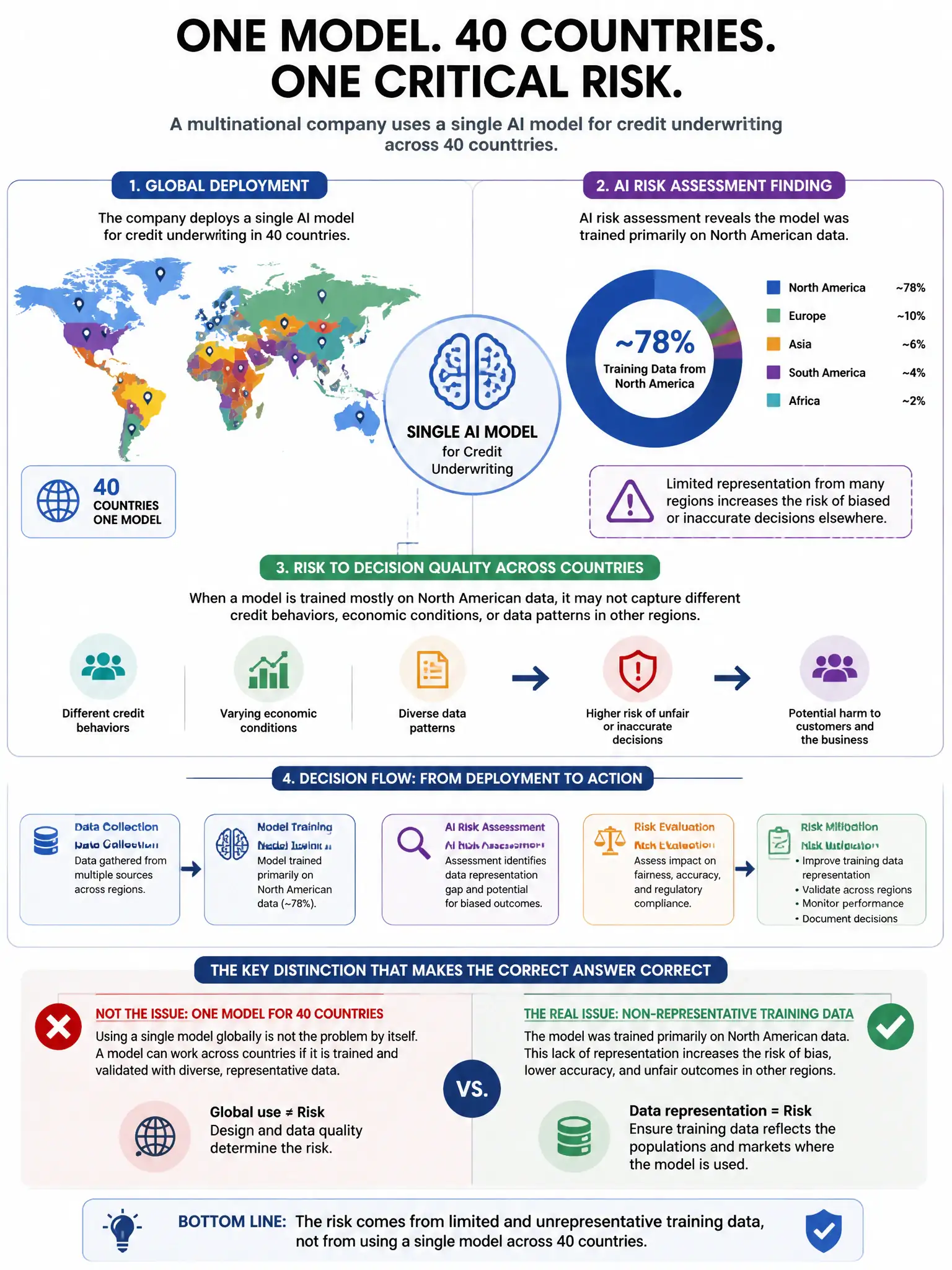
A multinational company uses a single AI model for credit underwriting across 40 countries. An AI risk assessment identifies that the model was trained primarily on North American and Western European data. Which risk is MOST significant for operations in sub-Saharan African markets?
Select an answer to reveal the explanation.
Short Explanation
Here's the deal — the correct risk is distributional shift and cultural context mismatch because a model trained mostly on North American and Western European credit data learns those markets' economic structures, credit bureau systems, employment patterns, and consumer behaviors. When you apply it in sub-Saharan African markets, differences in credit data availability, economic formalization, and financial behavior can make its credit-risk patterns generalize poorly and produce systematically inaccurate decisions.
Full Explanation
The distributional shift and cultural context mismatch risk is correct because a model trained primarily on North American and Western European credit data reflects those regions' economic structures, credit bureau systems, employment patterns, and consumer behaviors. Applying it in sub-Saharan African markets, where credit data availability, economic formalization, and financial behavior differ substantially, creates a distributional shift that can cause systematically inaccurate credit decisions. The regulatory compliance claim that AI credit scoring is prohibited in most sub-Saharan African jurisdictions is wrong because AI credit scoring is not broadly prohibited there. The insufficient technology infrastructure risk is an operational concern unrelated to the model generalization risk identified. The currency conversion risk is also an operational or financial concern, not the core model risk created by training-data mismatch.