
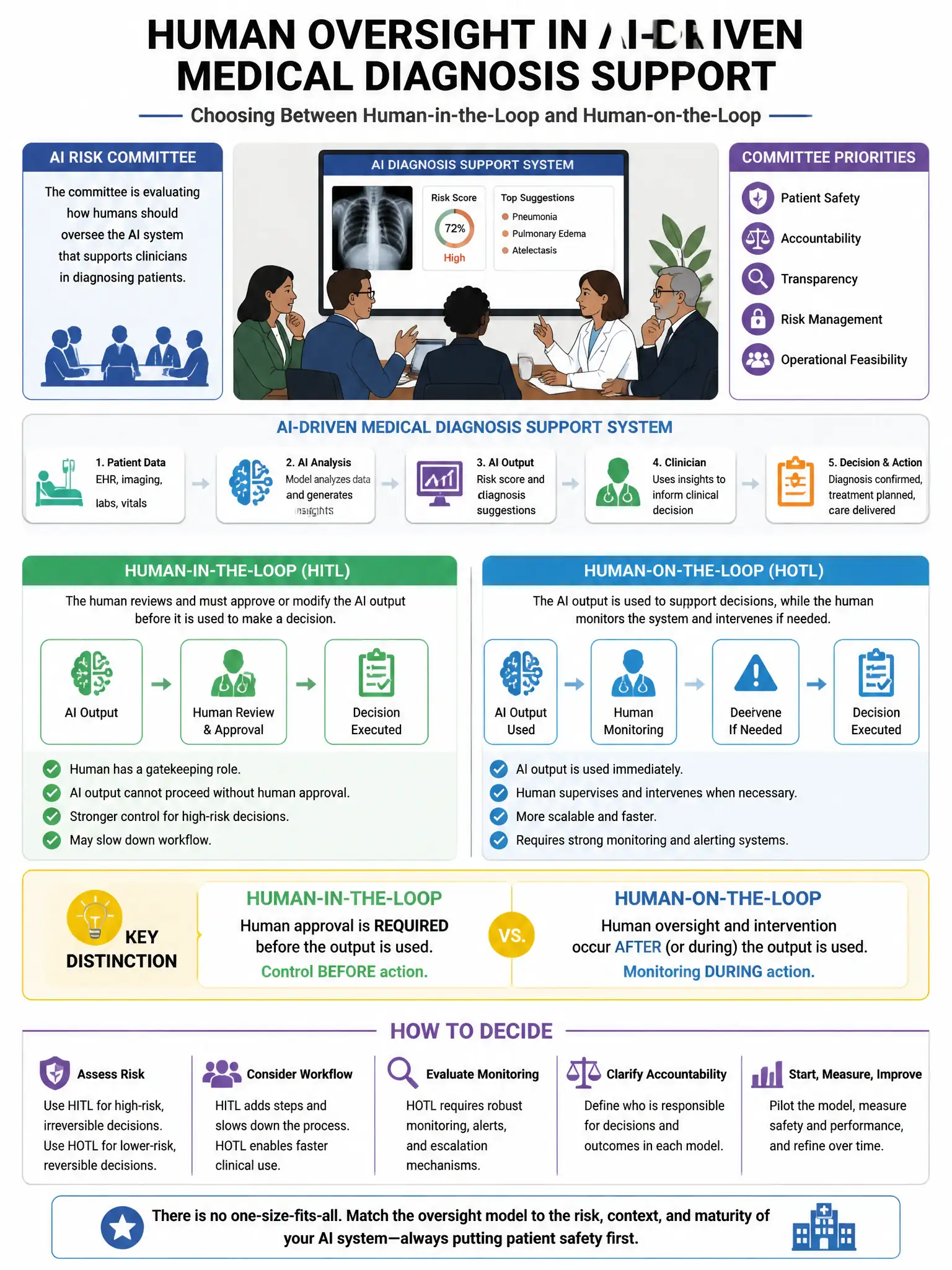
An organization's AI risk committee is debating whether to implement a 'human-in-the-loop' or 'human-on-the-loop' oversight model for their AI-driven medical diagnosis support system. Which statement BEST describes the key risk difference between these two approaches?
Select an answer to reveal the explanation.
Short Explanation
Here's the deal — you want the answer that says human-in-the-loop requires human approval before each AI action, while human-on-the-loop monitors after the fact. That matters because human approval stops unauthorized decisions before they happen, while post-hoc monitoring may only catch problems after the AI has already acted.
Full Explanation
The correct statement is the one saying human-in-the-loop requires human approval before each AI action, directly preventing unauthorized decisions, while human-on-the-loop monitors AI outputs post-hoc and can only intervene after AI decisions are executed. Human-in-the-loop places a human decision point before consequential AI action, so the AI recommends but a human must approve before it takes effect. Human-on-the-loop lets AI act autonomously while a human monitors and can override, meaning harmful actions may occur before intervention. For medical diagnosis support, human-in-the-loop gives stronger patient safety guarantees. The cost/no meaningful risk difference claim is wrong because the approaches differ meaningfully in risk. The human-on-the-loop preferred for high-stakes medical decisions claim is wrong because human-in-the-loop is generally preferred when stakes are high. The same explainability claim is partially true but not the key difference, because the central distinction is when human control occurs relative to the AI action.