
An organization adopts the NIST AI RMF MEASURE function. A key activity within MEASURE is quantifying AI risks. Which method BEST supports the quantification of AI trustworthiness characteristics?
Select an answer to reveal the explanation.
Short Explanation
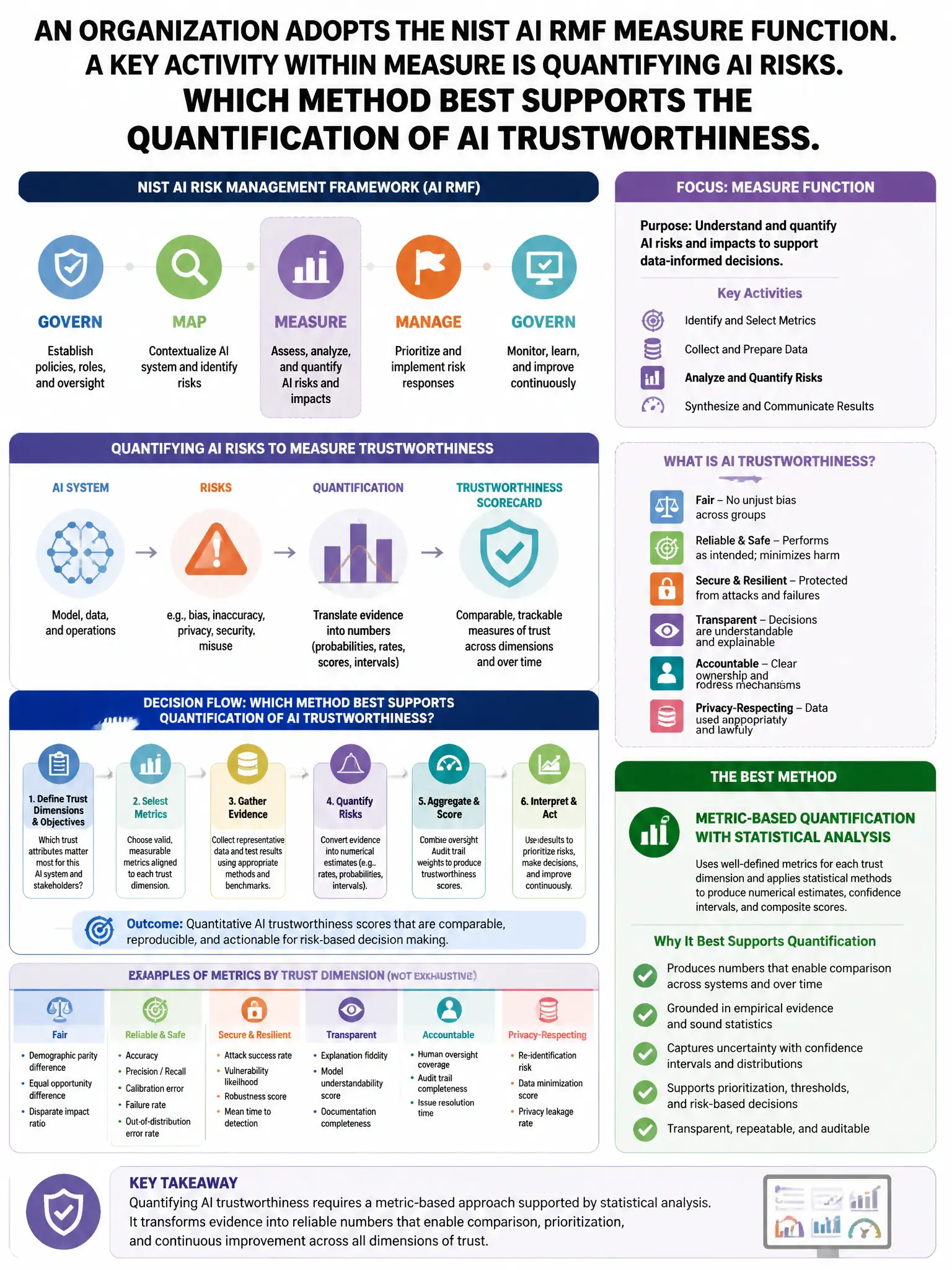
Here's the deal — you need to quantify trustworthiness, so you apply metrics aligned to characteristics like accuracy, fairness, robustness, explainability, and privacy. That is exactly what the NIST AI RMF MEASURE function asks for when quantifying AI risk.
Full Explanation
Applying metrics aligned to trustworthiness characteristics such as accuracy, fairness, robustness, explainability, and privacy is correct because NIST AI RMF MEASURE explicitly calls for quantifying AI risks and trustworthiness characteristics using metrics. The framework identifies trustworthiness properties including accuracy, fairness (bias), explainability, privacy, safety, security, and robustness, each of which can be measured with specific metrics. Conducting stakeholder interviews to collect qualitative assessments of AI system value supports MAP, not MEASURE. Benchmarking against competitor systems is not a trustworthiness assessment method. Calculating total cost of AI model development and deployment is a financial metric, not a trustworthiness metric.