
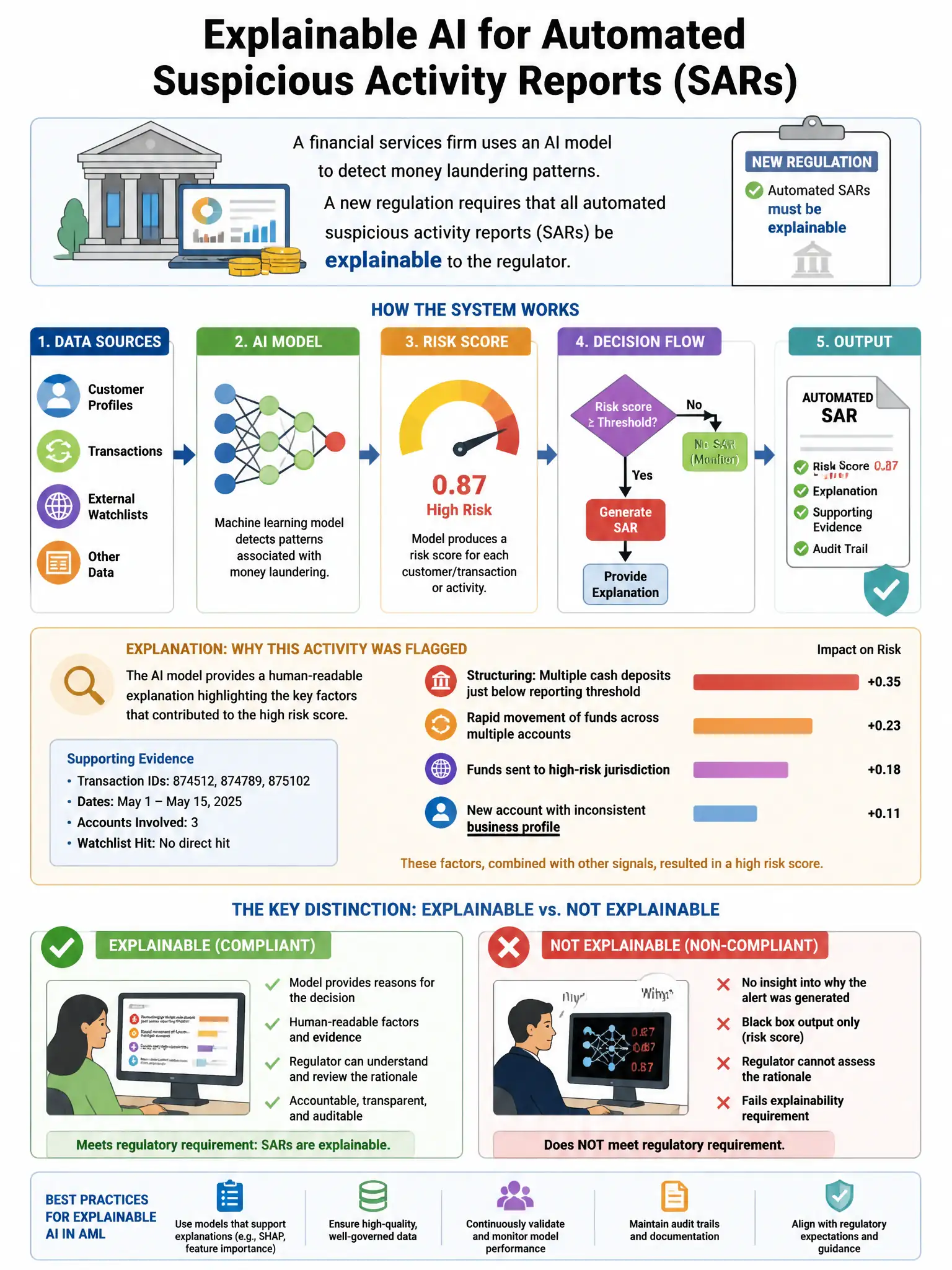
A financial services firm uses an AI model to detect money laundering patterns. A new regulation requires that all automated suspicious activity reports (SARs) be explainable to the regulator. The current model is a deep neural network with no built-in explainability. Which approach presents the GREATEST risk to the firm?
Select an answer to reveal the explanation.
Short Explanation
Here's the deal — filing SARs without any explanation to the regulator is the biggest risk because it violates the explainability requirement. FinCEN and other regulators expect you to explain the basis for suspicious activity reports, and skipping that invites sanctions and fines.
Full Explanation
Filing SARs based solely on model output without any supporting explanation to the regulator is correct because it constitutes a regulatory compliance failure. FinCEN and other financial regulators expect institutions to explain the basis for suspicious activity reports. This exposes the firm to regulatory sanctions, fines, and potential enforcement action. Using SHAP values to generate post-hoc explanations for each SAR, replacing the neural network with a gradient-boosted tree model that supports native feature importance, and using a rule-based system to generate explanations that are cross-referenced with neural network outputs are all legitimate technical approaches to satisfy explainability requirements.