
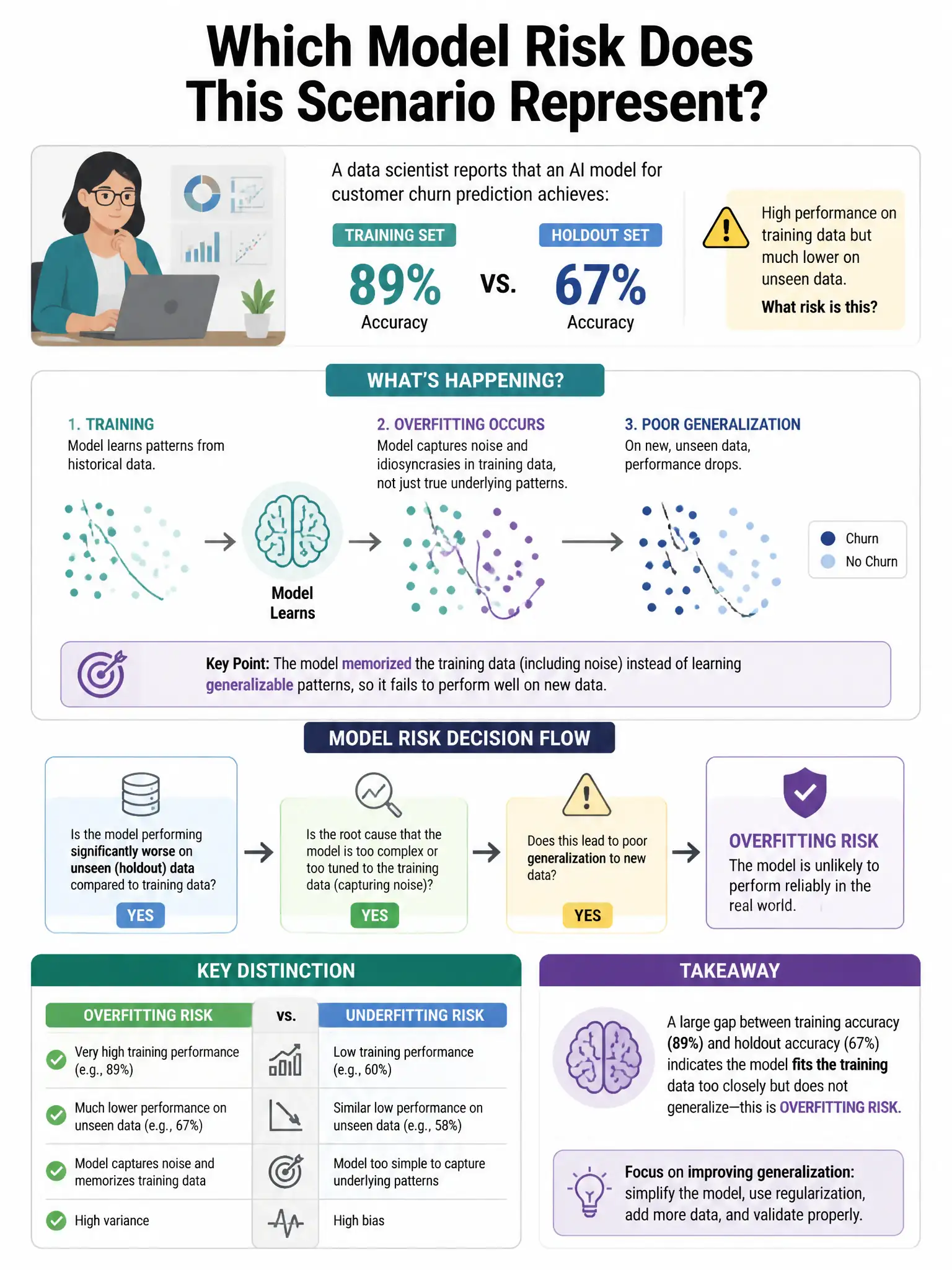
A data scientist reports that an AI model for customer churn prediction achieves 89% accuracy on the training set but only 67% on an independent holdout set. Which model risk does this MOST indicate?
Select an answer to reveal the explanation.
Short Explanation
Here's the deal — you're seeing overfitting because the model scores much higher on the training set than on the independent holdout set. That gap means it memorized training-data quirks instead of learning patterns that generalize.
Full Explanation
Overfitting, where the model has memorized training data patterns rather than learning generalizable relationships, is indicated by the large gap between 89% training accuracy and 67% holdout accuracy. That gap shows the model learned noise and idiosyncratic training patterns that do not generalize. Data drift due to changes in customer behavior after model training and concept drift due to changes in the definition of customer churn over time would usually appear as declining performance after deployment, not in this pre-deployment train-versus-holdout comparison. Underfitting, where the model is too simple to capture churn complexity, would show poor performance on both training and holdout sets.