
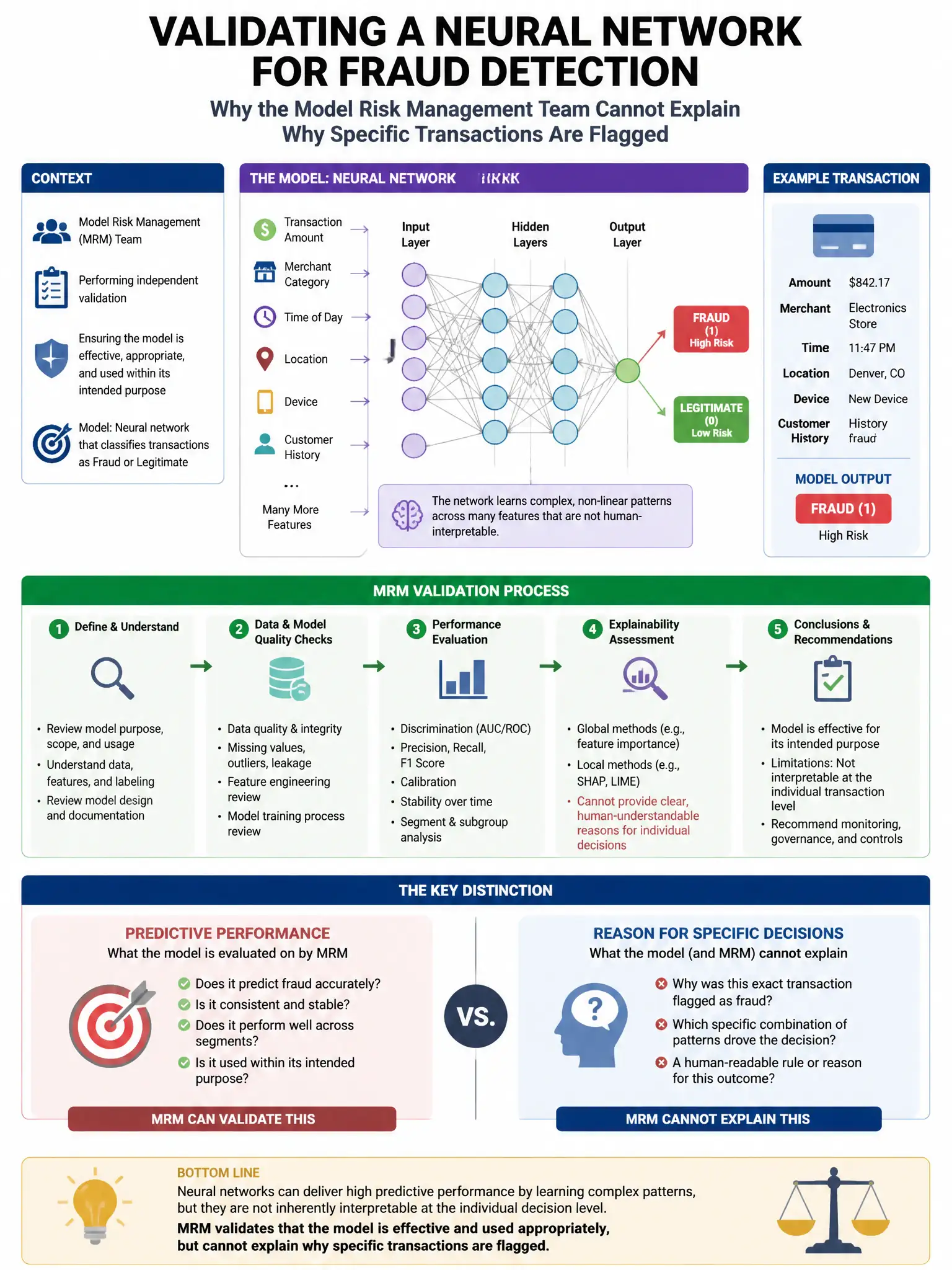
An organization's model risk management team is performing validation on a neural network that classifies transaction fraud. The team cannot explain why specific transactions are flagged. Which validation technique should the team employ to address explainability requirements under SR 11-7?
Select an answer to reveal the explanation.
Short Explanation
Here's the deal — you should apply post-hoc explainability methods like SHAP values to attribute feature importance to individual predictions. That gives you enough understanding of why a neural network flags a transaction to meet SR 11-7 without throwing away the model's predictive power.
Full Explanation
Applying post-hoc explainability methods such as SHAP values, LIME, or similar is correct because they provide feature attribution for individual predictions from complex models, satisfying SR 11-7 requirements for understanding outputs without requiring inherent interpretability. Rewriting the neural network as logistic regression for full transparency is unnecessary and may sacrifice predictive power. Validating only on aggregate population metrics and waiving individual-level explainability requirements is insufficient because SR 11-7 requires understanding of individual outcomes when models affect individuals. Documenting that the model is a black box and proceeding with deployment after management sign-off does not meet SR 11-7 validation standards.