
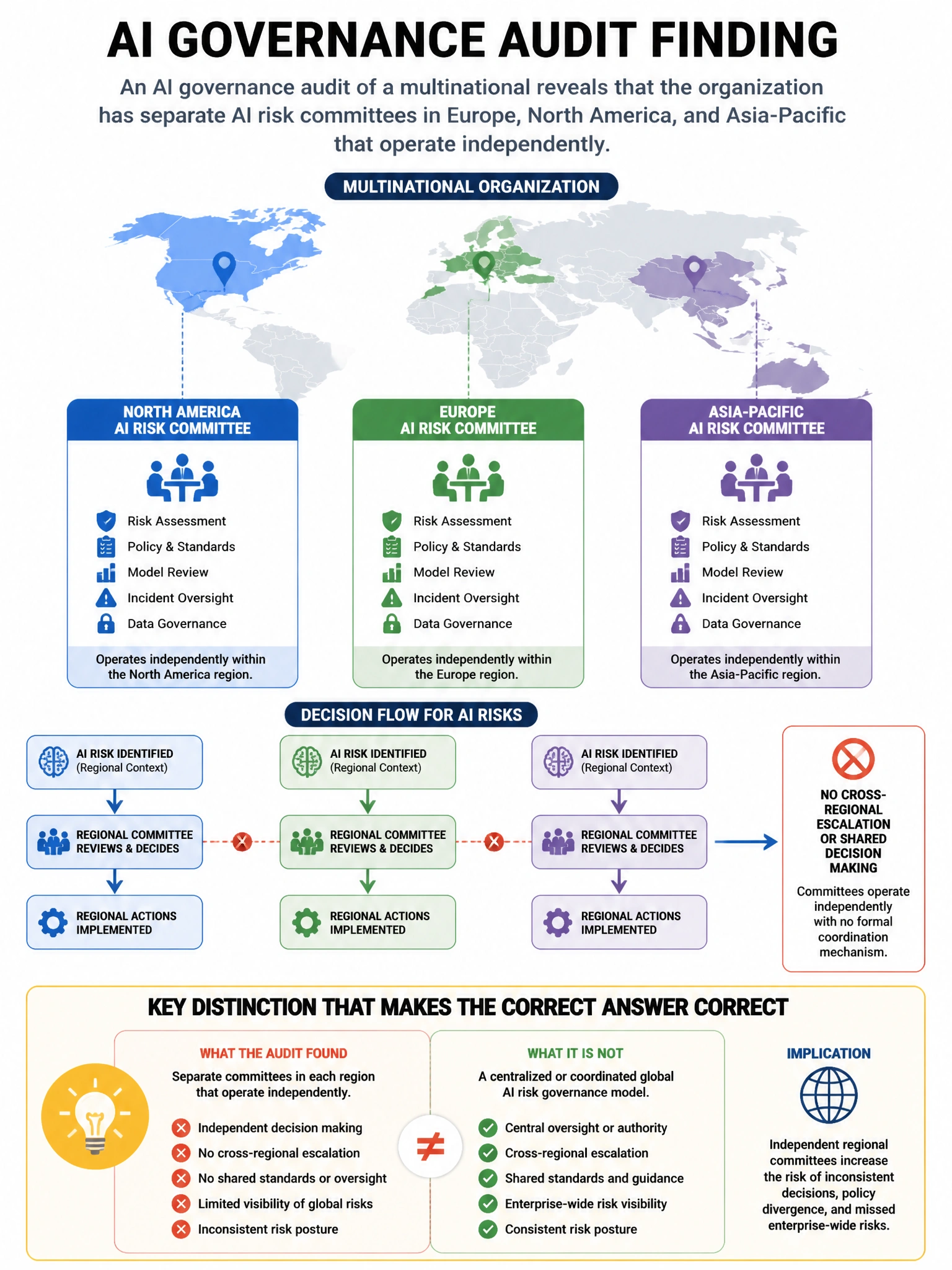
An AI governance audit of a multinational reveals that the organization has separate AI risk committees in Europe, North America, and Asia-Pacific that operate independently with no global coordination mechanism. Each region applies different risk thresholds, fairness standards, and approval criteria. What governance risk does this structure create?
Select an answer to reveal the explanation.
Short Explanation and Infographic
Here's the deal — b is correct because governance fragmentation creates multiple compounding risks: regulatory arbitrage (approving globally-deployed AI through the most lenient regional committee to avoid stricter requirements), uneven risk protection for customers and employees across regions, inability to manage the organization's global AI risk profile, and potential non-compliance with strict regional regulations (EU AI Act) for globally deployed systems. A (duplication/efficiency) is an operational concern, not the primary governance risk.
Full explanation below image
Full Explanation
B is correct because governance fragmentation creates multiple compounding risks: regulatory arbitrage (approving globally-deployed AI through the most lenient regional committee to avoid stricter requirements), uneven risk protection for customers and employees across regions, inability to manage the organization's global AI risk profile, and potential non-compliance with strict regional regulations (EU AI Act) for globally deployed systems. A (duplication/efficiency) is an operational concern, not the primary governance risk. C (conflicting outcomes) is a symptom of fragmentation but not the full characterization. D (board reporting) is a governance transparency concern that is also a symptom of fragmentation.