
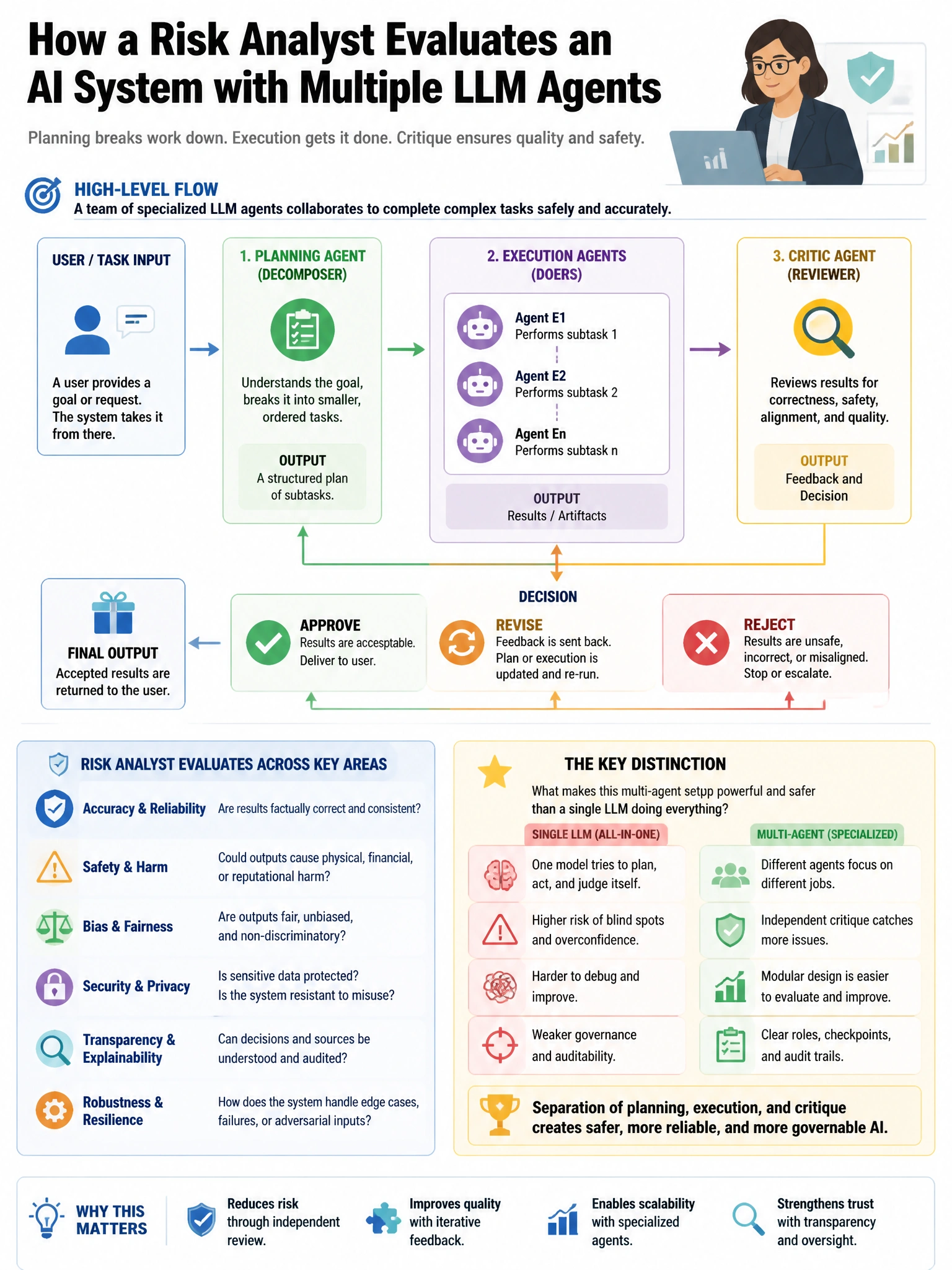
A risk analyst is evaluating an AI system in which multiple LLM agents collaborate: a planning agent decomposes tasks, execution agents carry them out, and a critic agent reviews outputs. Which failure mode is MOST unique to this multi-agent collaborative architecture?
Select an answer to reveal the explanation.
Short Explanation and Infographic
Here's the deal — a is correct because multi-agent systems introduce correlated failure risk — if the orchestrating planning agent makes an error in task decomposition, all execution agents carry out the wrong plan without independent verification, amplifying the impact of a single planning failure across the entire workflow. B is a technical limitation, not a unique failure mode.
Full explanation below image
Full Explanation
A is correct because multi-agent systems introduce correlated failure risk — if the orchestrating planning agent makes an error in task decomposition, all execution agents carry out the wrong plan without independent verification, amplifying the impact of a single planning failure across the entire workflow. B is a technical limitation, not a unique failure mode. C is a training misalignment concern but secondary. D is a performance characteristic, not a failure mode.