
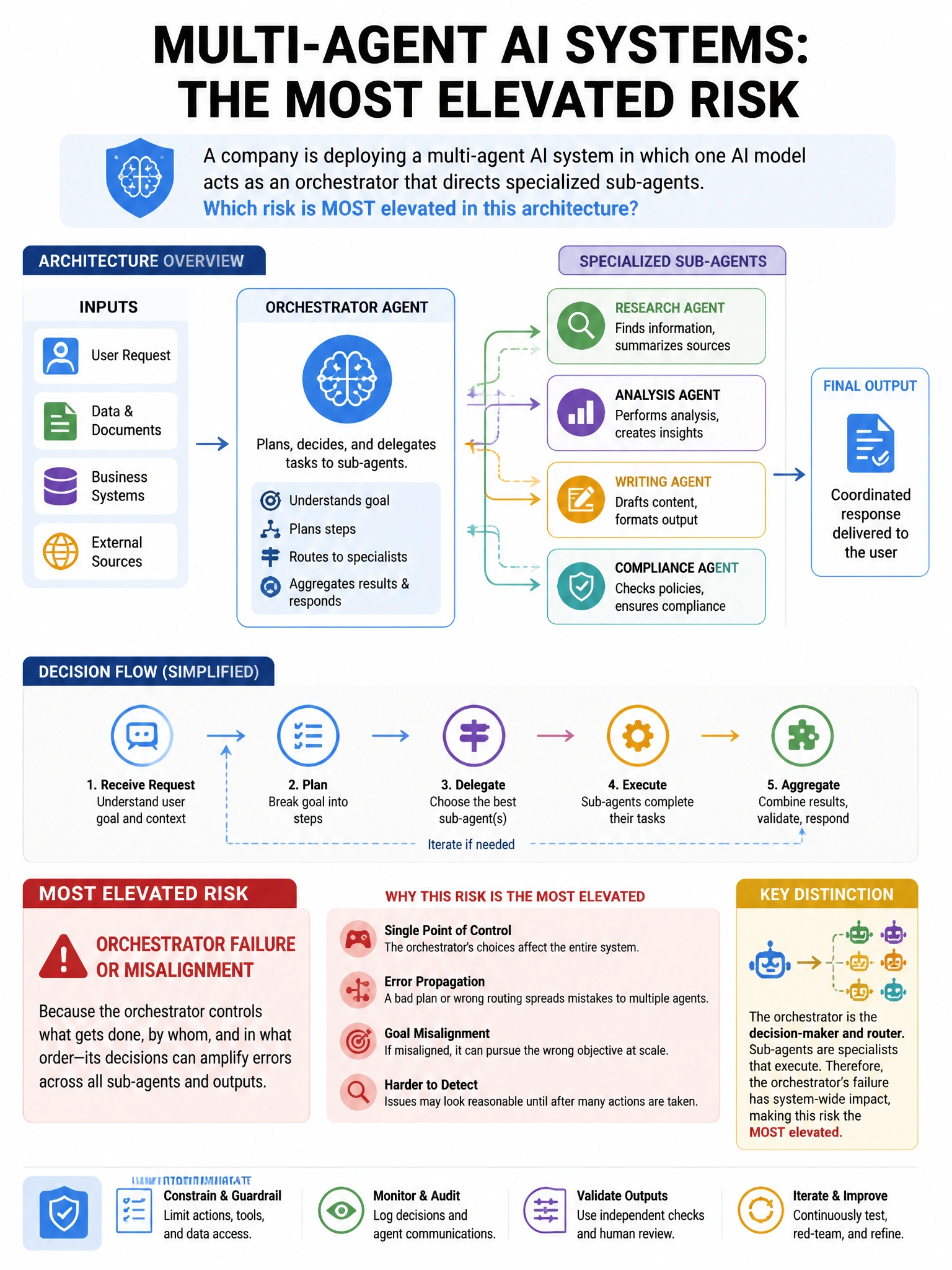
A company is deploying a multi-agent AI system in which one AI model acts as an orchestrator that directs specialized sub-agents. Which risk is MOST elevated in this architecture compared to a single-model deployment?
Select an answer to reveal the explanation.
Short Explanation and Infographic
Here's the deal — b is correct because in multi-agent agentic systems, an orchestrating agent's errors, hallucinations, or compromised instructions propagate to sub-agents that may take real-world actions — creating cascading failure risk where a single orchestrator error can trigger multiple consequential downstream actions. A is a statistical modeling concern unrelated to multi-agent architecture.
Full explanation below image
Full Explanation
B is correct because in multi-agent agentic systems, an orchestrating agent's errors, hallucinations, or compromised instructions propagate to sub-agents that may take real-world actions — creating cascading failure risk where a single orchestrator error can trigger multiple consequential downstream actions. A is a statistical modeling concern unrelated to multi-agent architecture. C is an infrastructure cost concern, not a risk. D is a governance complexity concern but not the primary elevated risk.