
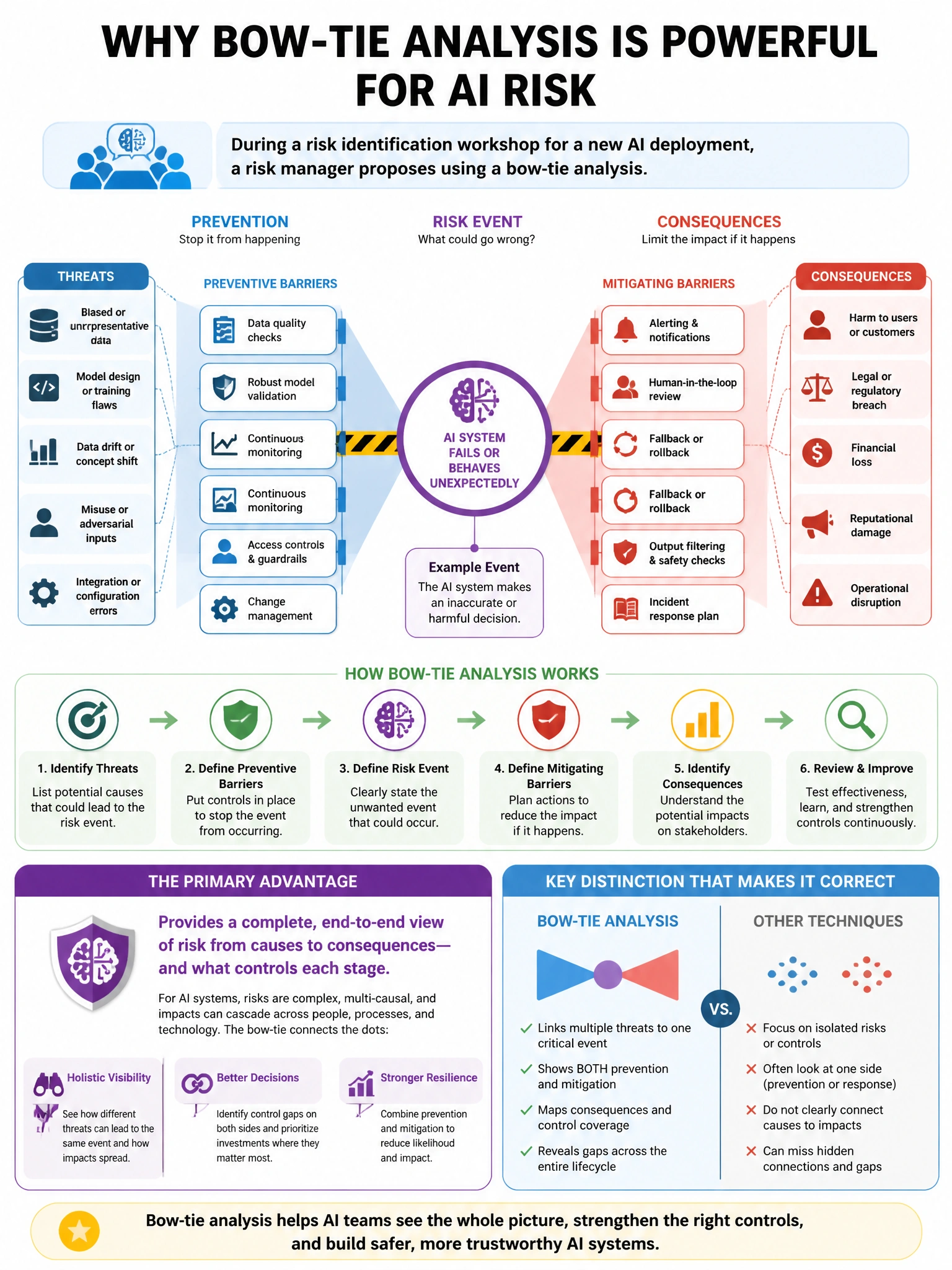
During a risk identification workshop for a new AI deployment, a risk manager proposes using a bow-tie analysis. What is the PRIMARY advantage of this technique for AI risk?
Select an answer to reveal the explanation.
Short Explanation and Infographic
Here's the deal — b is correct because bow-tie analysis visualizes threats (causes) on the left side of a central risk event and consequences (impacts) on the right, with controls mapped at each stage — useful for structured AI risk communication. A is wrong because bow-tie analysis is qualitative, not a Bayesian probability tool.
Full explanation below image
Full Explanation
B is correct because bow-tie analysis visualizes threats (causes) on the left side of a central risk event and consequences (impacts) on the right, with controls mapped at each stage — useful for structured AI risk communication. A is wrong because bow-tie analysis is qualitative, not a Bayesian probability tool. C is wrong because it does not assess training data. D is wrong because it is not a compliance checklist framework.