
An AI tool used in a criminal justice risk assessment is found to assign substantially different recidivism risk scores to defendants with identical criminal histories when race is inferred from names. Which technical root cause MOST likely explains this finding?
Select an answer to reveal the explanation.
Short Explanation and Infographic
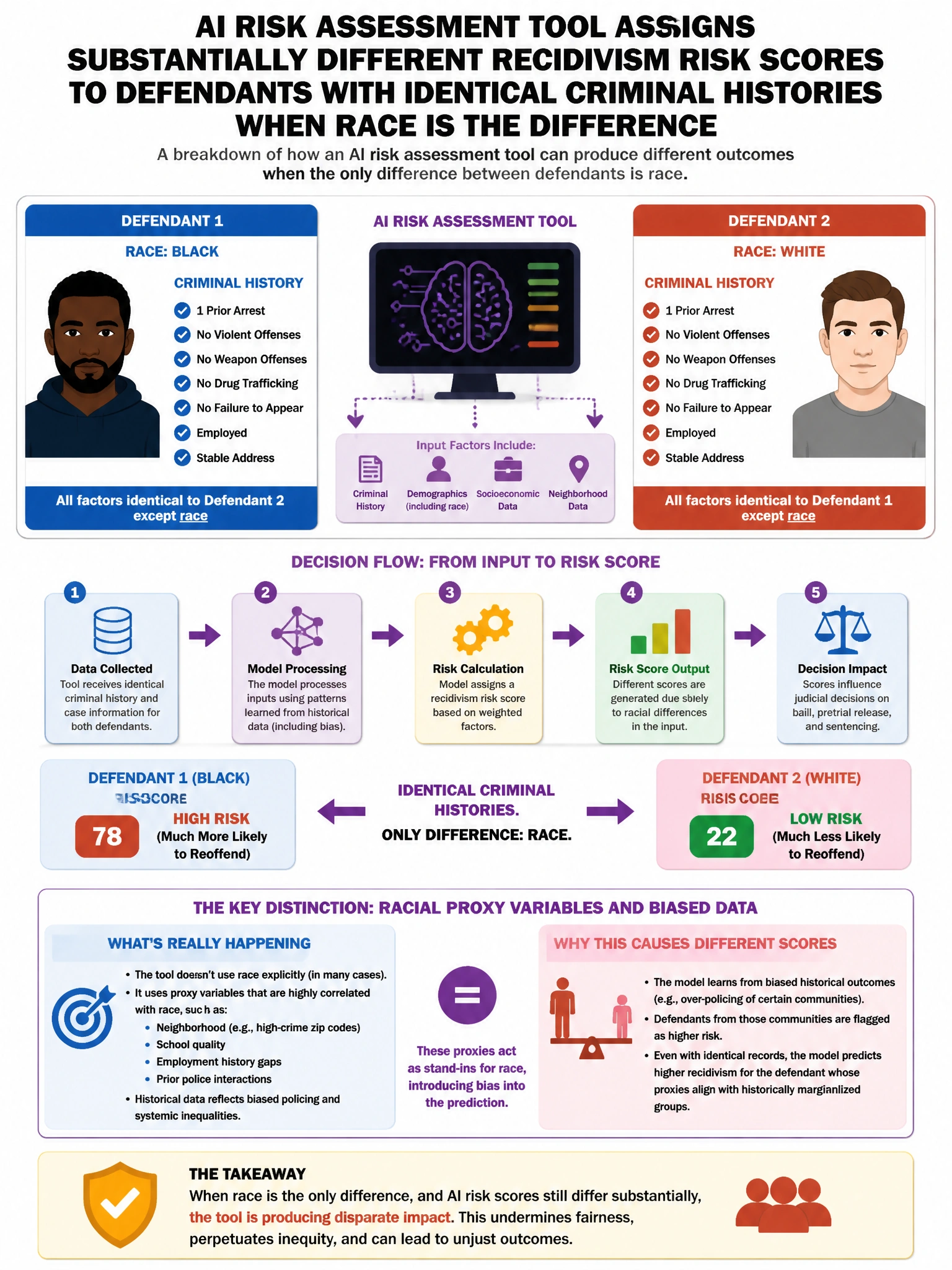
Here's the deal — c is correct because names are strongly correlated with race and ethnicity in U.S. criminal justice datasets. If the training data reflects historical racial disparities in arrests, convictions, or recidivism classifications, the model learns the correlation between…
Full explanation below image
Full Explanation
C is correct because names are strongly correlated with race and ethnicity in U.S. criminal justice datasets. If the training data reflects historical racial disparities in arrests, convictions, or recidivism classifications, the model learns the correlation between racially-associated names and the (historically biased) outcome variable. This produces racially discriminatory scores through proxy discrimination without explicitly using race. The model using name directly (A) is possible but the scenario describes inference from name, suggesting it is not a direct feature. Intentional encoding (B) is unlikely and difficult to substantiate. Evaluation dataset representativeness (D) is a measurement concern, not the root cause of the differential scoring.