
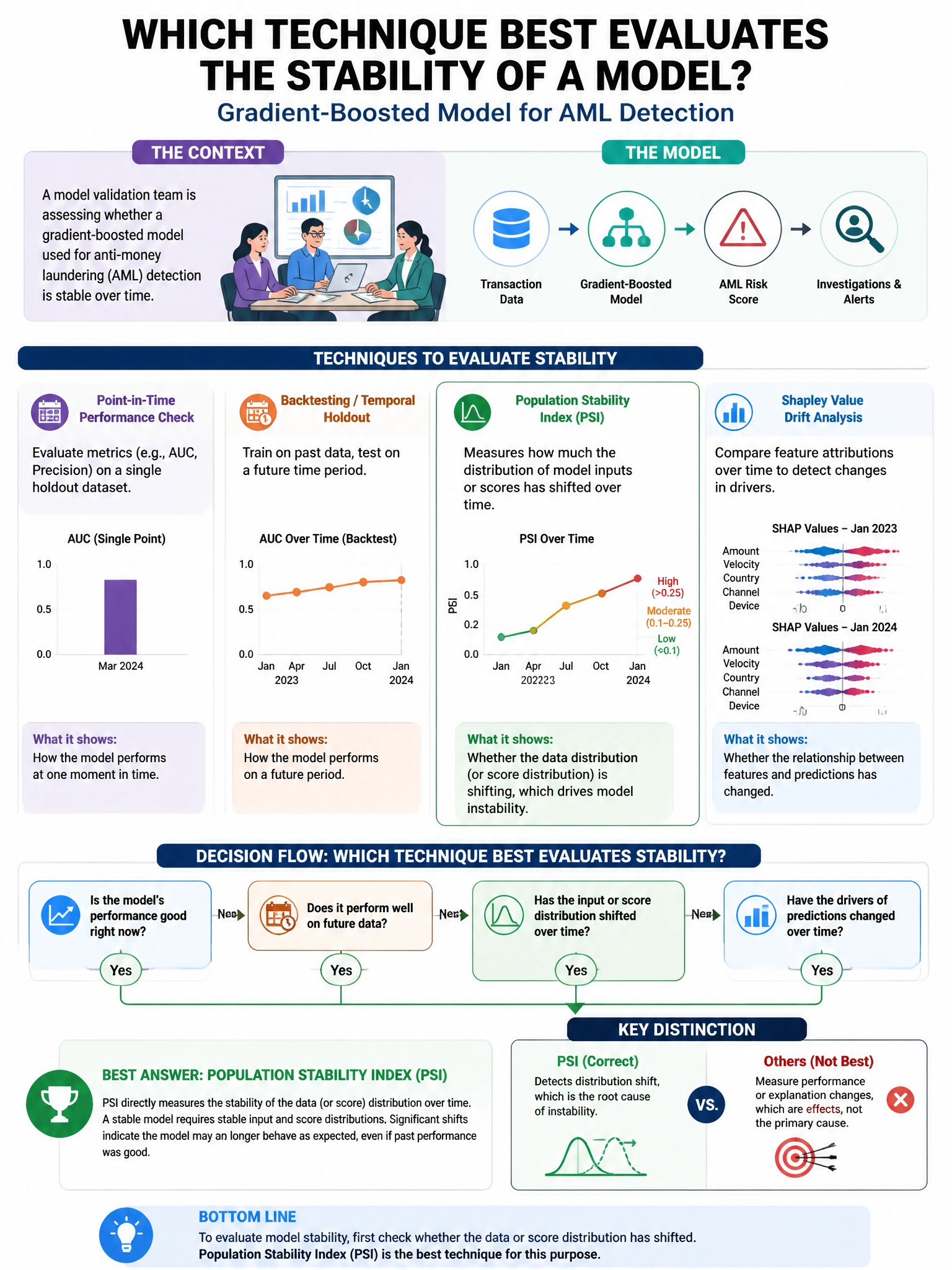
A model validation team is assessing whether a gradient-boosted model used for anti-money laundering (AML) detection is stable. Which technique BEST evaluates the stability of model predictions to small changes in input data?
Select an answer to reveal the explanation.
Short Explanation and Infographic
Here's the deal — b is correct because sensitivity analysis directly tests whether small, plausible changes to input values cause disproportionately large changes in model output scores. High sensitivity to small input perturbations indicates model instability, which is a reliability and auditability concern for AML models where investigators rely on score stability to prioritize cases.
Full explanation below image
Full Explanation
B is correct because sensitivity analysis directly tests whether small, plausible changes to input values cause disproportionately large changes in model output scores. High sensitivity to small input perturbations indicates model instability, which is a reliability and auditability concern for AML models where investigators rely on score stability to prioritize cases. Out-of-time validation (A) tests temporal generalization. Cross-validation (C) tests generalization within the training distribution. Holdout testing (D) measures overall predictive accuracy, not input sensitivity.