
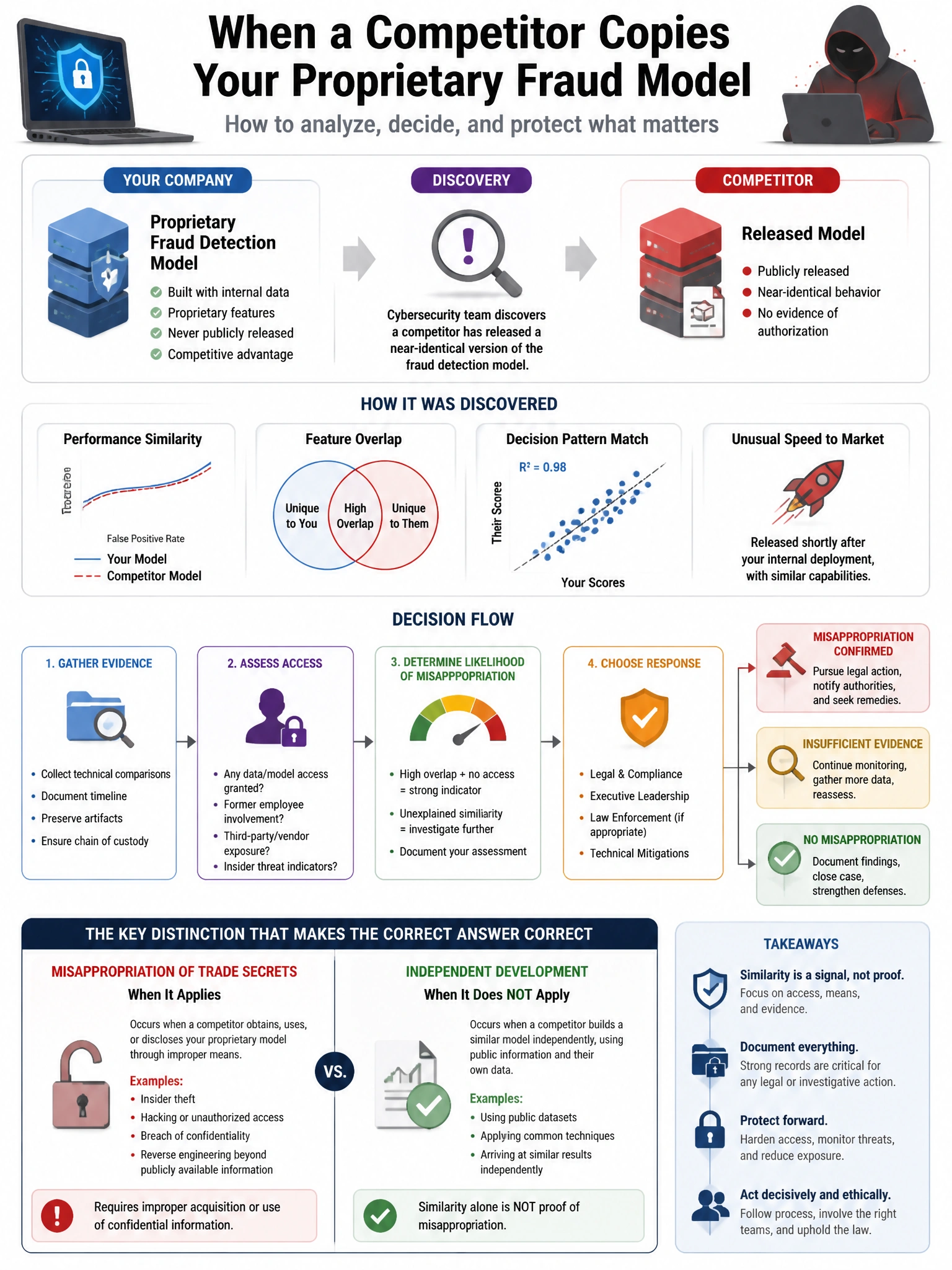
A cybersecurity team discovers that a competitor has released a near-identical version of their proprietary fraud detection model. The internal model was never publicly released. Which attack is the MOST likely explanation?
Select an answer to reveal the explanation.
Short Explanation and Infographic
Here's the deal — c is correct because a near-identical copy of a model that was never publicly released is most consistent with direct exfiltration by someone with internal access to the model weights, training code, or artifacts. Model extraction (B) through API queries typically produces a functionally similar but not near-identical model, and would require API access.
Full explanation below image
Full Explanation
C is correct because a near-identical copy of a model that was never publicly released is most consistent with direct exfiltration by someone with internal access to the model weights, training code, or artifacts. Model extraction (B) through API queries typically produces a functionally similar but not near-identical model, and would require API access. Data poisoning (A) affects model behavior, not replication. Adversarial evasion (D) affects how the model responds to specific inputs, not model structure. The near-identical characterization strongly suggests direct copying rather than reverse engineering.