
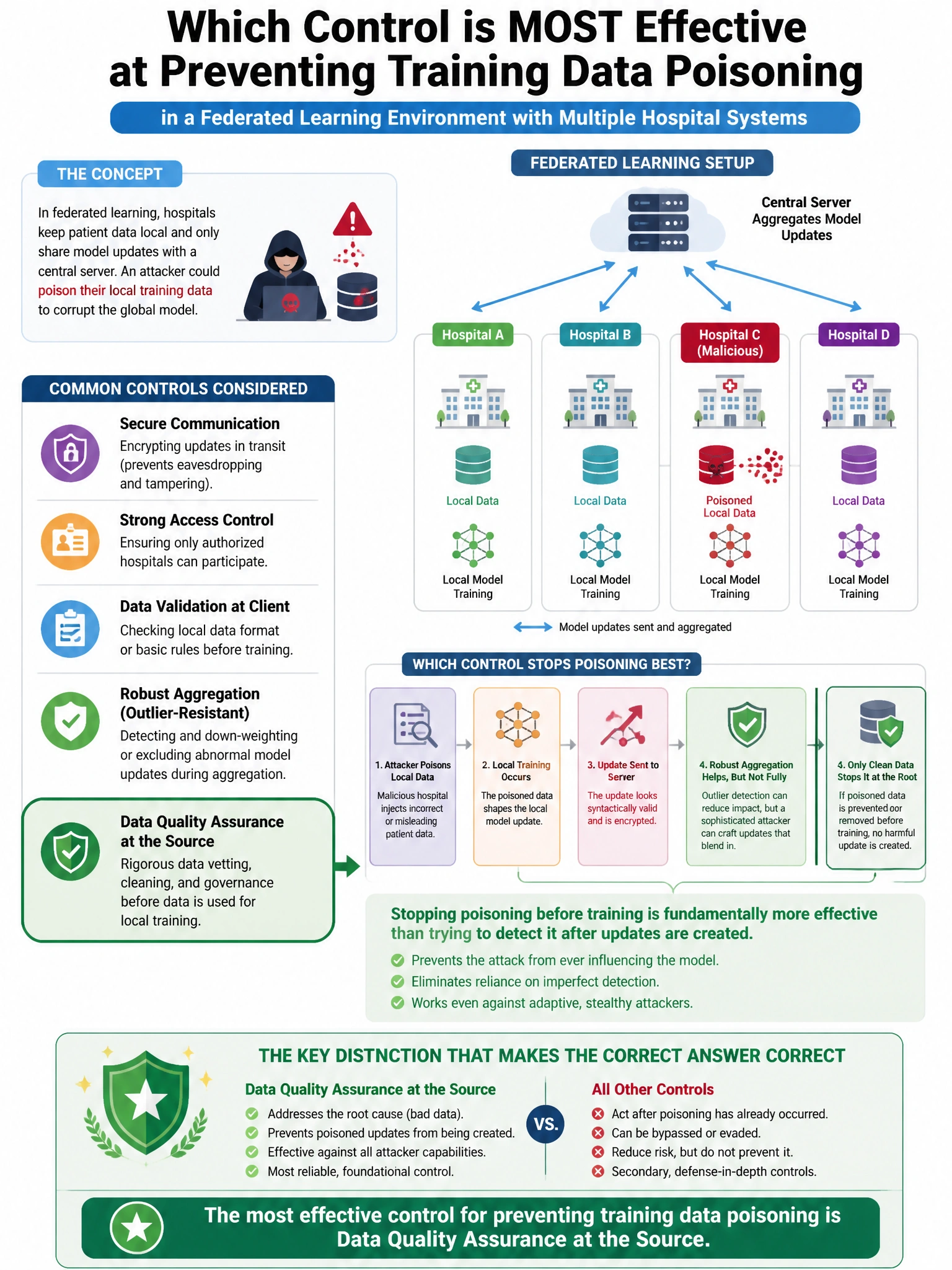
Which control is MOST effective at preventing training data poisoning in a federated learning environment where multiple hospital systems contribute patient data to a shared AI model?
Select an answer to reveal the explanation.
Short Explanation and Infographic
Here's the deal — b is correct because federated learning aggregates model gradient updates rather than raw data, and data poisoning in this context manifests as malicious gradient updates (Byzantine attacks) from compromised participants. Byzantine-robust aggregation algorithms (such as Krum, coordinate-wise median, or Trimmed Mean) are designed to detect and filter out anomalous gradients before aggregation, directly addressing the poisoning vector.
Full explanation below image
Full Explanation
B is correct because federated learning aggregates model gradient updates rather than raw data, and data poisoning in this context manifests as malicious gradient updates (Byzantine attacks) from compromised participants. Byzantine-robust aggregation algorithms (such as Krum, coordinate-wise median, or Trimmed Mean) are designed to detect and filter out anomalous gradients before aggregation, directly addressing the poisoning vector. Encryption (A) protects confidentiality but not integrity of gradient updates. Attestations (C) are administrative controls that do not prevent a dishonest or compromised participant from submitting poisoned updates. Network restriction (D) reduces attack surface but does not address the technical vulnerability.