
A compliance officer discovers that the organization's AI hiring tool was trained on application data where the offer/no-offer label was determined by the previous hiring manager, who had documented complaints of gender discrimination. Which data integrity issue is MOST critical?
Select an answer to reveal the explanation.
Short Explanation and Infographic
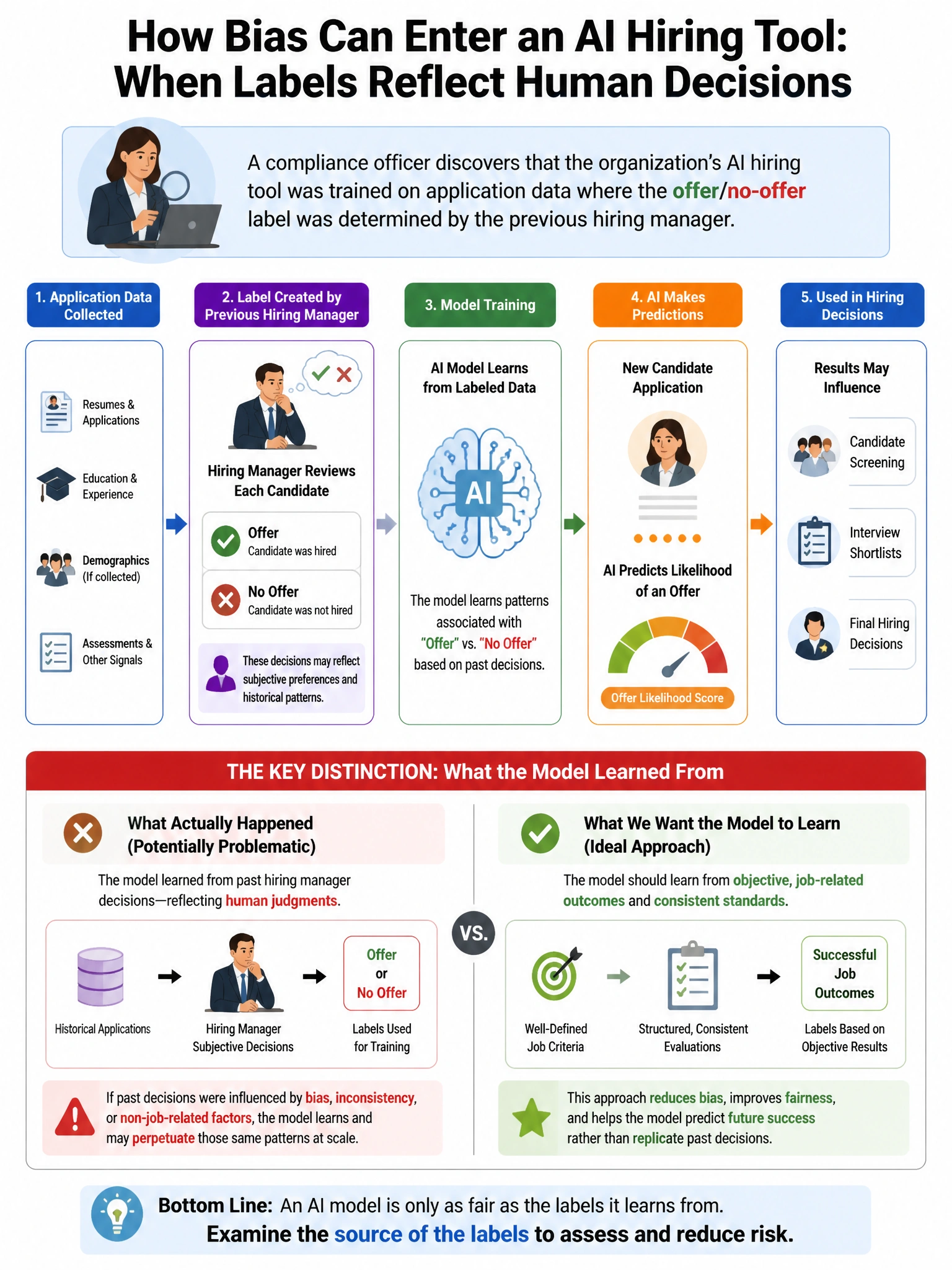
Here's the deal — b is correct because when training labels are derived from decisions made by a biased human decision-maker, those discriminatory decisions become embedded in the AI model as 'ground truth.' The model learns to replicate the manager's discriminatory pattern, regardless of the features used. This is label bias or ground truth contamination.
Full explanation below image
Full Explanation
B is correct because when training labels are derived from decisions made by a biased human decision-maker, those discriminatory decisions become embedded in the AI model as 'ground truth.' The model learns to replicate the manager's discriminatory pattern, regardless of the features used. This is label bias or ground truth contamination. Temporal bias (A) is about data staleness. Sampling bias (C) is about which examples were included in training. Feature engineering bias (D) would involve different features driving different problems.