
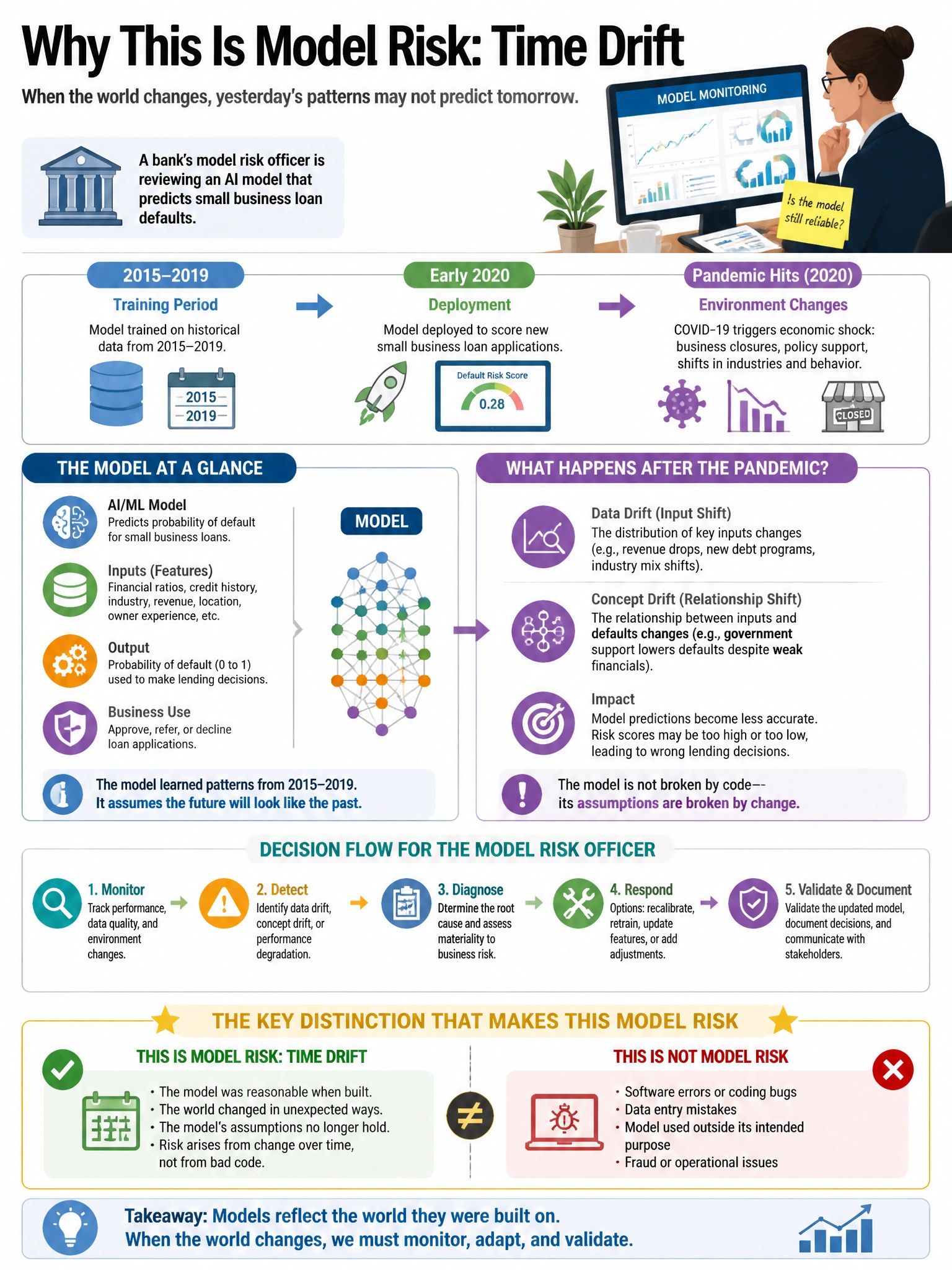
A bank's model risk officer is reviewing an AI model that predicts small business loan defaults. The model was trained on data from 2015–2019 and deployed in early 2020. During a post-deployment audit, performance has deteriorated sharply. The most plausible explanation is that the COVID-19 pandemic drastically changed default patterns. What type of model risk does this MOST represent?
Select an answer to reveal the explanation.
Short Explanation and Infographic
Here's the deal — b is correct because an external economic shock like a pandemic fundamentally changes the relationship between predictive features and outcomes, which is the definition of concept drift. The model's learned associations (e.g., industry type predicting low default risk) became invalid post-pandemic.
Full explanation below image
Full Explanation
B is correct because an external economic shock like a pandemic fundamentally changes the relationship between predictive features and outcomes, which is the definition of concept drift. The model's learned associations (e.g., industry type predicting low default risk) became invalid post-pandemic. Overfitting (A) would have been visible in pre-deployment validation, not only after the external shock. Data poisoning (C) would require an intentional attacker. Implementation error (D) would cause performance problems from the start of deployment.