
Which statement BEST describes the relationship between AI risk management and traditional enterprise risk management (ERM)?
Select an answer to reveal the explanation.
Short Explanation and Infographic
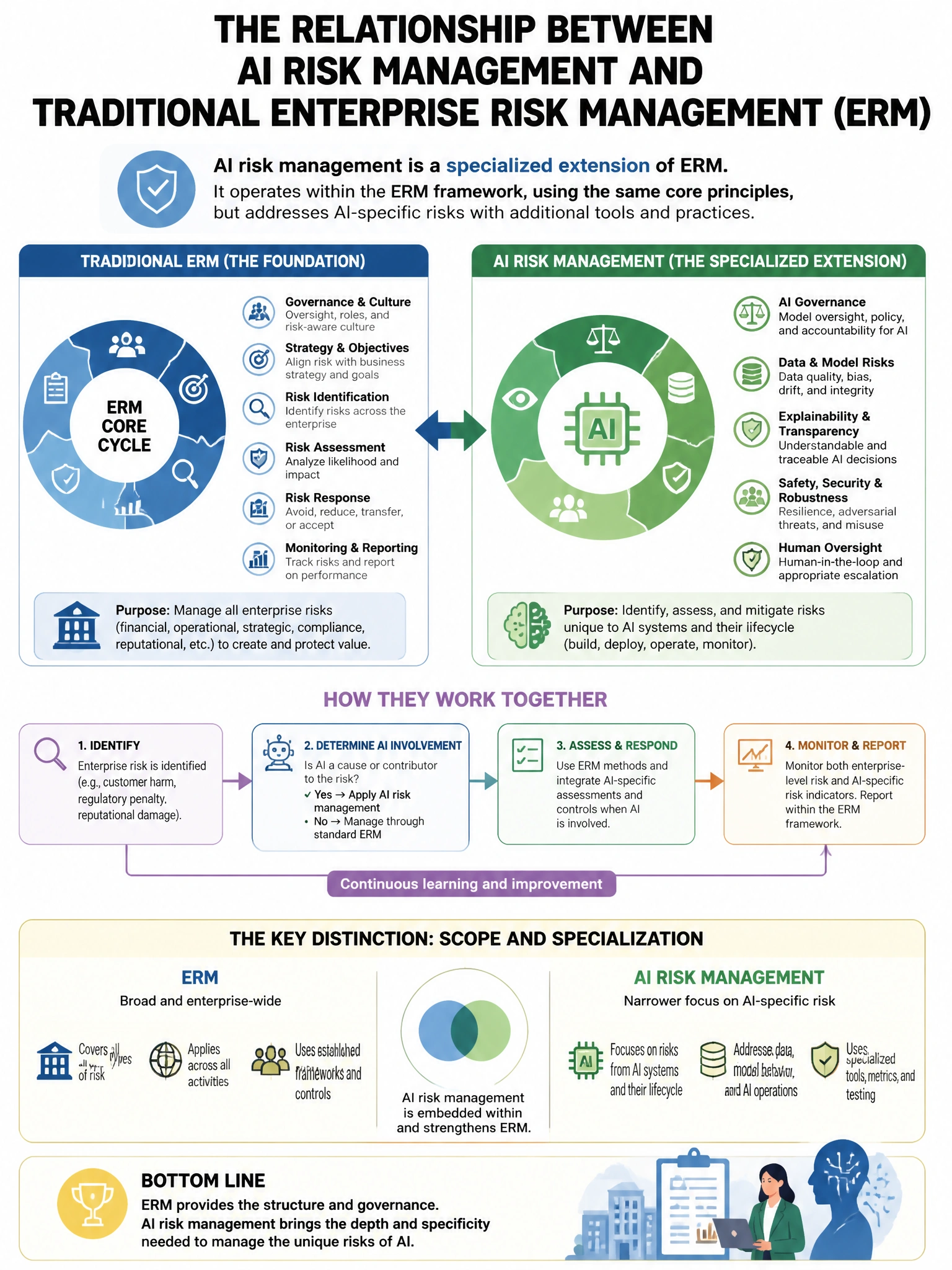
Here's the deal — b is correct because AI risk management introduces unique risk types (model drift, algorithmic bias, adversarial attacks, hallucination) that require specialized knowledge and controls, but these should be integrated into the broader ERM framework rather than siloed or left to IT alone. Integration ensures AI risks are treated with the same organizational rigor as other enterprise risks.
Full explanation below image
Full Explanation
B is correct because AI risk management introduces unique risk types (model drift, algorithmic bias, adversarial attacks, hallucination) that require specialized knowledge and controls, but these should be integrated into the broader ERM framework rather than siloed or left to IT alone. Integration ensures AI risks are treated with the same organizational rigor as other enterprise risks. Replacing ERM (A) is unnecessary and disruptive. Technology-only responsibility (C) misses the enterprise-wide impact of AI risks. Claiming ERM already covers AI (D) understates the unique nature of AI risks.