
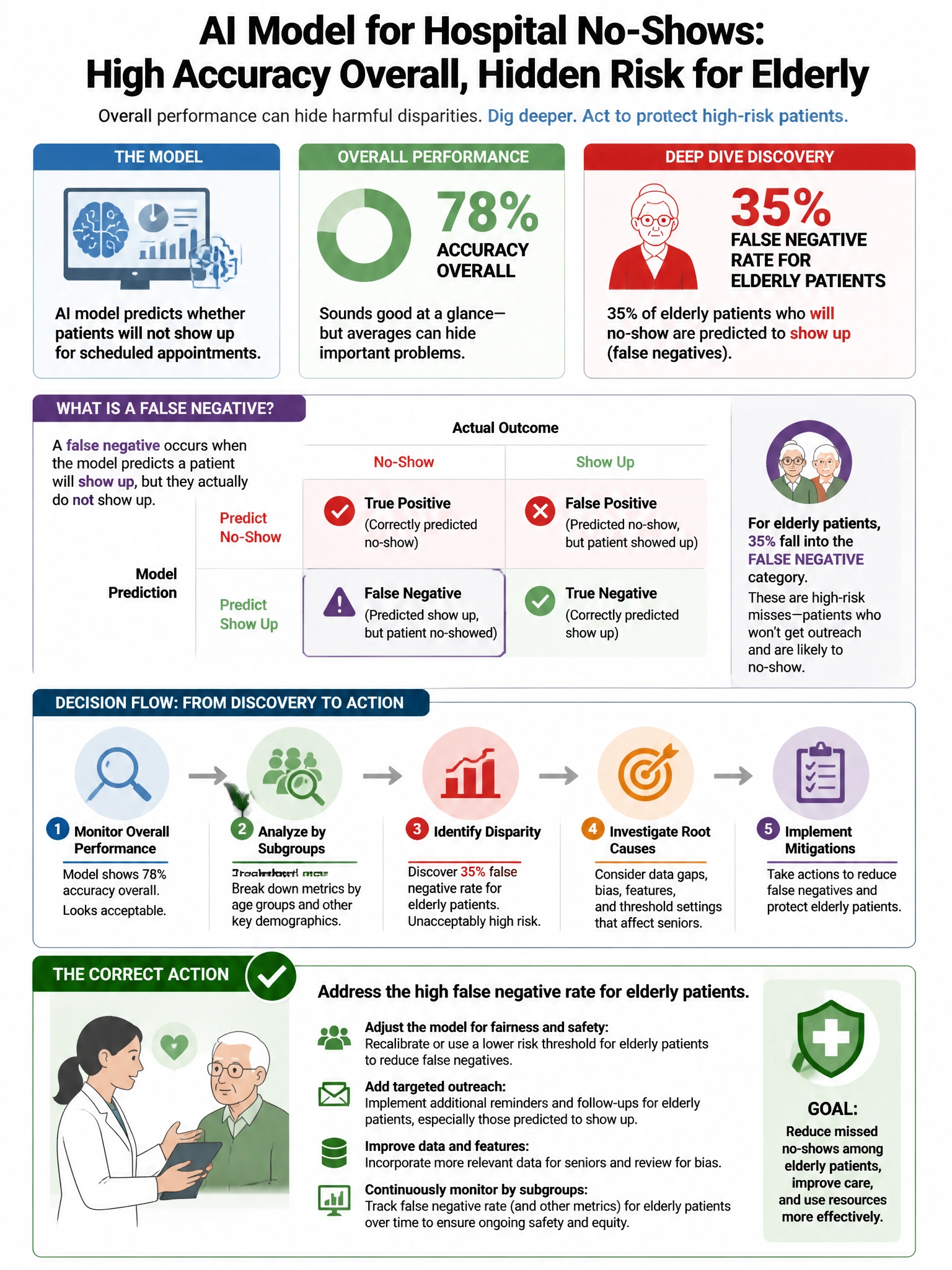
An AI model used for predicting hospital no-shows achieves 78% accuracy overall, but the AI risk team discovers it has a false negative rate of 35% for elderly patients. What action is MOST appropriate?
Select an answer to reveal the explanation.
Short Explanation and Infographic
Here's the deal — b is correct because a significantly higher false negative rate for elderly patients suggests systematic underperformance for this protected group, which may constitute age discrimination under applicable laws. The investigation should determine causation and whether retraining with stratified sampling can reduce the disparity.
Full explanation below image
Full Explanation
B is correct because a significantly higher false negative rate for elderly patients suggests systematic underperformance for this protected group, which may constitute age discrimination under applicable laws. The investigation should determine causation and whether retraining with stratified sampling can reduce the disparity. Accepting overall accuracy (A) ignores a material subgroup performance gap. Exclusion (C) may itself be discriminatory. Adjusting the global threshold (D) may worsen performance for other groups.