
An organization's model risk management team is performing validation on a neural network that classifies transaction fraud. The team cannot explain why specific transactions are flagged. Which validation technique should the team employ to address explainability requirements under SR 11-7?
Select an answer to reveal the explanation.
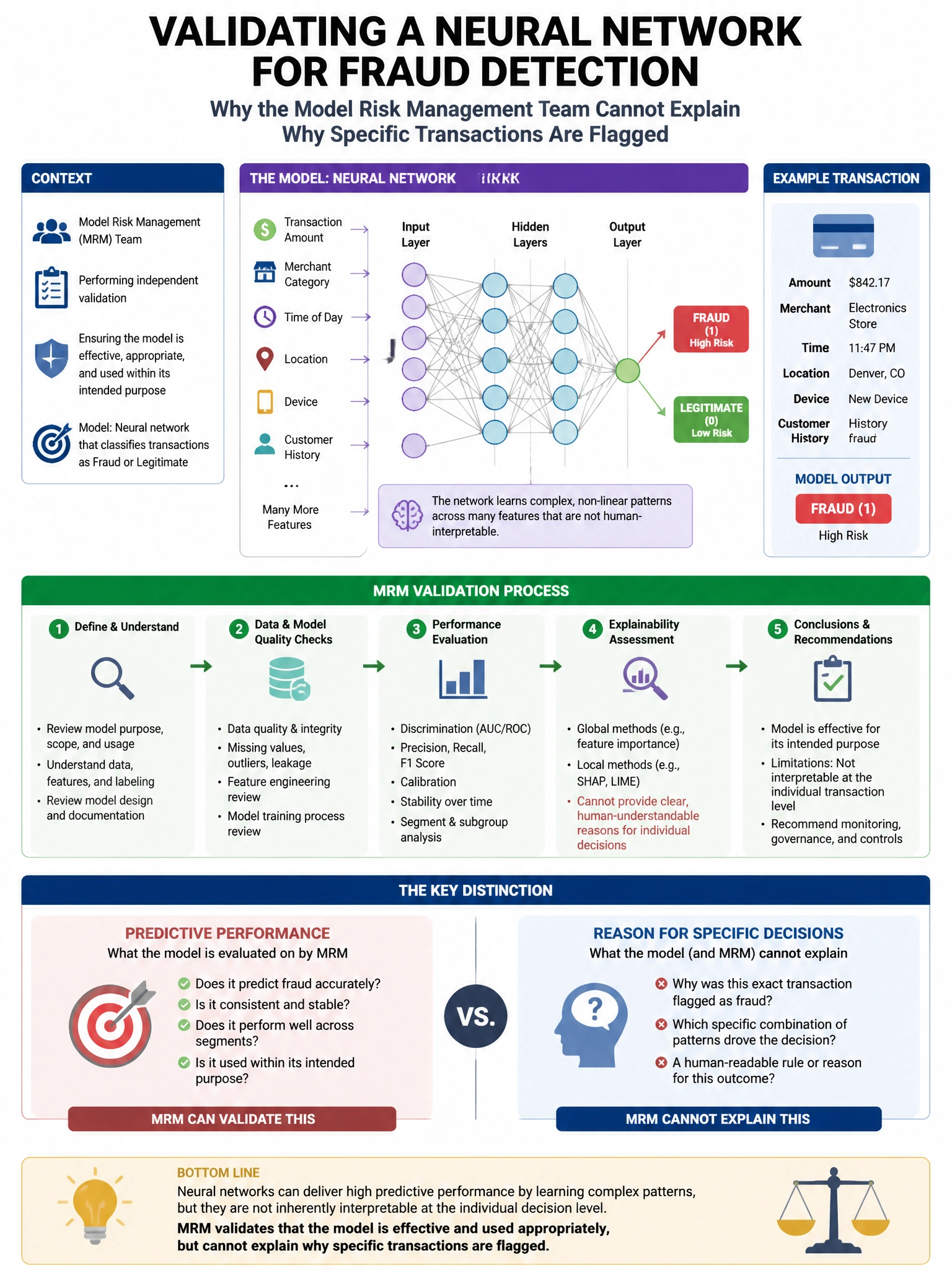
Short Explanation and Infographic
Here's the deal — b is correct because post-hoc explainability methods (SHAP, LIME, or similar) can provide feature attribution for individual predictions from complex models, satisfying SR 11-7 requirements for understanding model outputs without requiring the model to be inherently interpretable. A is unnecessary and may sacrifice predictive power.
Full explanation below image
Full Explanation
B is correct because post-hoc explainability methods (SHAP, LIME, or similar) can provide feature attribution for individual predictions from complex models, satisfying SR 11-7 requirements for understanding model outputs without requiring the model to be inherently interpretable. A is unnecessary and may sacrifice predictive power. C is insufficient because SR 11-7 requires understanding of individual outcomes when models affect individuals. D does not meet SR 11-7 validation standards.