
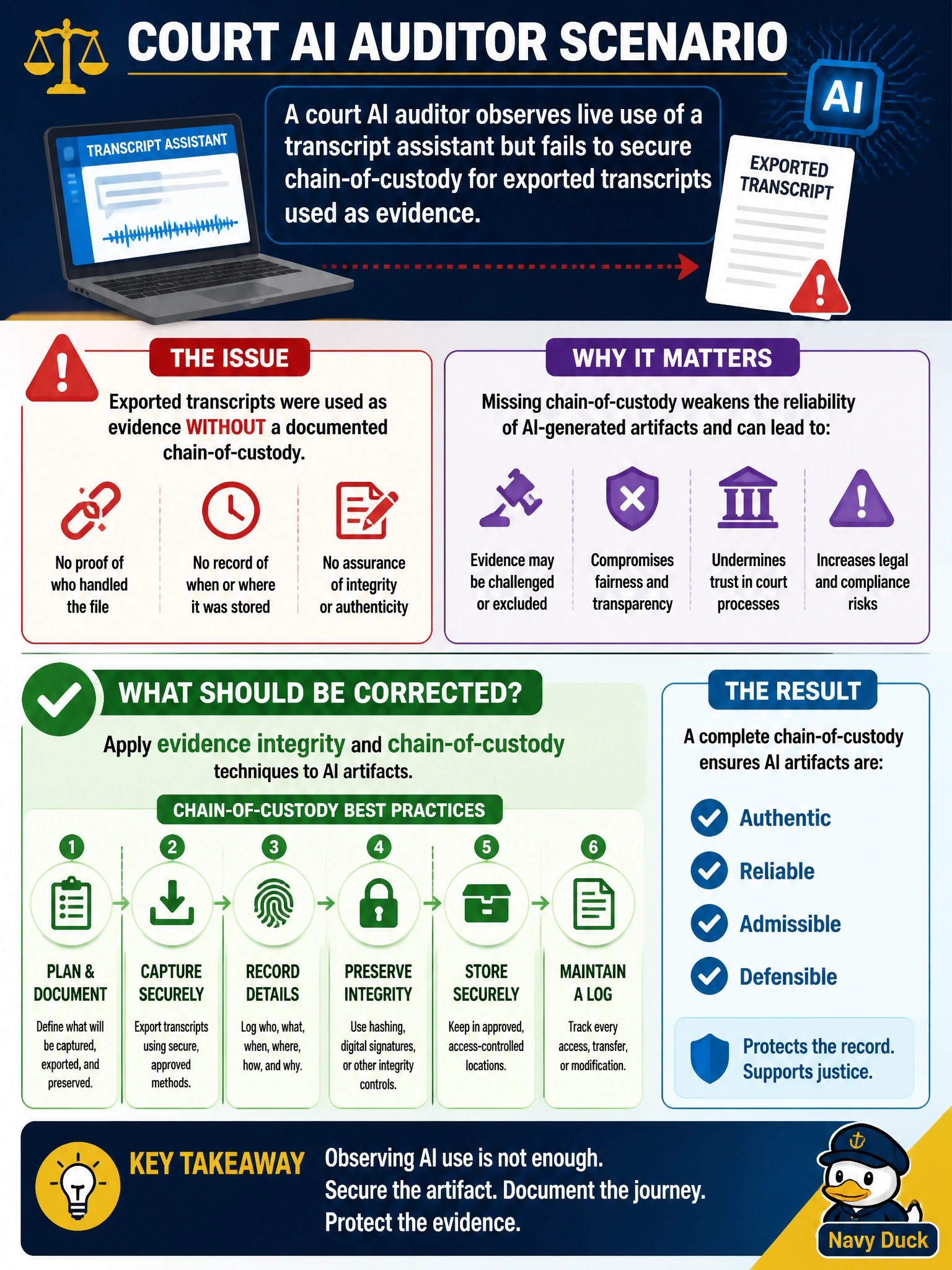
A court AI auditor observes live use of a transcript assistant but fails to secure chain-of-custody for exported transcripts used as evidence. What should be corrected?
Select an answer to reveal the explanation.
Short Explanation
If the export can wander without a custody trail, the evidence softens. Treat AI transcripts like other sensitive audit artifacts — control the handoffs. Taking observation notes won't fix broken custody.
Full Explanation
Applying evidence integrity and chain-of-custody techniques to AI artifacts is required because exported court transcripts used as audit evidence can be altered, misplaced, or disclosed improperly if handoffs are uncontrolled. Hashing, inventory logs, access controls, and retention rules preserve authenticity from export through workpaper filing. Observing live use of a transcript assistant is useful context but does not replace custody over the files the auditor will rely on.
Recording live observation notes to document contextual use findings fails because observation notes are only contextual and do not secure chain-of-custody for exported transcripts or prevent alteration, loss, or improper disclosure of evidence. Capturing model version and prompt settings for observed sessions fails because recording configuration details does not establish custody, hashing, or controlled handoffs for the exported transcripts themselves. Comparing transcript accuracy against manual reporter notes for quality review fails because verifying content accuracy does not create a custody trail, apply hashing, or control access to the exported evidence files.
Exam caveat: custody procedures must match sensitivity of court content; oversharing within the audit team can still be a control failure even if hashes exist. Operational check: on export, compute and record hashes, log custodian and transfers, store in approved repositories, and verify hash match before using transcripts as support for court AI findings.