
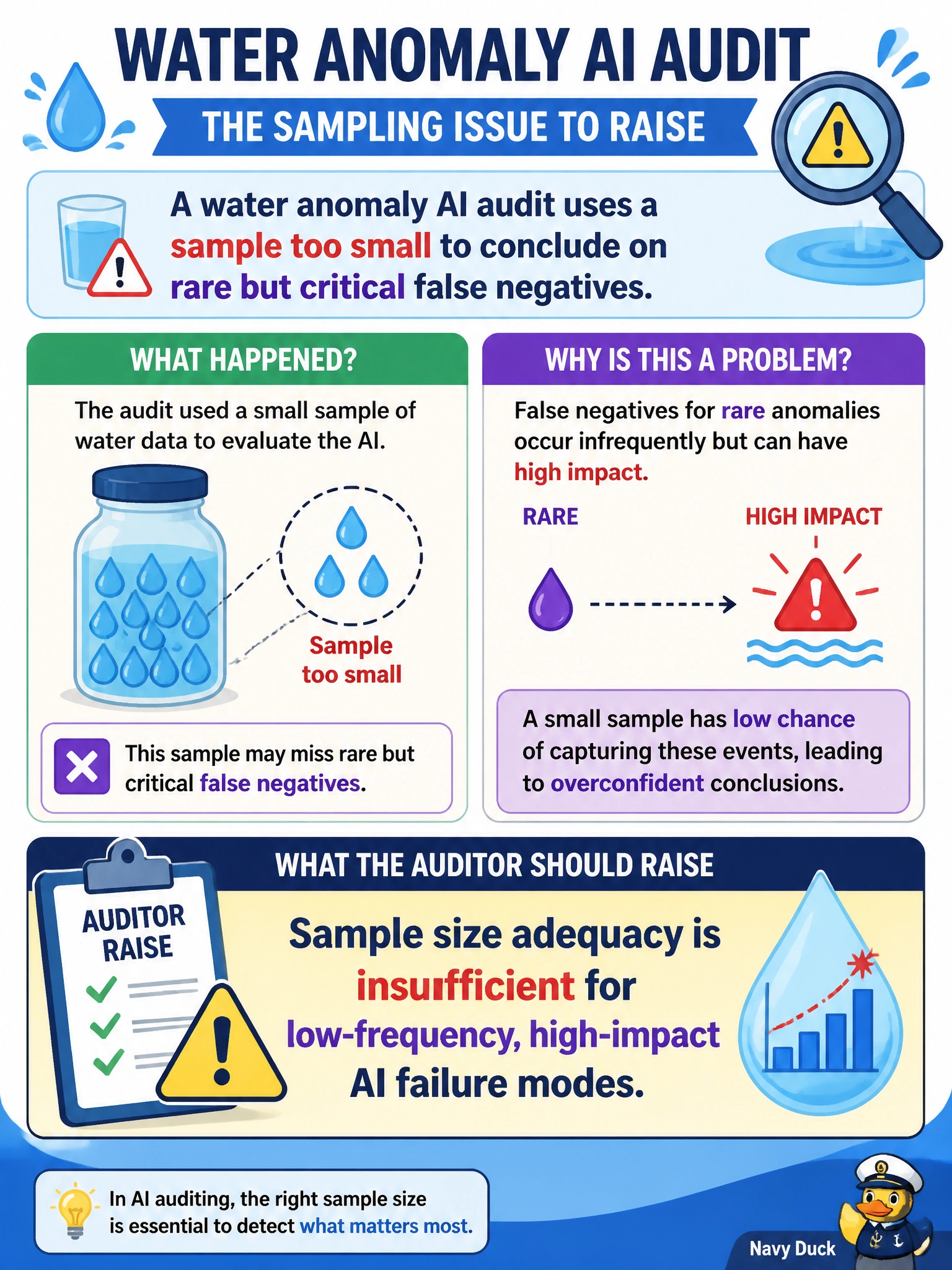
A water anomaly AI audit uses a sample too small to conclude on rare but critical false negatives. What sampling issue should the auditor raise?
Select an answer to reveal the explanation.
Short Explanation
Routine turbidity precision and calibration false-positive review won't catch rare spill misses — a tiny sample won't find them. Size the test for low-frequency, high-impact failures. One busy shift is not the whole calendar.
Full Explanation
Raising sample size adequacy for low-frequency, high-impact AI failure modes works because rare false negatives in water anomaly detection can still drive spills, contamination events, or regulatory breaches. Tiny samples sized for common cases systematically miss infrequent misses. Municipal AI audits must power tests—or use targeted extended observation, synthetic rare-event suites, and historical incident replay—for failure modes whose civic impact is severe despite low base rates.
Claiming sample precision for routine turbidity predictions meets expected confidence thresholds fails: routine precision says nothing about whether the sample is large enough to detect rare, high-impact false negatives. Selecting the sample only from the plant's busiest shift may capture plenty of events overall, but it still does not address whether the sample is large enough across the full operating calendar to catch the rare, high-impact false negatives the audit is questioning. Asserting that sample error review prioritized frequent false positive alerts during calibration fails: frequent false positives during calibration are not the same as rare, high-impact false negatives, and reviewing them does not establish sample adequacy for the latter.
Exam caveat: “adequate” depends on the claim—absolute proof of zero rare failures may be impossible; auditors should align sample/design with the conclusion’s wording and use complementary methods for rare events. Operational check: define the rare high-impact failure mode (e.g., spill false negatives), choose an extended sample, historical replay, or stratified rare-event test set, document power/limitations, and avoid overclaiming from undersized clear-weather samples.