
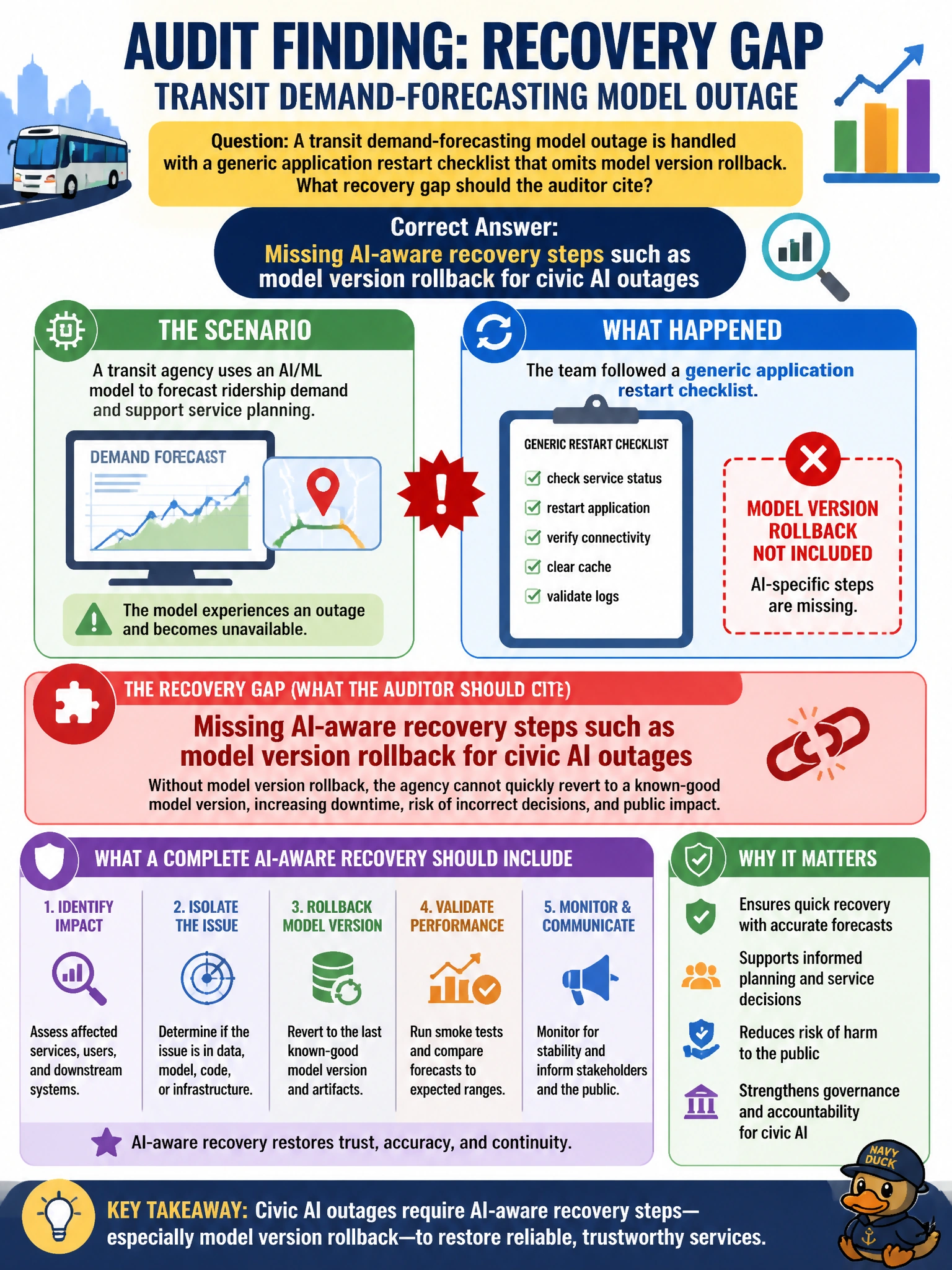
A transit demand-forecasting model outage is handled with a generic application restart checklist that omits model version rollback. What recovery gap should the auditor cite?
Select an answer to reveal the explanation.
Short Explanation
Restarting the app without rolling back a bad model is like rebooting and hoping the wrong map redraws itself. Transit AI recovery needs model-version steps. Fare database drills aren't the AI rollback control you need.
Full Explanation
Citing missing AI-aware recovery steps such as model version rollback for civic AI outages emphasizes that transit demand-forecasting failures may be caused by a defective model artifact, not only a crashed process. The correct gap works because restarting the application can reload the same bad model version and recreate the outage; recovery must include registry actions to restore a known-good model, validate outputs, and only then resume automated forecasting for municipal operations.
Incomplete disaster recovery drills for fare transaction database restoration processes fail as the recovery gap because restoring fare transaction databases does not address the defective demand-forecasting model artifact causing the outage. Delayed escalation to infrastructure support for server hardware failures overnight fails conceptually: server-hardware escalation timing is unrelated to model-version recovery for the forecasting application. Absent validation of timetable data feeds from legacy scheduling systems after restarts fails because data-feed validation does not substitute for rolling back a bad model version in the AI recovery procedure.
Exam caveat: rolling back without checking feature-pipeline compatibility can still produce bad forecasts if the restored model expects different inputs. Operational check: document model rollback steps in the transit IR/continuity checklist, test restoring a prior registry version under time pressure, and record who can authorize AI artifact rollback during forecasting outages.