
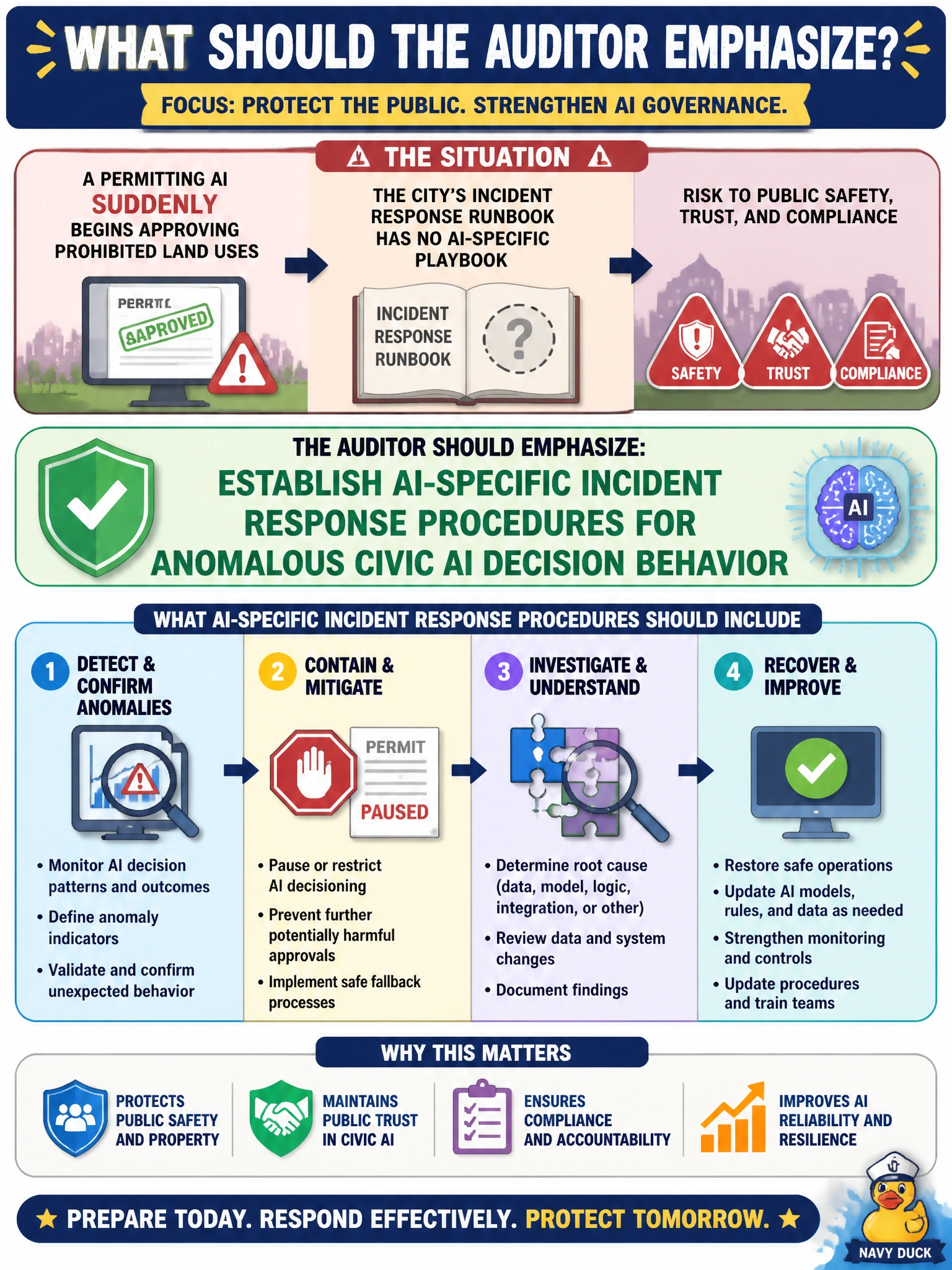
A permitting AI suddenly begins approving prohibited land uses, and the city's incident response runbook has no AI-specific playbook. What should the auditor emphasize?
Select an answer to reveal the explanation.
Short Explanation
When the bot starts rubber-stamping banned uses, generic "reboot the server" runbooks won't cut it. You need AI-specific IR steps for bad decisions. Routing anomalous approvals through general IT workflows or retraining on tainted data isn't a plan.
Full Explanation
Establishing AI-specific incident response procedures for anomalous civic AI decision behavior emphasizes that sudden approval of prohibited land uses is an AI-behavior incident, not only an infrastructure outage. The correct emphasis works because containment may require disabling the model path, forcing human review, rolling back versions, and preserving decision logs—steps generic "reboot the app" runbooks omit. Municipal IR must define roles, severity, and actions for harmful or anomalous AI decisions in permitting.
Routing anomalous permit approvals through existing general IT incident handling workflows fails because generic IT runbooks are built for outages and configuration errors, not anomalous civic AI decisions; they lack the model-path disabling, forced human review, version rollback, and permit-specific decision-log preservation this incident requires. Initiating model retraining on recent permit approval data that includes the anomalous decisions fails because it risks baking the prohibited approvals into the model and does nothing to stop harmful permits from being issued while retraining runs; the incident needs immediate AI-specific containment and governance, not retraining on contaminated data. Continuing incident logging and writing a summary report afterward preserves a record, but it still does not establish the AI-specific containment, rollback, and human-override steps the permitting incident actually needs while prohibited approvals keep happening.
Exam caveat: IR playbooks that stop at "turn it off" without communication to affected applicants and oversight bodies leave residual civic harm unaddressed. Operational check: publish an AI decision-incident playbook (containment, rollback, human override, evidence retention, stakeholder notice), exercise it, and link permitting AI alerts to on-call IR ownership.