
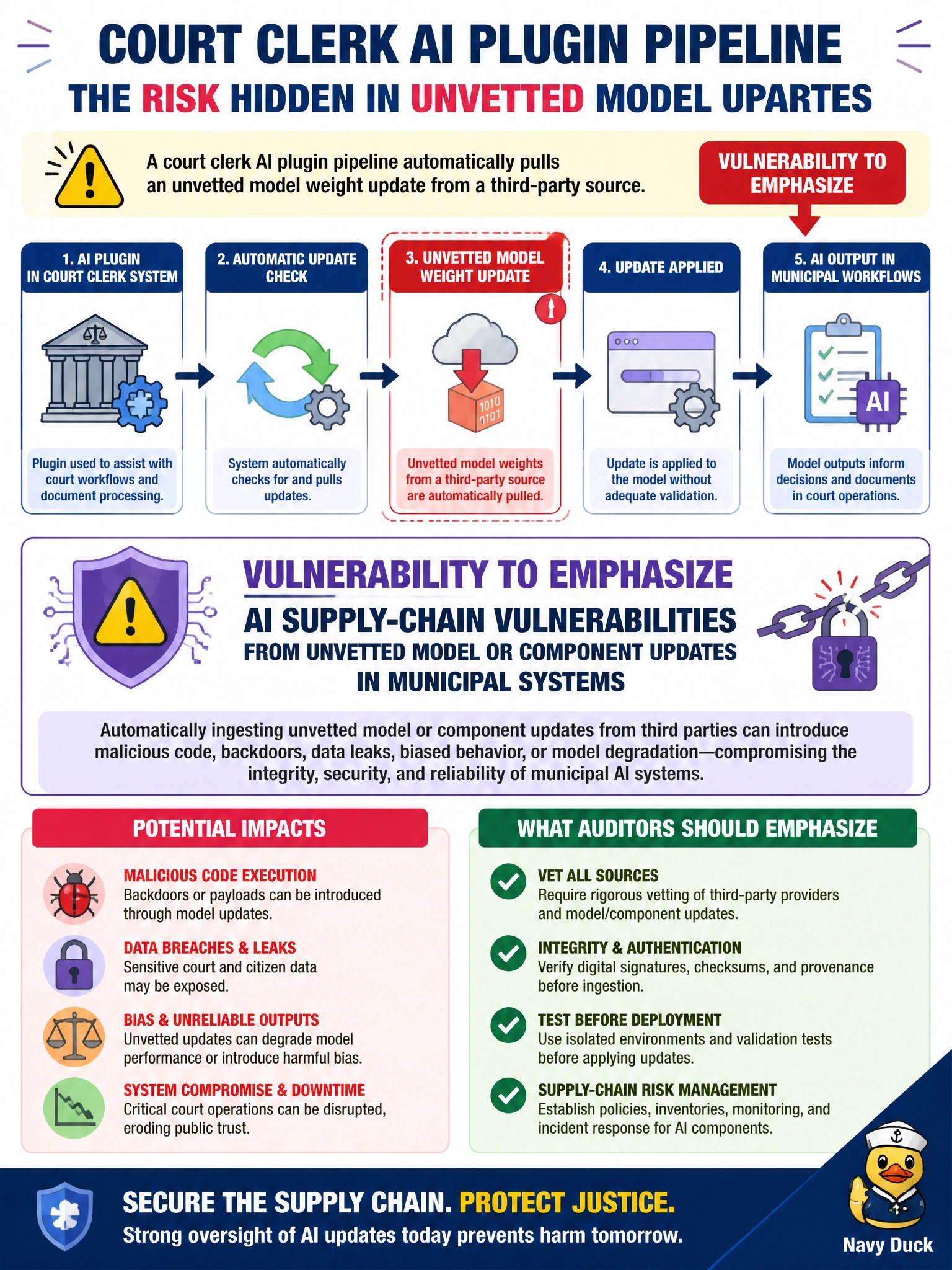
A court clerk AI plugin pipeline automatically pulls an unvetted model weight update from a third-party source. What vulnerability should the auditor emphasize?
Select an answer to reveal the explanation.
Short Explanation
Auto-grabbing mystery model weights is a supply-chain foot-gun for court AI. Vet and pin trusted components before they touch clerk workflows. Delayed patching, weak archive encryption, and prompt injection are real issues, but they're not the unvetted weights supply-chain finding.
Full Explanation
Emphasizing AI supply-chain vulnerabilities from unvetted model or component updates in municipal systems highlights integrity risk when court clerk AI plugins auto-pull third-party weights. The correct vulnerability works because untrusted model artifacts can introduce backdoors, degraded behavior, or malicious tooling into judicial workflows without the change controls applied to ordinary software packages. Municipal AI supply chain assurance must cover models, embeddings, plugins, and update channels—not only traditional OS packages.
Delayed patching of operating system flaws on shared courthouse clerk workstations fails as the vulnerability because OS patch cadence, while important, does not address the automatic ingestion of unvetted third-party model weights into the court clerk AI pipeline. Weak encryption of stored court transcripts in the legacy municipal archive database fails conceptually: data-at-rest encryption in an archive is unrelated to the supply-chain risk of automatically pulling unvetted model weights into live AI plugins. Prompt injection vulnerabilities from unvalidated litigant filings processed by court AI assistants fail because, although this is an AI risk, it concerns input validation at inference time rather than the compromise of model artifacts through the update supply chain.
Exam caveat: "vendor signed" updates still need provenance checks if signing keys, mirrors, or plugin intermediaries are weak. Operational check: disable automatic unvetted pulls, require registry allowlisting and integrity verification before court AI components update, and document change approval for model or plugin promotions that touch clerk workflows.