
A parks department computer-vision project uses the same images for both training and final test scoring. What testing weakness should the auditor highlight?
Select an answer to reveal the explanation.
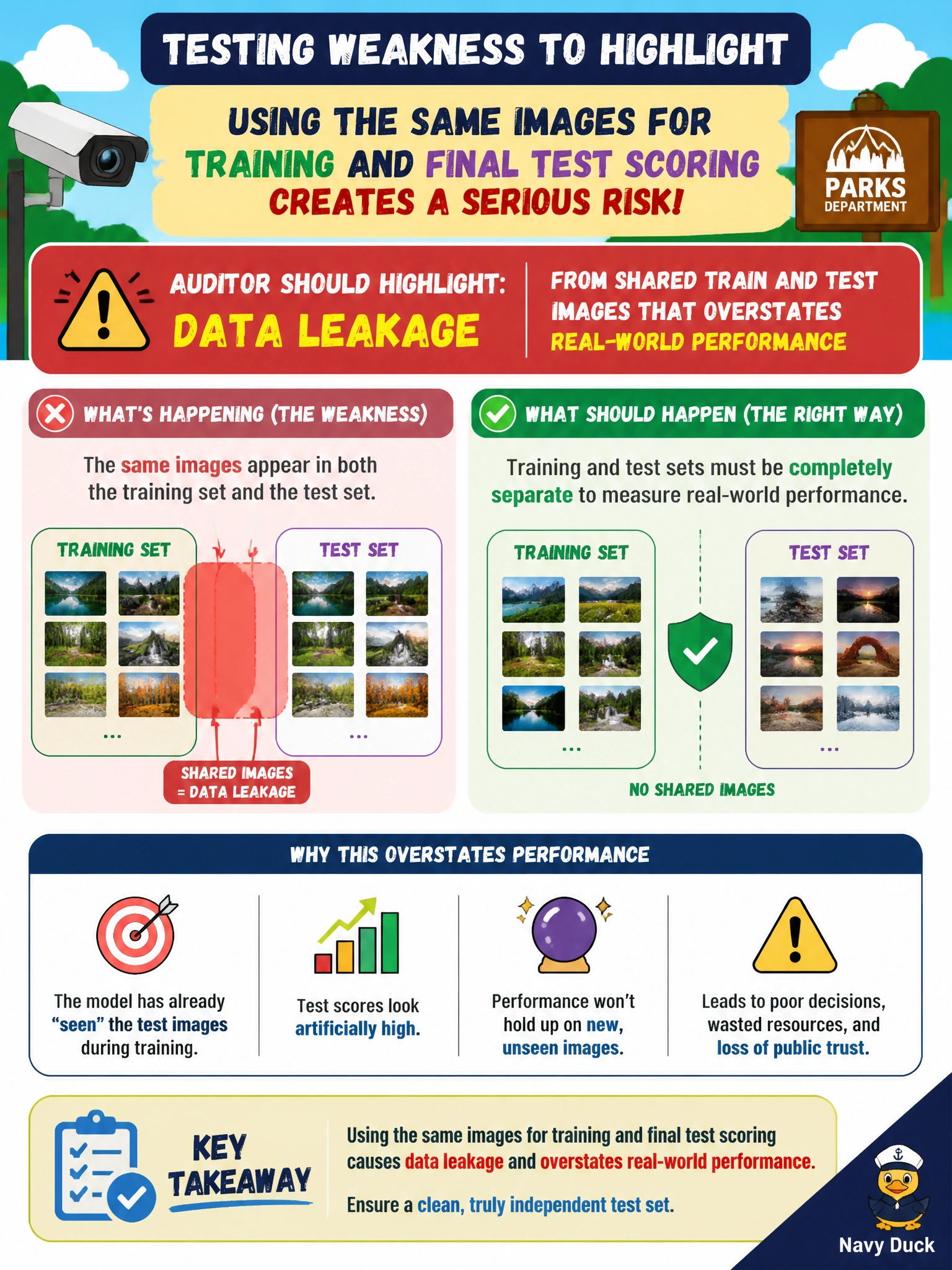
Short Explanation
If the model already memorized the test pictures, the score is a pep rally, not a road test. Keep train and holdout images separate so parks AI results mean something outdoors. Seasonal drift, annotation inconsistency, or a small model miss the real problem: you're scoring on data the model already saw.
Full Explanation
Highlighting data leakage from shared train and test images that overstates real-world performance emphasizes independence of evaluation data for municipal computer-vision projects. The correct finding works because scoring a model on images it already saw during training measures memorization more than generalization; parks AI that appears accurate on leaked test images may fail on new cameras, seasons, lighting, or park layouts. Auditors should require separated holdout or validation sets and evidence that evaluation conditions represent outdoor municipal operations.
Concept drift from gradual seasonal vegetation change fails as the highlighted weakness because it describes real-world performance decay after deployment, not inflated scores caused by scoring on training images; it does not explain why the current test results are invalid. Annotation inconsistency across labeling teams is not the highlighted testing weakness here—label noise affects training data quality, but the defect in this scenario is shared train/test membership that invalidates the final score. Underfitting from small model capacity misstates the issue: limited capacity would constrain learning generally, but the testing weakness here is that the same images appear in both train and test, inflating apparent performance.
Exam caveat: mere file-path separation is insufficient if near-duplicates, temporal siblings, or augmented copies of training images leak into the holdout. Operational check: verify dataset lineage (split method, overlap checks, duplicate detection), store hash inventories of train versus test sets, and require re-evaluation on freshly collected park imagery before accepting published accuracy for go-live decisions.