
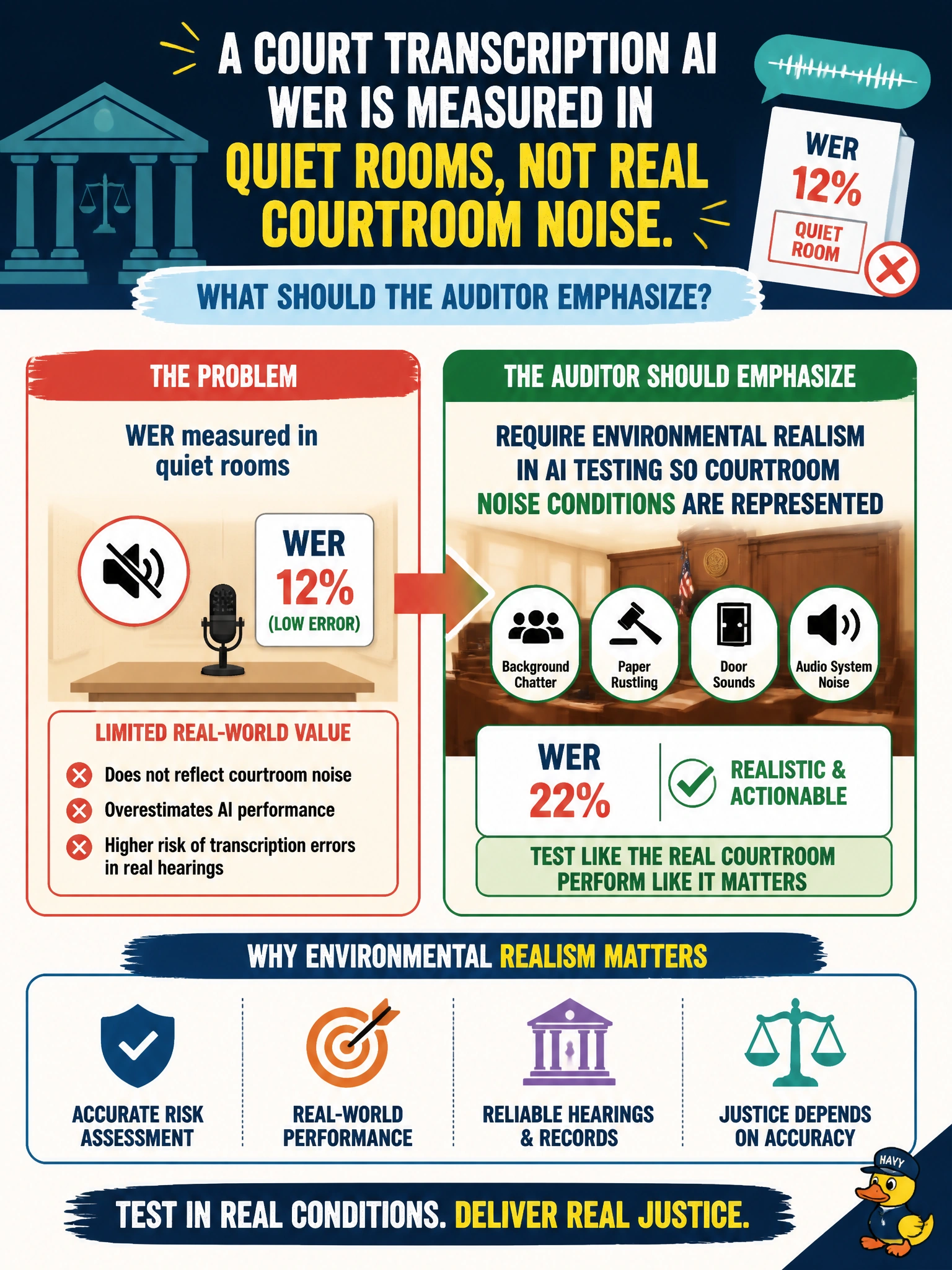
A court transcription AI WER is measured in quiet rooms, not real courtroom noise. What should the auditor emphasize?
Select an answer to reveal the explanation.
Short Explanation
Quiet-room word-error rates are like practicing piano in a library then performing at a parade. Test in real courtroom noise. Lab silence is not municipal reality.
Full Explanation
Court transcription AI evaluated only in quiet rooms may report optimistic word error rates that collapse under real courtroom noise—overlapping speech, HVAC, movement, gallery sound, and variable microphones. Environmental realism is a key AI testing technique for municipal deployments. The auditor should emphasize testing under representative courtroom acoustic conditions so WER and related quality metrics reflect live hearings, not lab silence.
Accepting quiet-room WER as sufficient for all courtroom deployments fails by extrapolating from non-representative conditions to justice settings where transcript errors can affect records and fairness. Testing only on studio audio because noisy courts are "edge cases" fails—live hearings are the primary environment, not an edge case. Ignoring lab-versus-live acoustic differences fails the validity of the entire test program for municipal justice use.
Exam caveat: AAIA testing includes environmental and operational realism, not only clean-benchmark scores. Operational check: require WER and critical-term error results on courtroom-noise corpora or supervised pilot recordings before relying on transcription AI in live municipal hearings; quiet-room-only evidence is incomplete assurance.