
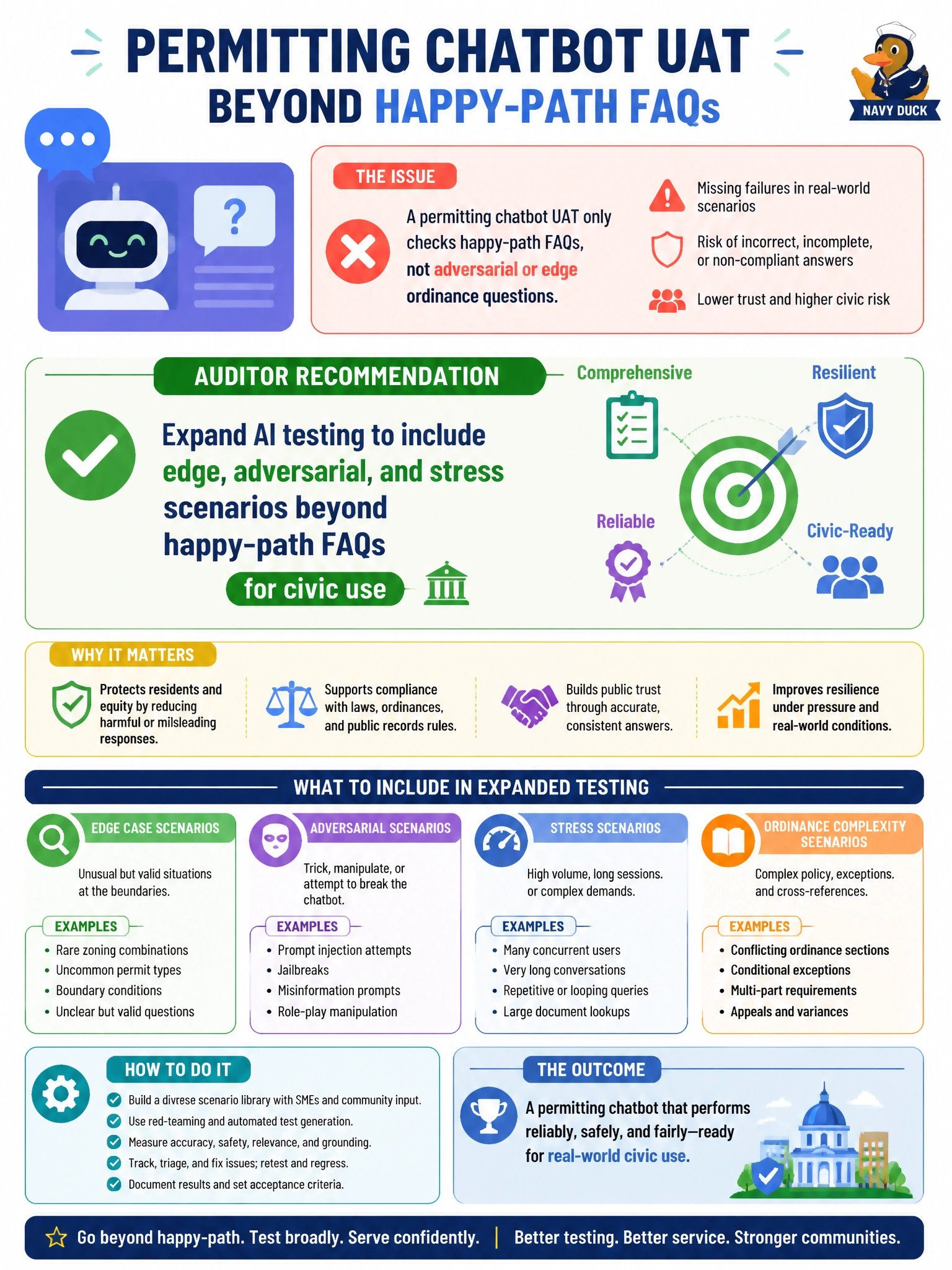
A permitting chatbot UAT only checks happy-path FAQs, not adversarial or edge ordinance questions. What should the auditor recommend?
Select an answer to reveal the explanation.
Short Explanation
If you prioritize happy-path FAQ pass rates for UAT sign-off while scheduling edge testing for a later civic release phase, it's a dress rehearsal that never throws a curveball. Test edge and adversarial ordinance questions too. Vendor demo script results aren't the formal UAT record a city needs.
Full Explanation
Permitting chatbots face ordinance edge cases, adversarial prompts, and stressed or incomplete phrasing from real residents. User acceptance testing limited to happy-path FAQs understates production risk for civic legal guidance. The auditor should recommend expanding AI testing to edge, adversarial, and stress scenarios for civic use so incorrect legal guidance, policy evasion attempts, and brittle retrieval are found before go-live.
Prioritizing happy-path FAQ pass rates for UAT sign-off while scheduling edge testing for a later civic release phase fails by trading assurance for calendar convenience and deferring adversarial coverage. Testing ordinance edge cases only during development and flagging ambiguous ones for manual review still skips the adversarial and stress testing that UAT itself needs before go-live; development-time spot checks are not the same as a municipal acceptance test pack. Adopting vendor demo script results as the formal municipal UAT record for civic audit traceability fails because demos are curated sales artifacts, not city-owned adversarial evidence tied to local codes.
Exam caveat: AI testing techniques for AAIA include edge, adversarial, and stress coverage beyond functional happy paths. Operational check: require a municipal test pack with adversarial ordinance questions, explicit failure criteria, and business sign-off before production; reject go-live evidence that consists only of vendor demo script results or scripted FAQ walks.