
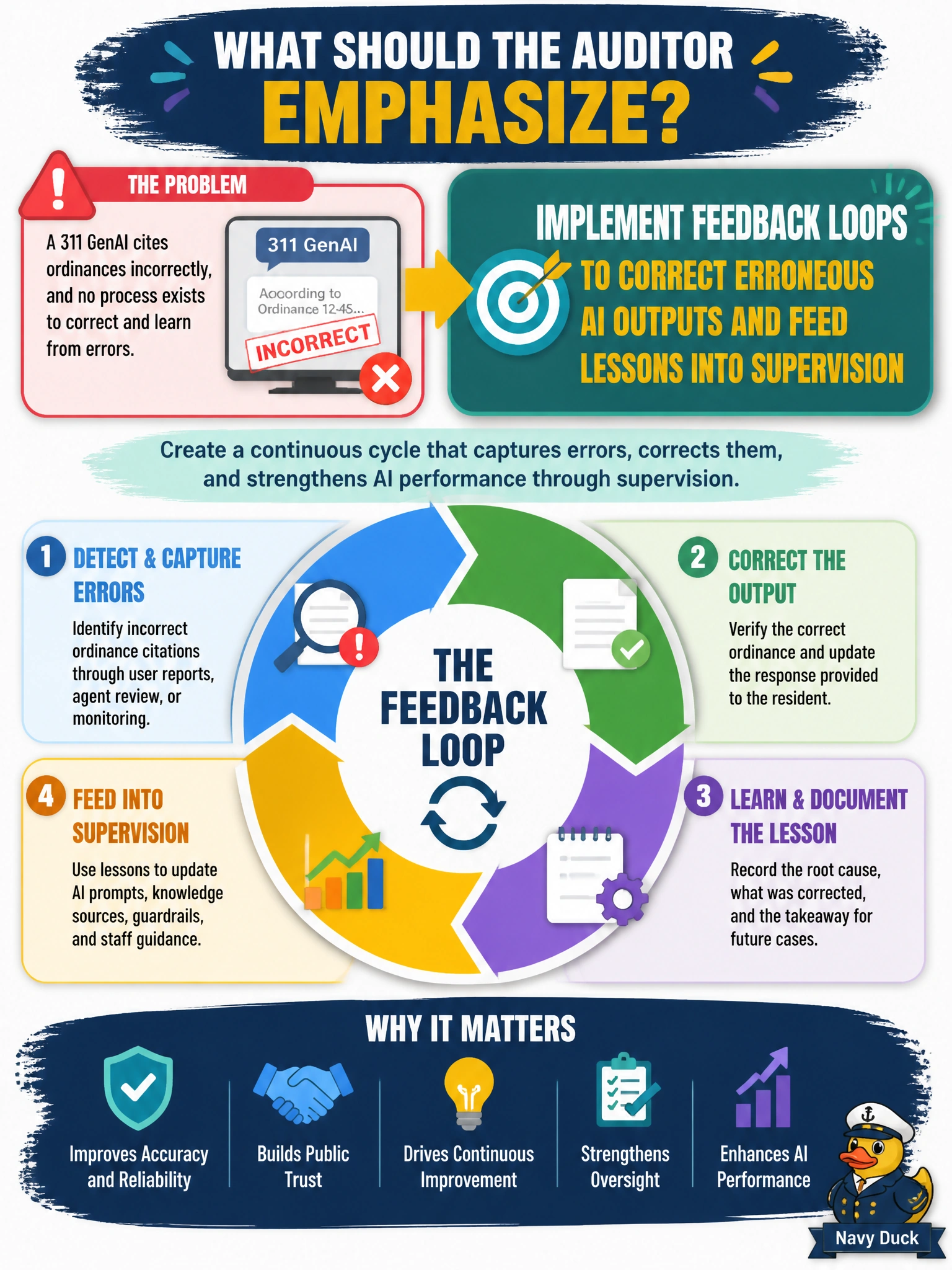
A 311 GenAI cites ordinances incorrectly, and no process exists to correct and learn from errors. What should the auditor emphasize?
Select an answer to reveal the explanation.
Short Explanation
Wrong ordinance cites from 311 are like handing out bad street maps. Build a feedback loop that fixes answers and teaches the system. Routing every flagged error to legal staff fixes one case, but it won't teach the system or stop the next wrong cite.
Full Explanation
When a 311 GenAI cites ordinances incorrectly, residents may act on false legal information about city rules. Supervision requires more than detecting the error once: the municipality needs feedback loops that correct the live output path and feed lessons into ongoing oversight—content fixes, retrieval updates, prompt or tool changes, and monitoring for recurrence. The auditor should emphasize implementing those feedback loops as core supervision of civic AI outputs so wrong citations do not linger as de facto city guidance.
Publishing periodic transparency reports summarizing ordinance citation accuracy fails because it only describes trends after errors occur; wrong citations stay live and nothing flows back into the AI output, content fixes, or ongoing supervision. Expanding the retrieval index with additional ordinance archives may broaden coverage, but it does not correct the specific erroneous citations already in use or close the loop from error reports back into content, retrieval, prompts, or supervision. Routing flagged citation errors to legal staff for individual case correction and resident notification fixes one resident at a time, but it does not feed lessons into the AI's knowledge, retrieval, prompts, or monitoring, so the same errors can recur.
Exam caveat: AAIA expects closed-loop correction and learning from erroneous outputs, not cosmetic KPI hygiene. Operational check: trace an ordinance-citation error from resident or staff report through corrected knowledge or retrieval, retest of the same intent, and updated supervision metrics—confirm the loop exists and is used, not merely promised in a policy slide.