
A library embedding model swap invalidates prior evaluation results, but no re-approval is triggered. What should the auditor recommend?
Select an answer to reveal the explanation.
Short Explanation
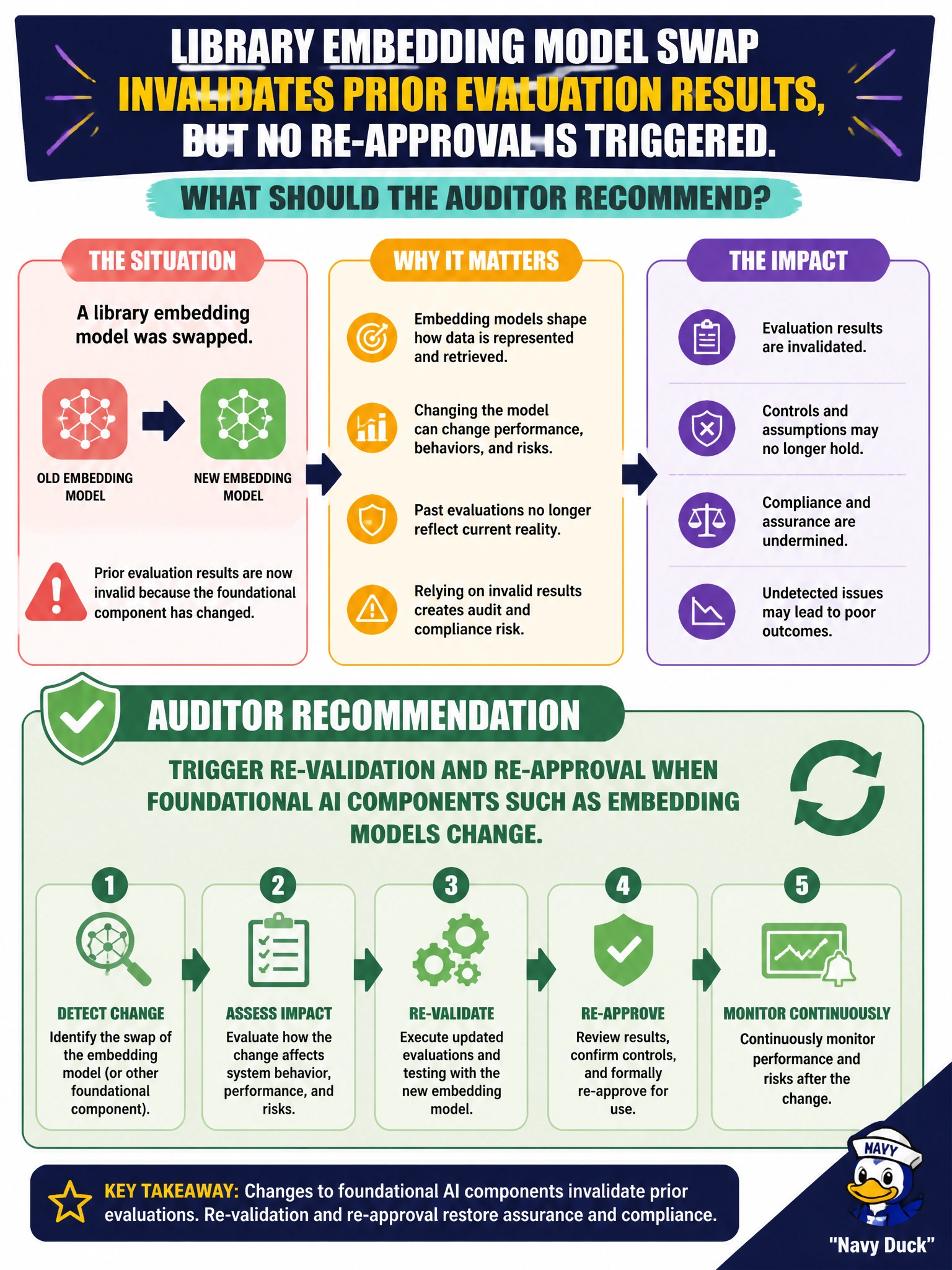
You can't fix obsolete test results just by documenting the replacement embedding version in the inventory and keeping current approval. Foundational component changes need re-validation and re-approval. You can't treat scheduling re-validation during the annual review as a minor delay; it leaves the library serving answers built on obsolete evidence.
Full Explanation
In a library retrieval stack, an embedding model defines the vector space used for search and RAG. Swapping embeddings can invalidate prior evaluation results, relevance rankings, and risk conclusions even if the application UI looks unchanged. The auditor should recommend triggering re-validation and re-approval when foundational AI components such as embedding models change, so the library does not rely on obsolete evidence for municipal content quality and safety. Documenting the replacement embedding version in the inventory and retaining current approval for library search fails because a foundational component change invalidates prior evaluation results, so merely recording the swap and keeping the old approval leaves the library relying on obsolete evidence for municipal content quality and safety. Reviewing an embedding swap for API compatibility while assuming retrieval quality remains stable fails conceptually: a compatible interface says nothing about whether the new vector space preserves relevance rankings, so retrieval quality still needs its own re-validation, not an assumption. Scheduling re-validation during the next annual review cycle to reduce disruption to library services fails because an embedding model swap invalidates prior evaluation results immediately; waiting for an annual review means the library continues to serve public-facing answers based on obsolete evidence and invalid risk conclusions, which violates municipal content quality and safety requirements. Exam caveat: foundational component changes (embeddings, base models, critical prompts/tools) are classic re-validation triggers on AI change exams. Operational check: after an embedding change, confirm a new evaluation pack, comparison to prior metrics, and recorded re-approval by the municipal AI owner before the library assistant returns to unrestricted production use.