
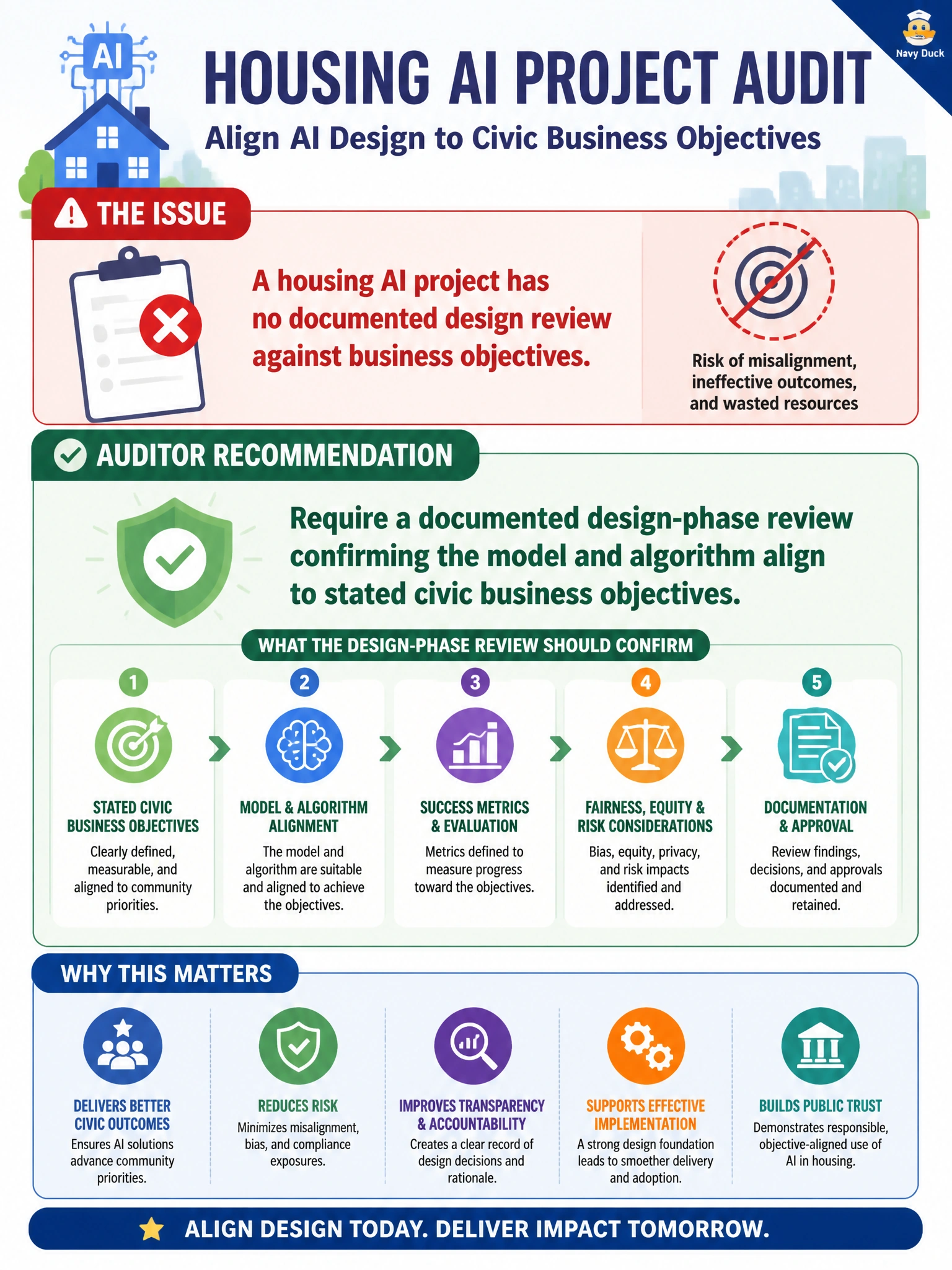
A housing AI project has no documented design review against business objectives. What should the auditor recommend?
Select an answer to reveal the explanation.
Short Explanation
If nobody checked the blueprint against the housing goals, the model may optimize the wrong thing. Do a design review before build locks in the wrong objective. Vendor technical specs and model cards don't prove your civic objectives are baked in.
Full Explanation
Requiring a documented design-phase review confirming that the housing AI model and algorithm align to stated civic business objectives works because methodology expects intentional fit between authorized outcomes and technical design. Housing authorities optimize for eligibility fairness, waitlist integrity, fraud reduction, or placement speed—proxies chosen without review can silently redefine policy. A design review records objectives, success metrics, constrained features, and known trade-offs before build locks them in. The correct control prevents optimizing the wrong thing under the banner of “housing AI.” Documenting a post-deployment performance review linking model outputs to housing allocation service metrics fails because checking performance after deployment is not a design-phase control; it cannot confirm that the model and algorithm were aligned to civic business objectives before build locked them in. Accepting vendor technical specifications and model cards as confirmation of civic business objective alignment fails because vendor documentation describes product features, not whether this municipality’s authorized housing objectives are encoded in the detailed design. Treating approved procurement business case sign-off as documented evidence that detailed design reflects civic housing priorities fails because procurement sign-off is a purchasing decision, not a design-phase review confirming that the model and algorithm align to stated civic business objectives.
Exam caveat: objectives themselves can be contested across agencies; the review should capture authorized decision-makers and unresolved conflicts rather than papering over disagreements with vague mission language. Operational check: produce a signed design-alignment memo linking each primary model output to a stated business objective and metric, and halt build tickets until that review artifact exists in the project record.