
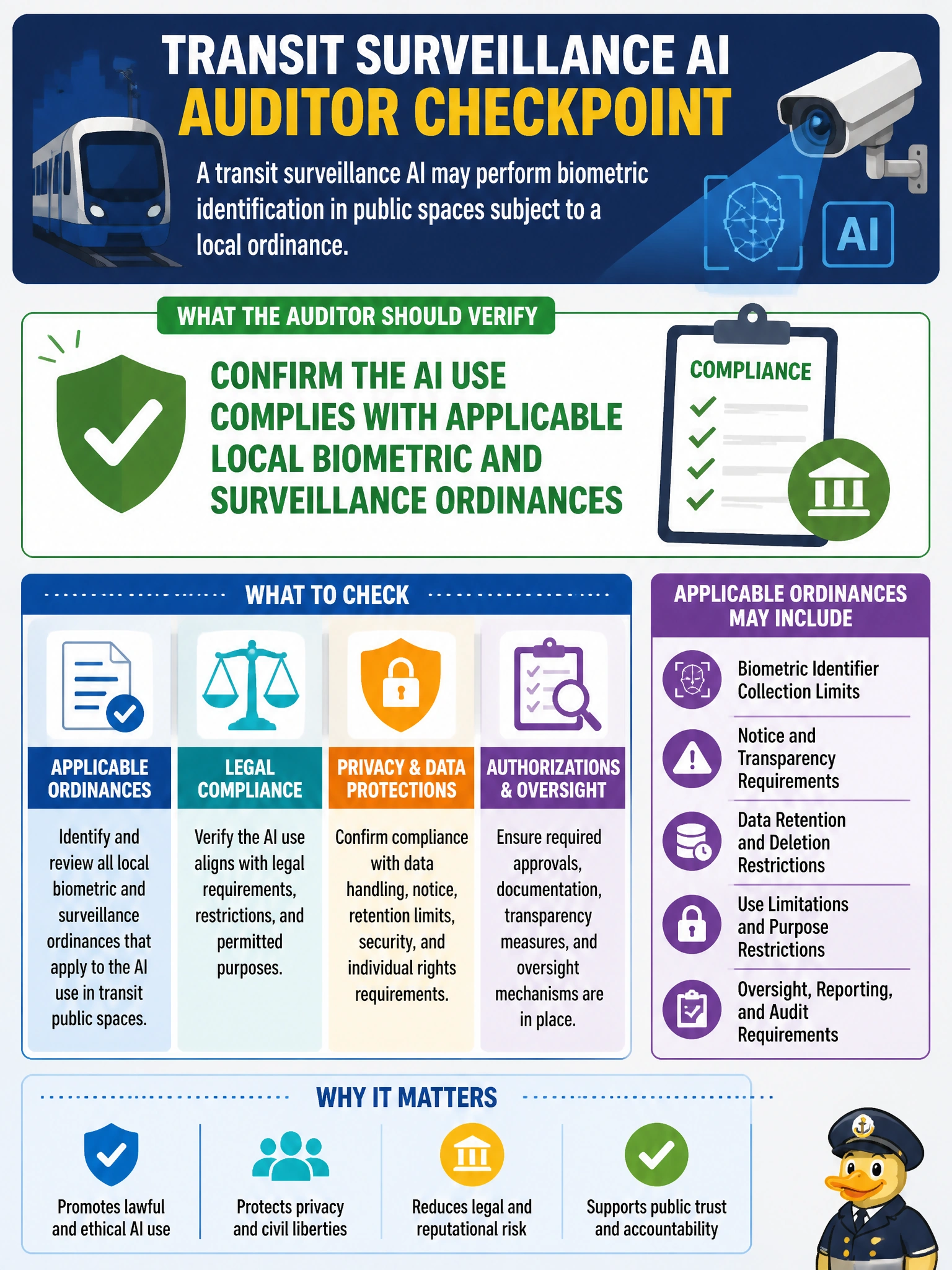
A transit surveillance AI may perform biometric identification in public spaces subject to a local ordinance. What should the auditor verify?
Select an answer to reveal the explanation.
Short Explanation
Local rules can slam the brakes on biometric matching even when the tech works. Read the ordinance and prove the transit AI fits — or redesign it. Validating a vendor's accuracy report doesn't clear you under the local ordinance.
Full Explanation
A transit surveillance AI that may perform biometric identification in public spaces is often constrained by local biometric and surveillance ordinances even when federal law is silent or less specific. The auditor should verify that the AI use complies with applicable local biometric and surveillance ordinances because municipal deployments must meet the jurisdiction's enforceable limits on notice, purpose, retention, location, and prohibited practices before or during operation. Confirming that the AI use meets federal biometric requirements for transportation systems fails by concept: federal transportation requirements do not replace the auditor's duty to verify compliance with applicable local biometric and surveillance ordinances, and meeting a federal standard does not by itself satisfy stricter local limits. Validating vendor-provided accuracy reports for biometric matching in crowded stations fails by concept: accuracy reports address technical performance, not whether the deployment satisfies the enforceable limits of the applicable local biometric and surveillance ordinance. Reviewing published transit privacy signage describing biometric data collection practices fails by concept: checking signage is only one piece of notice and does not verify that the AI use complies with the full scope of applicable local biometric and surveillance ordinance requirements. Exam caveat: AAIA regulatory items reward confirming applicable local biometric/surveillance requirements for civic AI—not swapping in federal transportation requirements, vendor accuracy reports, or signage review as a substitute for that local-ordinance check. Operational check: inventory biometric identification features in the transit system, map them to ordinance requirements, obtain legal sign-off, configure technical and process controls to match legal limits, and retain evidence of compliance review before expansion.