
A housing AI shares case notes with a vendor whose subprocessor list audit cannot obtain. What is the primary privacy-governance concern?
Select an answer to reveal the explanation.
Short Explanation
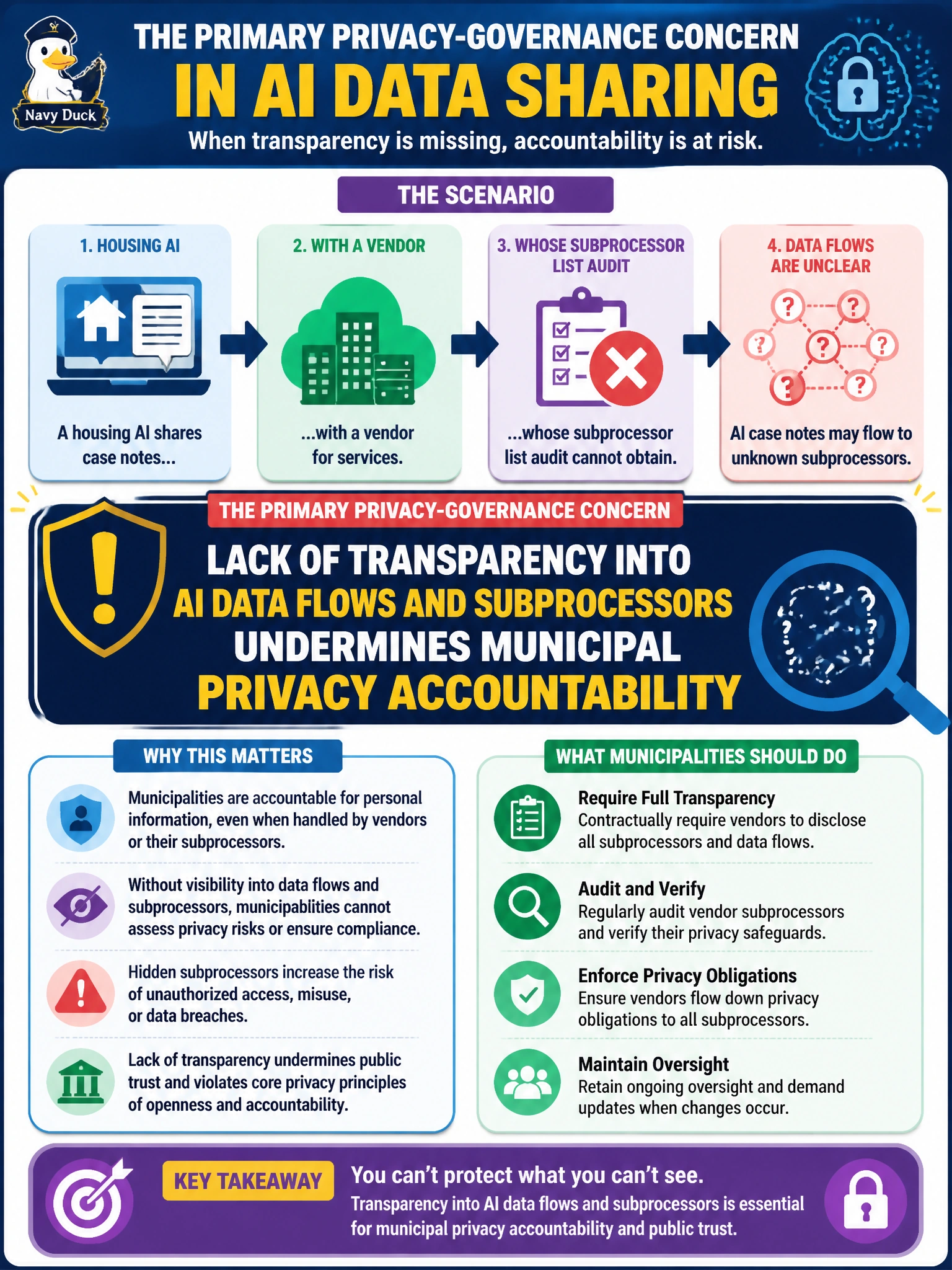
If you cannot see who else touches case notes, you cannot govern them. Opaque subprocessors break the chain of privacy accountability for housing AI. Demand the map of data flows.
Full Explanation
The primary privacy-governance concern is that lack of transparency into AI data flows and subprocessors undermines municipal privacy accountability. When housing AI shares case notes with a vendor and audit cannot obtain the subprocessor list, the housing authority cannot know who else processes sensitive resident data, in which jurisdictions, or under what safeguards. Privacy programs require mapped flows—including downstream processors—not only the effectiveness of prime vendor encryption controls for stored municipal housing case notes.
Focusing on the effectiveness of prime vendor encryption controls for stored municipal housing case notes misses the point because encryption at rest does not reveal who else receives case notes or where they flow. Claiming completeness of redaction rules applied in vendor analytics portal for municipal case notes fails conceptually: redaction completeness does not authorize unknown onward transfers or replace contractual transparency. Relying on the currency of annual vendor security questionnaire for continuous monitoring of evolving AI data sharing chains fails because questionnaire currency is not auditable evidence of subprocessor flow control or legal commitments.
Exam caveat: a stale subprocessor list that is not contractually required to stay current can create false assurance; update obligations and notification rights matter as much as the initial list. Operational check: require an authoritative subprocessor inventory and data-flow diagram for the housing AI before continued sharing of case notes, and suspend or limit transfers if the vendor cannot produce them.