
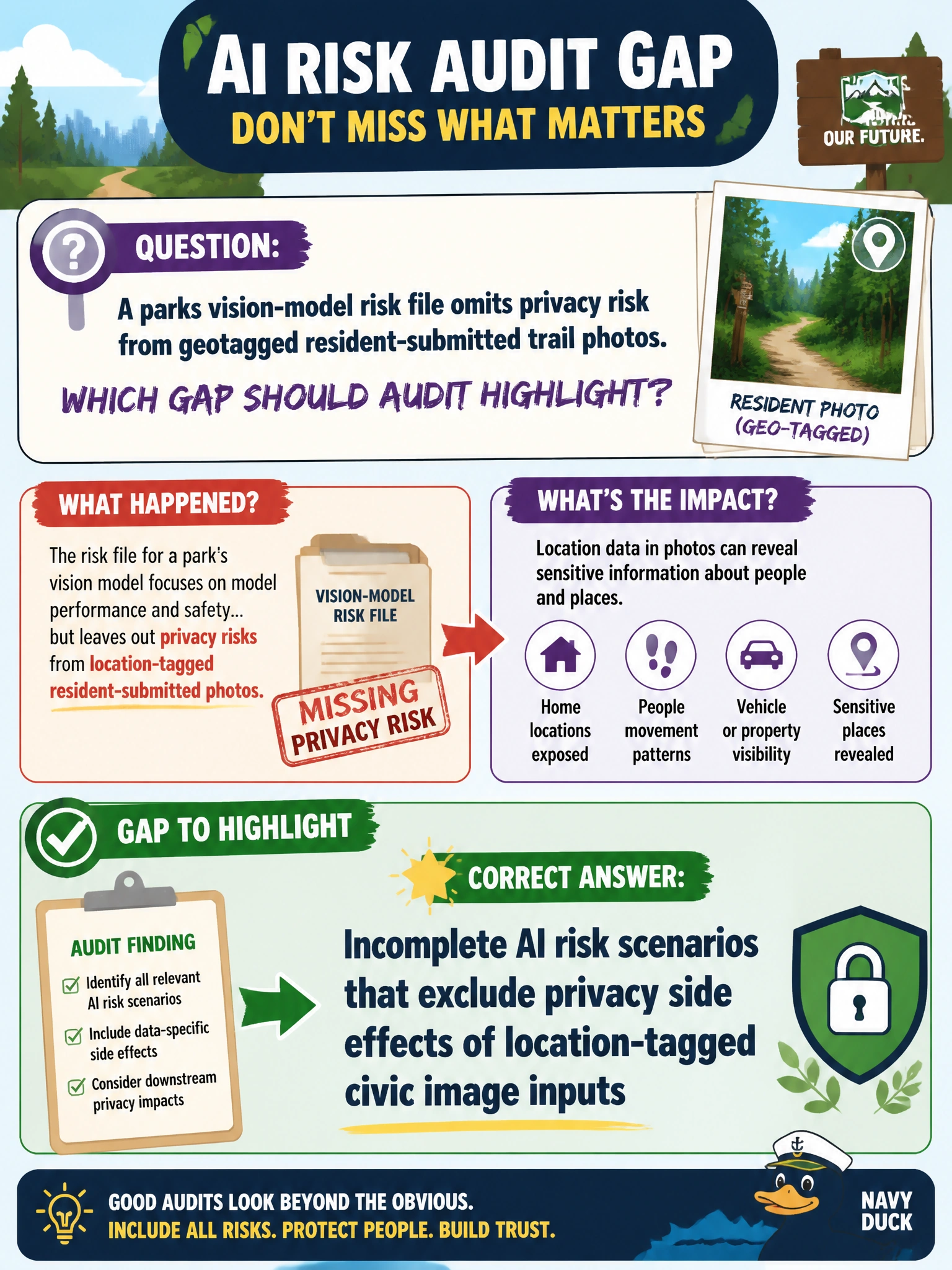
A parks vision-model risk file omits privacy risk from geotagged resident-submitted trail photos. Which gap should audit highlight?
Select an answer to reveal the explanation.
Short Explanation
A trail selfie can pin someone's home path on a map — that is privacy risk, not just "mud detection." If the risk file skips geotagged side effects, the scenario list is incomplete. Call that out.
Full Explanation
Audit should highlight incomplete AI risk scenarios that exclude privacy side effects of location-tagged civic image inputs. Parks vision models trained or inferred on geotagged resident-submitted trail photos can reveal where people go, when they visit, and patterns near homes or sensitive sites. Omitting privacy from the risk file understates residual risk even when the stated task is classifying mud and cracks.
Arguing that the issue is untested trail defect classification accuracy thresholds for mud and crack detection models is off-target: accuracy thresholds concern model performance, whereas the audit gap is the missing privacy risk scenario for location-tagged civic image inputs. Citing incomplete data retention schedules for archived civic trail inspection image collections does not address the finding: retention is a data-governance control, but the missing piece in the risk file is the privacy scenario tied to geotagged resident-submitted photos. Pointing to limited demographic representation in trail image training sets affecting defect detection fairness across parks identifies a different concern; it does not replace the omitted privacy risk scenario for geotagged civic images that the audit should flag.
Exam caveat: stripping EXIF in one pipeline stage does not close the scenario if other stages retain originals or if coarse location remains in filenames and tickets. Operational check: review the parks AI risk scenarios for explicit geotag/location privacy entries, data-handling controls (stripping, retention, access), and confirm resident photo workflows match those controls in practice.