
A city emergency AI dispatcher-assist tool has no documented risk appetite thresholds. What should leadership establish before wider use?
Select an answer to reveal the explanation.
Short Explanation
Emergency assist without appetite limits is a gas pedal with no redline. Leaders need written thresholds for when AI error is too much and when humans must take over. High-stakes civic dispatch is exactly where appetite belongs on paper.
Full Explanation
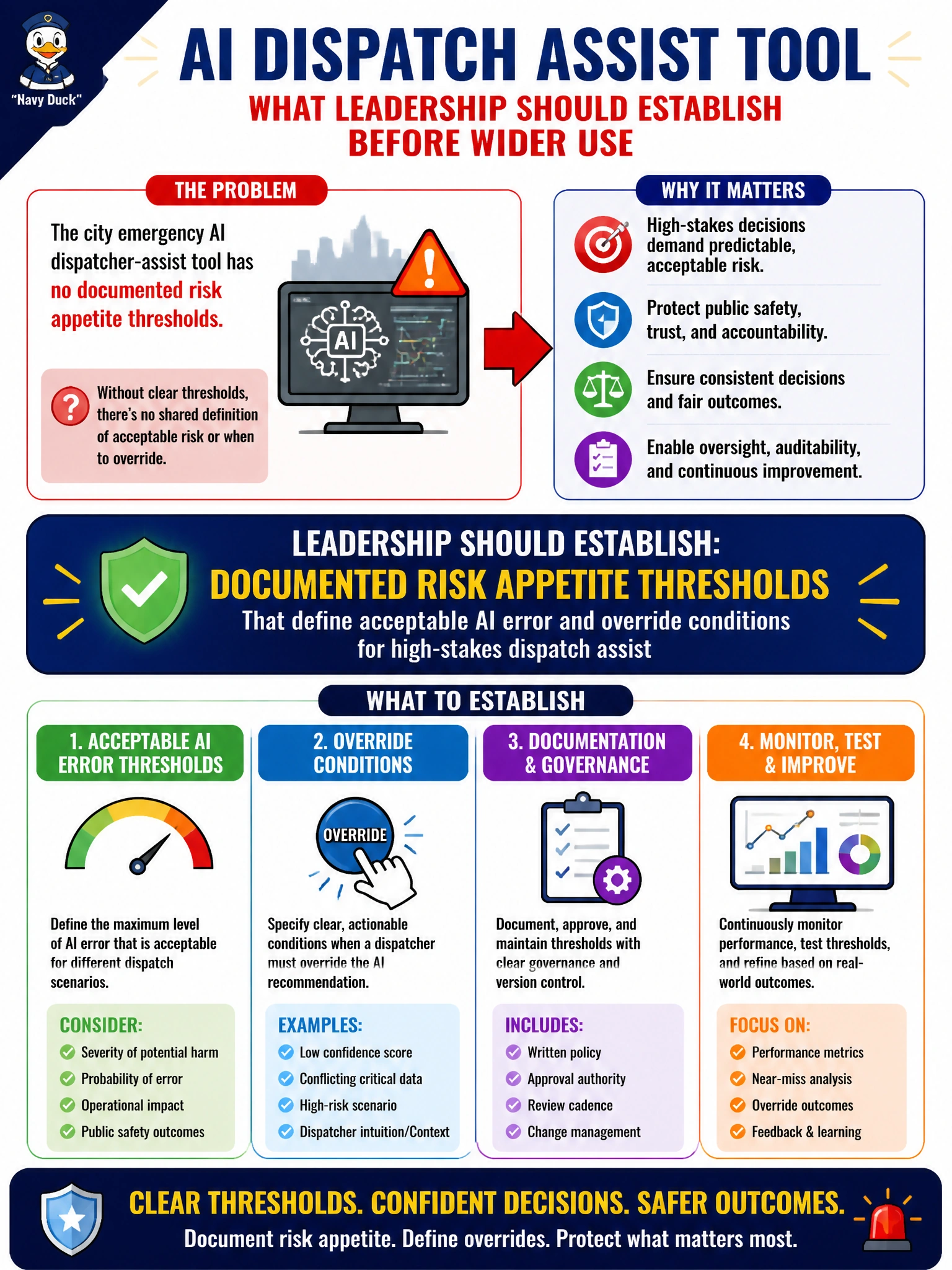
Leadership should establish documented risk appetite thresholds that define acceptable AI error and override conditions for high-stakes dispatch assist before wider use. Emergency dispatcher-assist AI can influence life-safety routing; without written thresholds for error tolerance, confidence cutoffs, and mandatory human override, operators lack a shared boundary between automation and human control. Risk appetite converts vague caution into enforceable operating limits for municipal public-safety AI.
Published citywide AI ethics principles describing fairness goals for emergency dispatch support operations fails because general fairness principles do not substitute for specific, documented risk appetite thresholds with numeric error and override limits for high-stakes dispatch. Adopted vendor service level targets for system uptime as the operational tolerance for dispatch decision risk fails conceptually: vendor uptime targets measure system availability, not the acceptable level of AI decision error or mandatory override conditions for life-safety dispatch. Approved detailed post-incident review procedures to evaluate dispatch errors following expanded deployment across districts fails because after-the-fact reviews do not establish the pre-deployment risk appetite thresholds that must bound AI error and override conditions before wider use.
Exam caveat: thresholds that are documented but not instrumented in the tool (no confidence gates, no forced override UX) do not operationalize appetite. Operational check: verify a signed risk-appetite statement for dispatch-assist AI with numeric or categorical error/override rules, and confirm the production configuration enforces those rules with logged human overrides.