
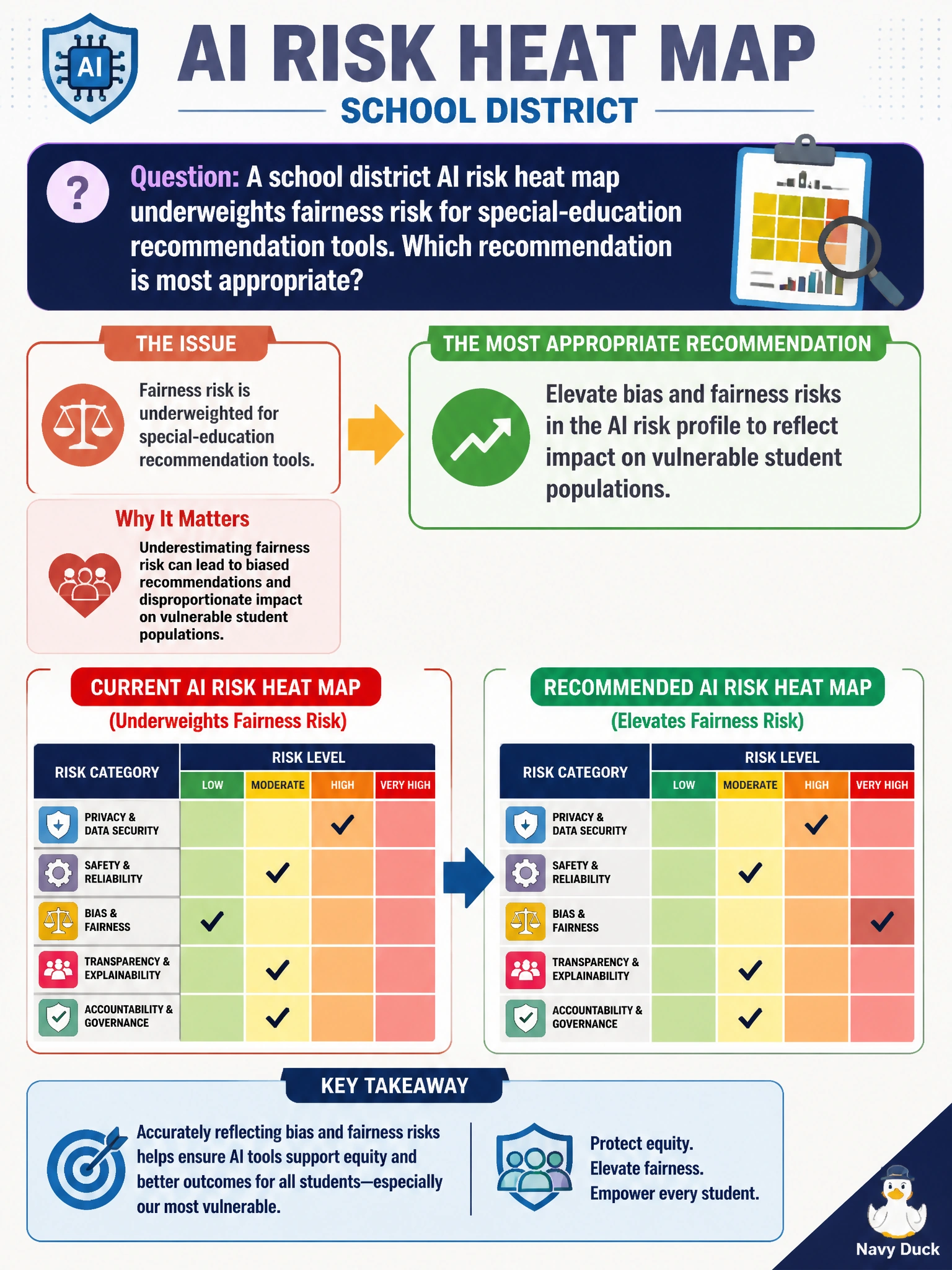
A school district AI risk heat map underweights fairness risk for special-education recommendation tools. Which recommendation is most appropriate?
Select an answer to reveal the explanation.
Short Explanation
Special-education recommendations touch kids who already need extra care — fairness is not a footnote. Turn up that risk cell on the heat map so leaders see bias as a real civic harm, not something covered by cybersecurity and privacy controls alone. Underweighting it is the finding.
Full Explanation
Elevating bias and fairness risks in the AI risk profile to reflect impact on vulnerable student populations is the appropriate recommendation. Special-education recommendation tools influence services for students who already face heightened stakes; underweighting fairness on a heat map systematically under-prioritizes monitoring, testing, and mitigation where disparate impact matters most. Municipal education AI risk profiles should scale severity with population vulnerability and decision consequence, not treat fairness as a soft secondary theme.
Applying district-wide average fairness metrics from general tools to score special-education systems for consistency fails because aggregate metrics can mask disparities for vulnerable students; fairness must be assessed against the specific outcomes and stakes of special-education recommendations. Prioritizing cybersecurity and data privacy controls in the risk profile for these recommendation tools fails because it still underweights fairness; strong security and privacy protections do not detect or prevent disparate impact on special-education students. Scheduling detailed fairness validation for the district annual AI inventory review cycle fails because it delays bias detection; special-education tools need prioritized, ongoing fairness review rather than waiting for a periodic inventory cycle.
Exam caveat: elevating a heat-map cell without funding fairness testing, demographic performance monitoring, and escalation paths is cosmetic prioritization. Operational check: confirm the district’s AI risk profile ranks fairness/bias for special-education tools among top risks, with owners, KRIs (e.g., recommendation disparities), and scheduled bias reviews—not only cybersecurity and data privacy controls.