
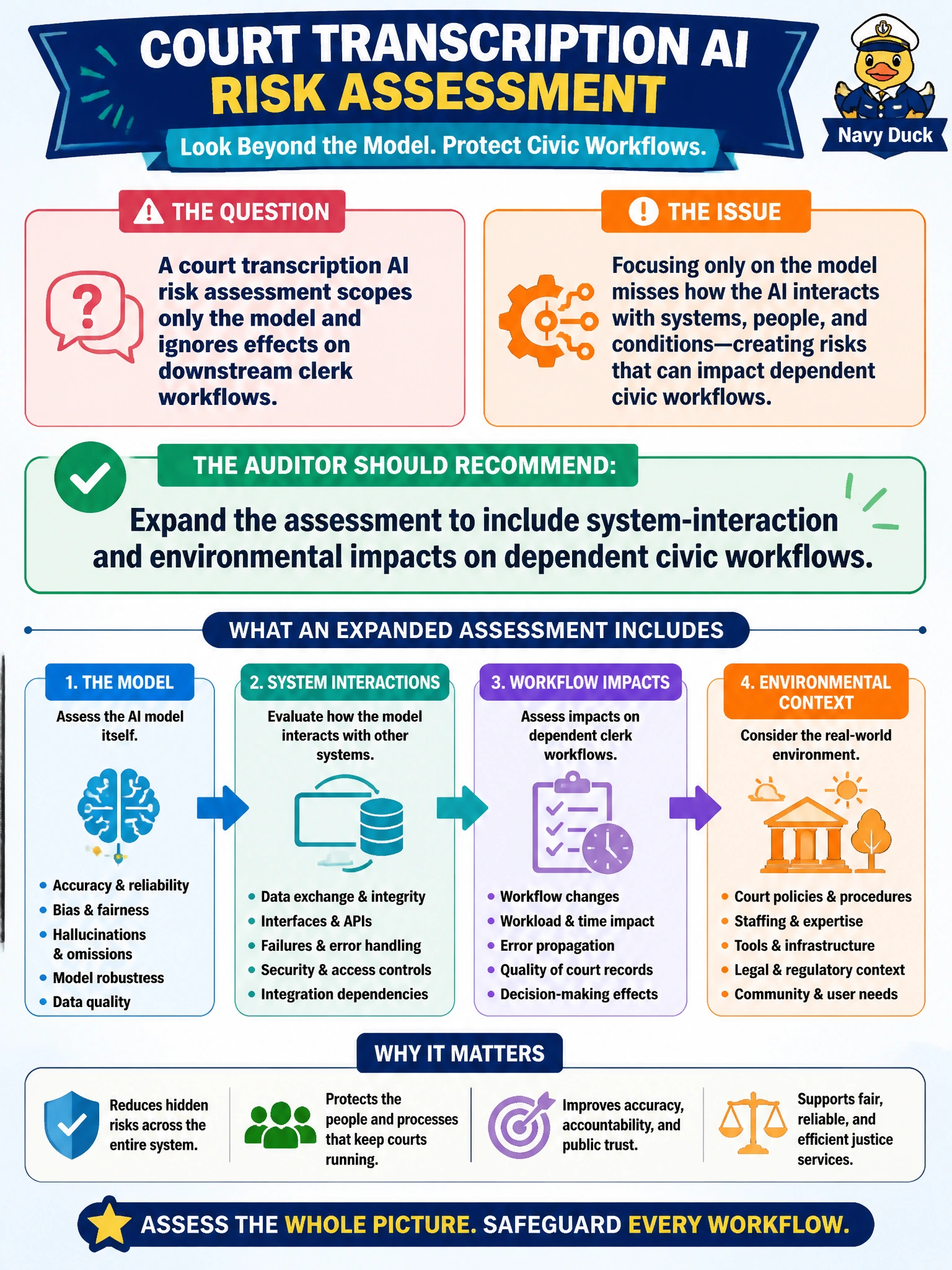
A court transcription AI risk assessment scopes only the model and ignores effects on downstream clerk workflows. What should the auditor recommend?
Select an answer to reveal the explanation.
Short Explanation
The model is one gear; the clerk queue is the whole machine. If AI transcripts change how filings move, those knock-on effects belong in the risk file. Widen the lens beyond the black box alone.
Full Explanation
The auditor should recommend expanding the assessment to include system-interaction and environmental impacts on dependent civic workflows. Court transcription AI does not operate in isolation: outputs change clerk review load, exception queues, filing timelines, and quality-assurance steps. Scoping risk only to the model misses how transcription errors or latency cascade into case processing, so the assessment must cover surrounding systems and work environments.
Restricting the assessment to transcription accuracy benchmarks and model validation reports for release approval fails because accuracy benchmarks and validation reports do not capture workflow harm, clerk process changes, exception queues, or downstream case-processing impacts. Deferring workflow mapping to post-deployment clerk feedback sessions and vendor support documentation fails conceptually: post-deployment feedback and vendor documentation are not substitute controls and leave workflow risk unassessed before release. Assigning residual workflow risk to the court IT vendor under standard procurement and maintenance clauses fails because contractual risk transfer does not eliminate or assess the actual workflow impacts; timeline effects and dependent civic workflows are precisely what a broadened assessment should test.
Exam caveat: expanding scope without assigning owners for clerk-process mitigations still leaves interaction risk orphaned between IT and court operations. Operational check: review the risk file for explicit clerk-workflow scenarios, RACI for exception handling, and evidence that court operations accepted residual process impacts before production use.