
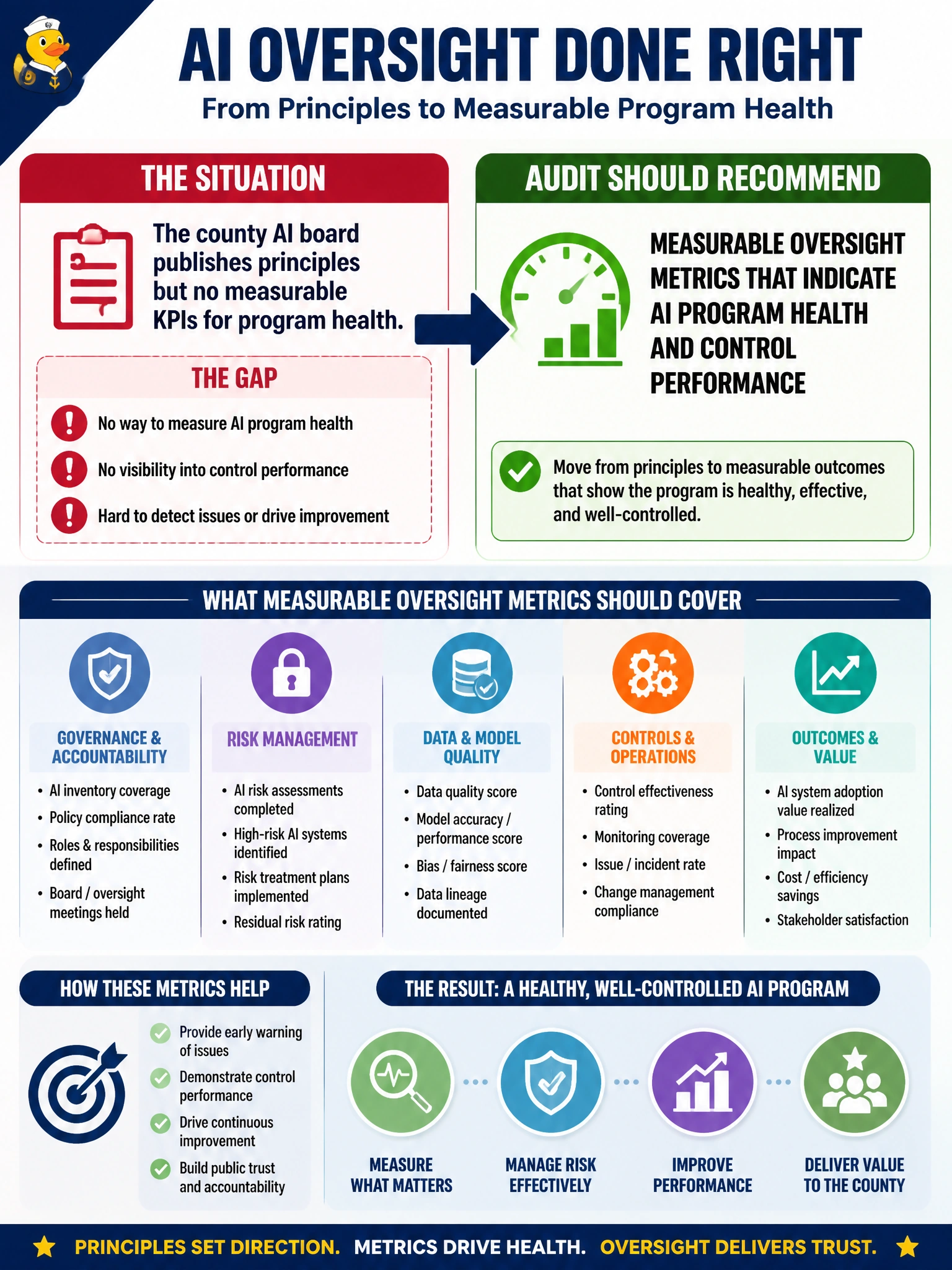
A county AI board publishes principles but no measurable KPIs for program health. What should audit recommend?
Select an answer to reveal the explanation.
Short Explanation
Documented principle reaffirmation in annual strategy sessions doesn’t tell you if the program is healthy. Pick real KPIs—incidents, review completion, inventory coverage—so the board can see the pulse, not just the slogan.
Full Explanation
A county AI board that publishes principles but no measurable KPIs for program health should be advised to adopt measurable oversight metrics that indicate AI program health and control performance. Principles communicate intent and values; KPIs show whether inventory coverage, review completion, incident rates, training completion for AI roles, vendor assessment currency, exception aging, and policy-to-procedure mapping are actually improving. Without measures, the board cannot oversee effectiveness or allocate remediation resources.
Documented board reaffirmation of AI principles during annual strategy sessions is not evidence of program effectiveness and can create a false sense of maturity. Expanded principle statements covering emerging AI risks and opportunities are still just aspirational statements—they add topic coverage but do not supply the measurable oversight metrics the board lacks. Quarterly technical accuracy summaries for deployed use cases are too narrow to serve as program-health oversight; they report on model outputs rather than the full set of governance controls and program indicators the board needs.
Exam caveat: governance maturity questions distinguish aspirational principles from monitored performance indicators used in board reporting. Operational check: define a small KPI set with owners, data sources, and thresholds; report them to the AI board on a fixed cadence; link red metrics to corrective actions with due dates; and avoid substituting new principle statements for missing measures.