
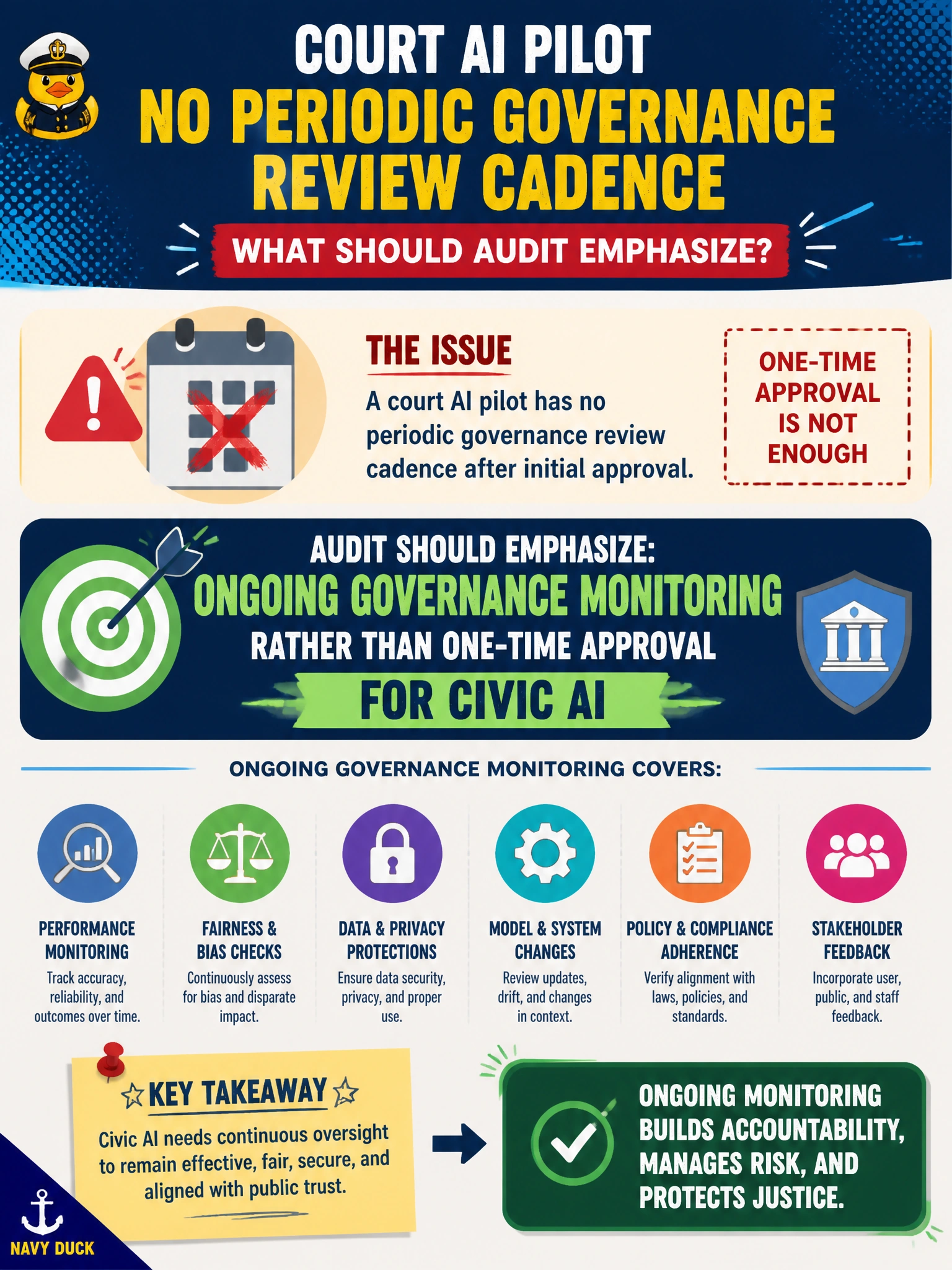
A court AI pilot has no periodic governance review cadence after initial approval. What should audit emphasize?
Select an answer to reveal the explanation.
Short Explanation
AI isn't a vendor validation you accept once and forget. Courts need a review rhythm after go-live—don't defer formal review until full rollout with an adopted court AI policy. Don't treat a judge's override as a periodic governance review; it's not scheduled oversight.
Full Explanation
A court AI pilot with no periodic governance review cadence after initial approval needs ongoing governance monitoring rather than one-time approval for civic AI. Models drift, prompts change, new data sources appear, and use cases expand under operational pressure; initial vendor validation results cannot cover indefinite evolution. Courts handling procedural or public-facing AI need scheduled reviews of performance, incidents, access control, vendor changes, and scope creep, with authority to suspend use when controls degrade.
Relying on initial vendor validation results for drift and use-case expansion is inadequate for systems that affect filings or public information. Deferring formal review until full rollout with an adopted court AI policy is reactive postponement, not governance. Treating judicial discretion to override outputs as periodic governance review is a common anti-pattern that leaves production-like risk unmonitored while benefits continue to accrue.
Exam caveat: continuous monitoring and periodic re-approval appear across AI audit frameworks—initial go-live is not the finish line. Operational check: set a review calendar (for example quarterly), trigger out-of-cycle reviews on material changes, retire or re-certify pilots on a hard deadline, and retain evidence packets of reviews performed and findings closed.