
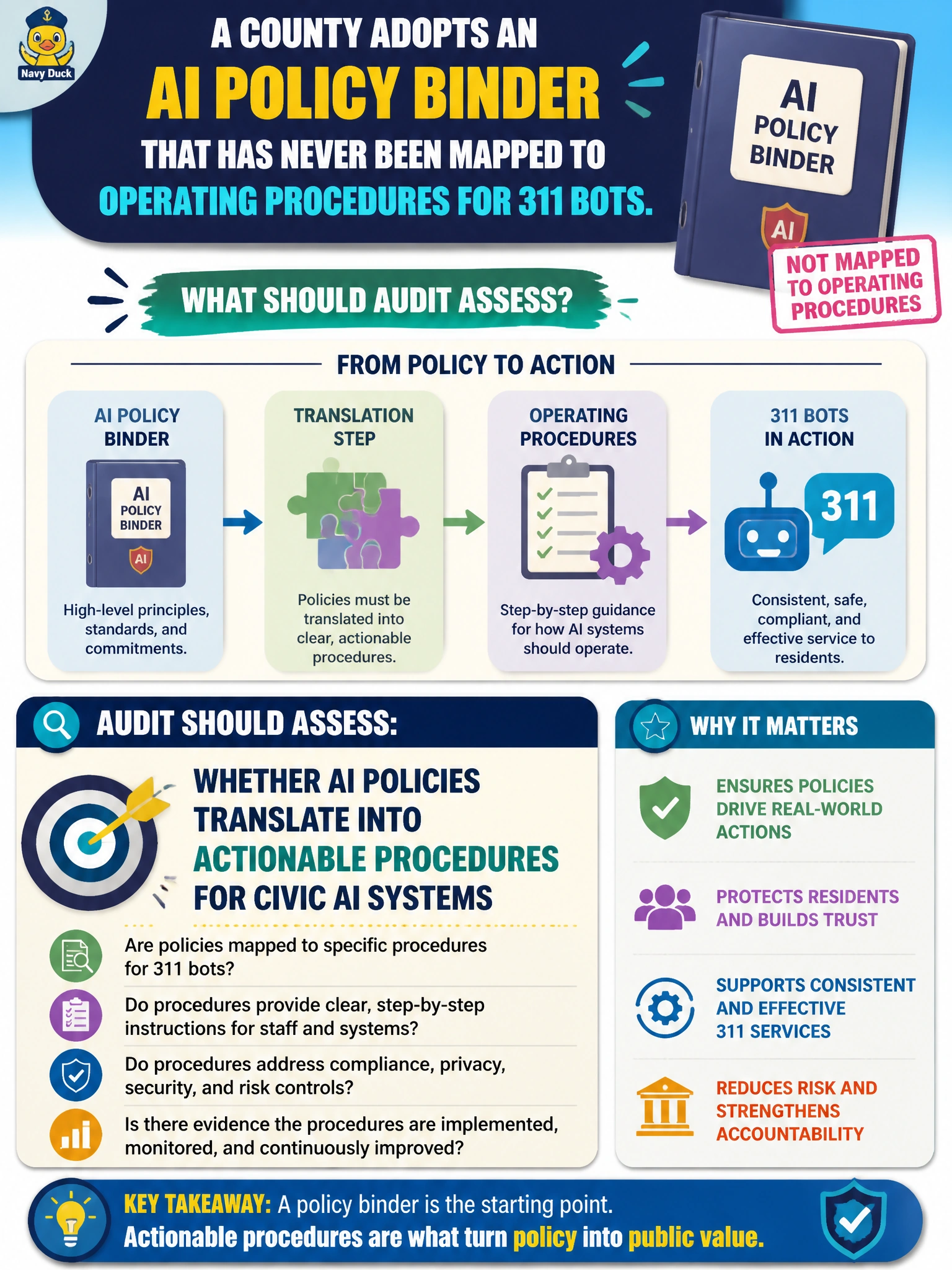
A county adopts an AI policy binder that has never been mapped to operating procedures for 311 bots. What should audit assess?
Select an answer to reveal the explanation.
Short Explanation
A shiny policy binder on a shelf doesn’t run the 311 bot. Audit looks for the how-to procedures that turn those rules into daily controls—not just whether vendor contracts define uptime targets for support services.
Full Explanation
When a county adopts an AI policy binder never mapped to operating procedures for 311 bots, audit should assess whether AI policies translate into actionable procedures for civic AI systems. Policy without procedures leaves frontline staff without steps for approval gates, monitoring, incident handling, prompt and change control, or vendor oversight. Effectiveness is demonstrated in day-to-day operations and retained evidence, not whether 311 bot vendor contracts define uptime targets for support services, because an uptime SLA does not show that county AI policies have been converted into 311 bot operating procedures.
Whether 311 bot vendor contracts define uptime targets for support services is irrelevant to control performance and distracts from whether AI policies have been mapped to 311 bot operating procedures. Whether 311 bot interaction logs meet records retention schedules proves records awareness, not whether AI policies have been translated into operating procedures. Whether 311 bot performance dashboards track containment and escalation trends does not prove that AI policies have been mapped to operating procedures or that bots are governed correctly when residents receive wrong answers.
Exam caveat: design effectiveness of policy differs from operating effectiveness of procedures and evidence—exams frequently test that distinction. Operational check: sample 311 AI procedures for intake, release, monitoring, and escalation; trace each major policy requirement to a procedure and a control owner; walkthrough whether staff can execute those steps and produce artifacts auditors can inspect.