
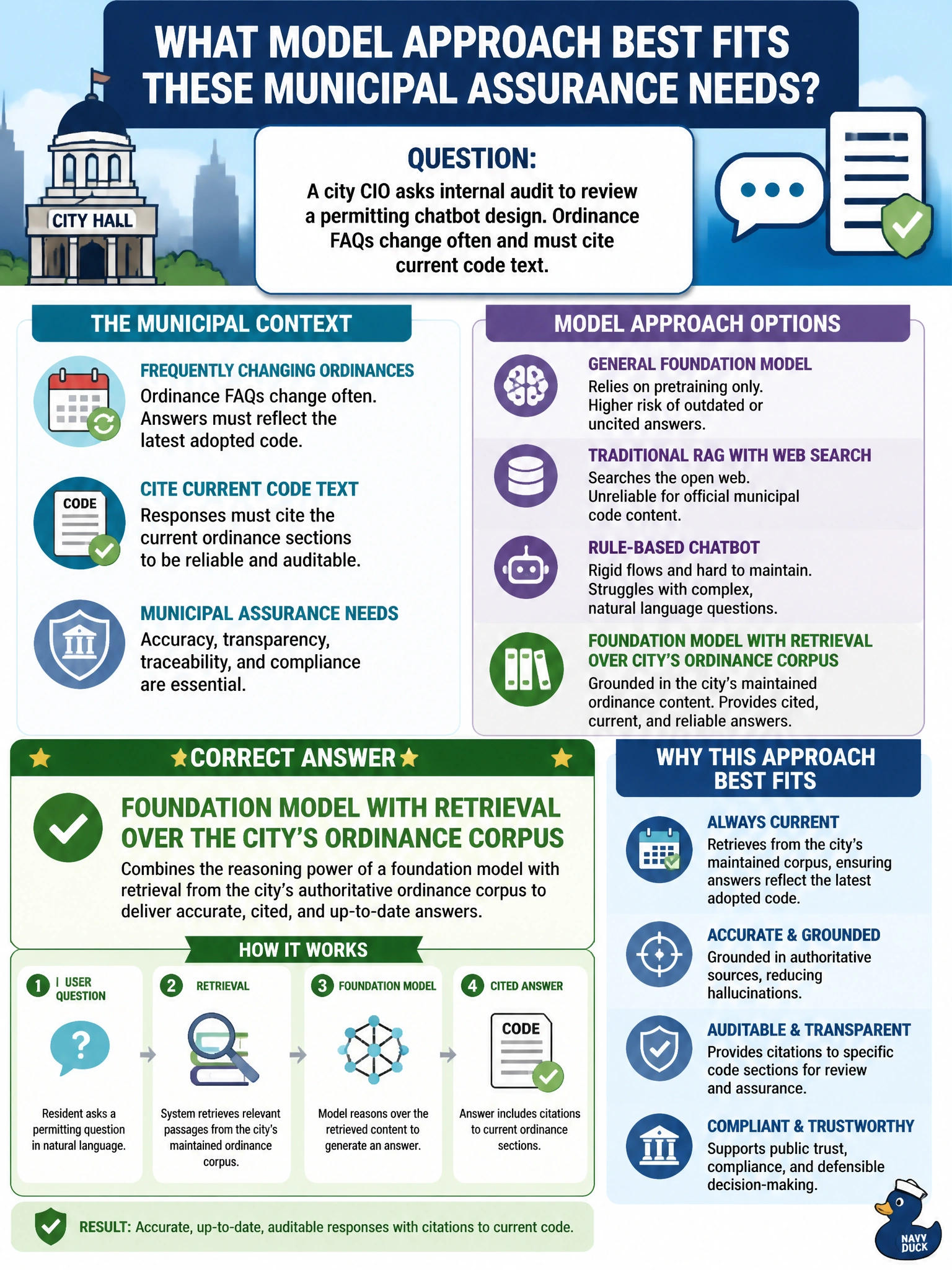
A city CIO asks internal audit to review a permitting chatbot design. Ordinance FAQs change often and must cite current code text. Which model approach best fits those municipal assurance needs?
Select an answer to reveal the explanation.
Short Explanation
Think of the ordinance book as a living binder, not a classifier retrained quarterly on ticket categories that still isn’t today’s code. Retrieval lets you pull today’s ordinance text instead of hoping a FAQ-template classifier or a model fine-tuned on older editions matches City Hall’s rules.
Full Explanation
A permitting chatbot that must cite current ordinance text is primarily a knowledge-grounding problem, not a one-shot classification problem. Municipal codes, fee schedules, and FAQ language change through council action and administrative updates; assurance therefore favors a foundation model paired with retrieval over a city-maintained ordinance corpus so answers can be constrained to the edition in force and citations can be inspected. Retrieval keeps the generative layer tethered to authoritative civic sources rather than to whatever patterns existed at pretraining time.
A custom classifier retrained quarterly on ticket categories linked to FAQ templates fails because ticket categories do not equal current ordinance text, and template links do not ground answers in the city-maintained corpus or support inspectable citations. Unsupervised clustering that surfaces emerging resident themes for FAQ drafting may highlight topics, but it does not answer FAQs from current ordinance text or cite code. A generative model fine-tuned on prior ordinance editions to draft FAQ responses fails because fine-tuning on older editions does not track current amendments and can still produce outdated or invented citations without retrieval over the city-maintained corpus.
Exam caveat: retrieval improves grounding only when the corpus is curated, versioned, and access-controlled; “RAG” labeled on a vendor slide does not prove municipal source of truth. Operational check: confirm corpus ownership, update cadence after ordinance changes, citation logging for appeals, and a test set of amended FAQs where answers must change when the binder changes.